New Delhi
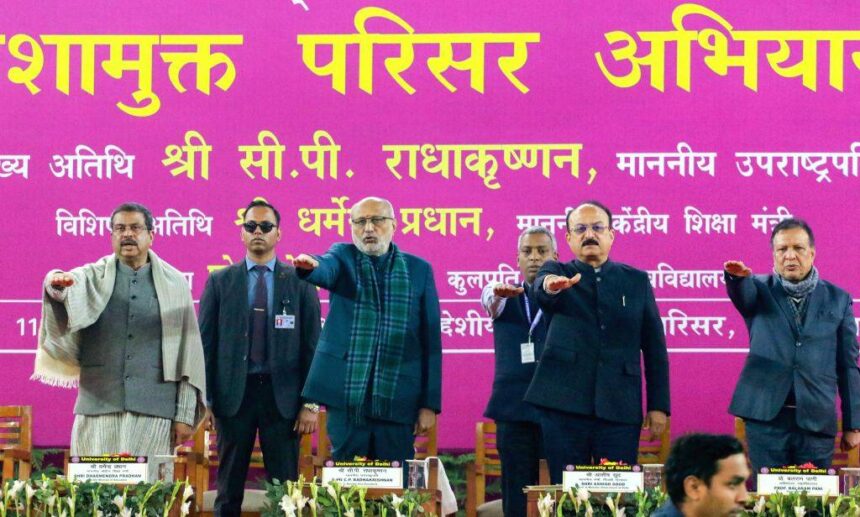
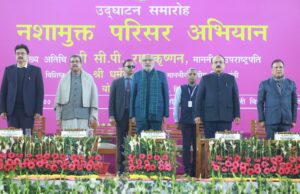
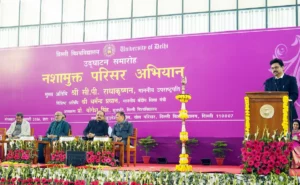
At a major event held at Delhi University on January 13 to mark the launch of the Drug-Free Campus Campaign, Delhi Education Minister Ashish Sood delivered a strong message on the need to protect youth from substance abuse, calling it a national responsibility rather than an individual choice. The programme was attended by Vice President C P Radhakrishnan and Union Education Minister Dharmendra Pradhan, underscoring the importance the government attaches to the campaign.
Addressing students, faculty members and dignitaries, Sood said the event was not merely the beginning of an awareness programme but the start of a new chapter in the university’s legacy. Recalling his own days as a student of Delhi University, he said he was speaking not just as a minister, but as an alumnus who understood the pressures and challenges faced by young people today.
Referring to National Youth Day, observed on January 12, Sood quoted Swami Vivekananda’s belief that youth power is the real strength of the nation. However, he stressed that youth can become a true national force only when they are mentally strong, emotionally stable and free from addiction. He noted that the presence of the Vice President and the Union Education Minister at the event reflected that the drug-free campus initiative is not just another government programme but a national resolve.
Sood said that for years, society had avoided confronting the harsh reality of substance abuse by labelling it as a personal choice or an urban lifestyle trend. He cautioned that addiction is not a matter of choice but a trap that first destroys a student’s clarity of thought and discipline. Once a student falls into substance abuse, he said, the damage extends far beyond physical health, affecting parents’ dreams, academic performance and ultimately the nation’s progress.
Highlighting the broader impact, the Delhi Education Minister pointed out that absenteeism, declining academic results and dropouts are only the visible consequences of addiction. The deeper loss lies in the wasted potential of young minds that could otherwise contribute to building a developed India and a developed Delhi as its capital.
Sood said the country, under the leadership of Prime Minister Narendra Modi, is turning the Drug-Free India campaign into a mass movement. He added that national leaders have consistently emphasised that educational institutions are not just centres for awarding degrees but spaces for character building.
He also spoke about Vice President C P Radhakrishnan’s long-standing commitment to the cause, noting that decades ago, Radhakrishnan undertook a historic 19,000-kilometre chariot journey to raise awareness about the dangers of drug abuse. According to Sood, for the Vice President, the fight against drugs is not a formal programme but a lifelong mission, and his presence at the event served as a major source of inspiration.
Referring to Union Education Minister Dharmendra Pradhan, Sood said the drug-free campaign has gained momentum as a powerful public movement under his leadership. He noted that Pradhan strongly believes the National Education Policy is aimed at creating a generation of job creators rather than job seekers, a vision that leaves no space for substance abuse in the lives of young people.
Sood welcomed the launch of the Drug-Free Campus portal and mobile application, describing it as a meaningful blend of technology and commitment. He said the digital platform would provide a safe space for students who want help but hesitate to seek it openly. Mental health support, he added, is one of the most effective tools for prevention, and it is encouraging to see leadership, administration and educational institutions working together to make such support easily accessible.
Making a significant announcement, Sood said the Delhi government’s education department would fully integrate the Drug-Free Campus campaign with the existing Science of Living curriculum, which already focuses on students’ mental and physical well-being. He assured that the initiative would be actively implemented across every school and college in Delhi. As part of the effort, peer-to-peer mentoring groups would be formed, recognising that messages delivered by friends often have the deepest impact.
In a direct appeal to students, Sood said substance abuse is not a symbol of being “cool” but a sign of losing oneself. He urged young people to seek the real sense of achievement in success and in the pride reflected in their parents’ eyes. Calling for a collective pledge from the university campus, he concluded with the message: “No to drugs, yes to life.”
The Delhi Education Minister assured the Vice President and the Union Education Minister that the Delhi University model would serve as an example for institutions across Delhi and the country. He said drug-free educational institutions are essential for ensuring a safe, developed India and a progressive Delhi.