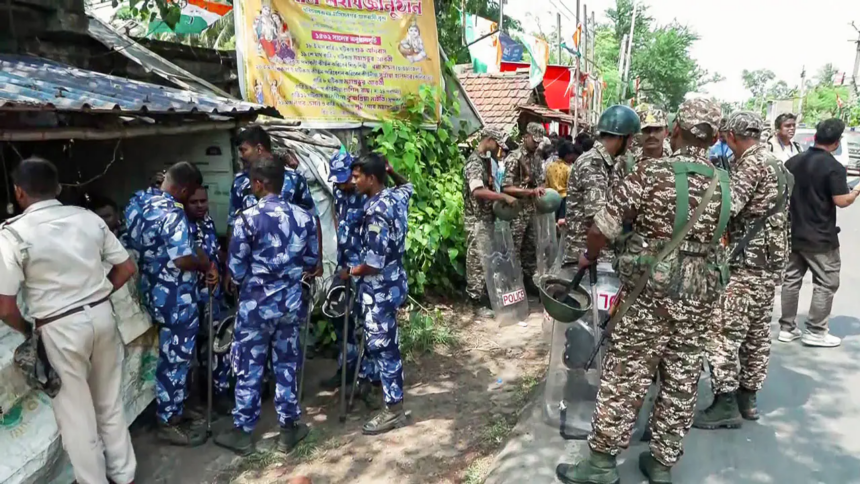
Repolling in West Bengal’s politically sensitive Falta Assembly constituency began under extraordinary security arrangements after the Election Commission cancelled the earlier voting process citing serious electoral irregularities. The repoll, which started at 7 am and will continue till 6 pm, has become one of the most closely watched political developments in the state after allegations of voter intimidation, electronic voting machine tampering and manipulation of polling procedures triggered widespread outrage.
The constituency, located in South 24 Parganas district and falling under the Diamond Harbour parliamentary seat represented by Trinamool Congress leader Abhishek Banerjee, has remained tense ever since the second phase of the Assembly elections conducted on April 29. The Election Commission’s unprecedented decision to order fresh polling across all booths transformed the Falta contest into a national political story, raising larger questions about electoral transparency, booth security and public trust in democratic institutions.
More than 2.36 lakh voters are eligible to cast their votes in the repoll. This includes nearly 1.15 lakh women voters and nine third-gender electors. Polling is taking place across 285 booths, including auxiliary polling centres, while counting of votes has been scheduled for May 24. Security forces were deployed in massive numbers across the constituency long before voting began, with authorities determined to prevent any repeat of the violence and controversies that marked the earlier election process.
The Election Commission took the rare step of annulling the previous polling after receiving multiple complaints regarding alleged irregularities. Reports submitted after scrutiny by former Election Commission Special Observer Subrata Gupta reportedly identified suspicious activities in at least 60 polling stations. These allegations included claims that adhesive material and perfume substances had been applied to EVM buttons, making it difficult for voters to choose specific candidates and potentially revealing voting preferences.
The accusations sparked intense political confrontation in the state. Opposition parties accused local ruling party workers of attempting to manipulate the democratic process, while the Trinamool Congress rejected the allegations and accused rivals of creating unnecessary panic. The controversy escalated further after reports emerged suggesting attempts to tamper with web-camera footage from polling booths. Questions were also raised regarding the conduct of booth-level officers, polling officials and election observers.
The political atmosphere in Falta had already become highly charged during the original election phase. Residents in several villages, including Hasimnagar, staged protests alleging intimidation, threats and fear of violence. Local people demanded stronger deployment of central security forces and fresh polling to ensure fair voting conditions. Their demands eventually gained momentum after the Election Commission initiated its investigation into the complaints.
For the repoll, security arrangements have been upgraded significantly. Thirty-five companies of the Central Armed Police Force have been deployed across the constituency. Each polling booth has been assigned eight CAPF personnel, double the number deployed during the original polling. Authorities have also stationed thirty Quick Response Teams across sensitive zones to respond immediately to any sign of unrest or disruption.
Election officials stated that strict surveillance mechanisms have been activated to ensure transparency throughout the polling process. Webcasting systems, micro observers and intensified patrolling have been introduced in sensitive areas. Senior officers are continuously monitoring developments from control rooms while drone surveillance is also reportedly being used in select locations.
The repoll has gained additional political significance because of the dramatic withdrawal announcement made by Trinamool Congress candidate Jahangir Khan. Just two days before voting, Khan publicly declared that he was pulling out of the contest. However, because the formal deadline for withdrawal had already expired, his name continues to remain on the EVMs.
Khan’s decision triggered speculation across Bengal’s political circles. While the exact reasons behind his withdrawal remain unclear, political observers believe the move could significantly alter the electoral dynamics in a constituency traditionally viewed as a Trinamool Congress stronghold. The BJP, which performed strongly in the wider Assembly elections, is now attempting to capitalise on the uncertainty created by Khan’s sudden exit.
The Bharatiya Janata Party has fielded Debangshu Panda as its candidate in the constituency. Political analysts believe the BJP sees Falta as an opportunity to strengthen its growing influence in South Bengal. The party has aggressively campaigned on allegations of electoral corruption and law-and-order failures, attempting to position itself as the primary challenger to the Trinamool Congress in the region.
Apart from the BJP and TMC, candidates from the CPI(M) and Congress are also in the contest. CPI(M) candidate Sambhu Nath Kurmi and Congress nominee Abdur Razzak Molla have attempted to highlight concerns regarding governance and democratic accountability during their campaigns. However, the main contest is widely perceived to remain between the BJP and the Trinamool Congress.
Political experts suggest the Falta repoll could become symbolically important far beyond the constituency itself. The Election Commission’s decision to order fresh polling across all booths is being viewed as one of the strongest interventions in recent years regarding electoral integrity in West Bengal. The outcome may influence future debates around poll monitoring, security deployment and transparency mechanisms in sensitive constituencies across India.
The controversy has also reignited discussions surrounding the use of electronic voting machines. Opposition parties have frequently raised concerns regarding EVM security in various elections across the country. Although election authorities have repeatedly defended the reliability of the system, incidents such as those reported in Falta continue to fuel public debate and political accusations.
Meanwhile, voters arriving at polling stations on Wednesday expressed mixed emotions ranging from anxiety to cautious optimism. Many residents said they hoped the repoll would finally allow them to vote freely without intimidation or confusion. Long queues were visible at several polling booths from the early hours of the morning, indicating significant voter interest despite the tense environment.
Security officials described the overall situation as peaceful during the initial phase of voting. However, authorities remain alert because the constituency has a history of politically sensitive clashes. Additional personnel have been deployed near vulnerable areas, and movement of vehicles is being monitored carefully.
Political observers believe turnout figures during the repoll could become a major indicator of public confidence in the revised election process. A strong turnout may suggest that voters feel reassured by the enhanced security arrangements, while lower participation could indicate lingering fear and distrust among sections of the electorate.
The broader political implications of the Falta repoll are likely to continue even after the final results are declared. For the ruling Trinamool Congress, retaining the constituency would help reinforce its dominance in South 24 Parganas. For the BJP, a strong performance could provide momentum in its efforts to expand further across Bengal. For the Election Commission, the repoll represents a critical test of its ability to restore confidence in the electoral system after serious allegations of misconduct.
As voting continues under tight security, Falta has effectively become the centre of Bengal’s political attention. The constituency now stands not only as a battleground between political parties but also as a symbol of the larger debate surrounding electoral credibility, institutional trust and democratic accountability in modern India.