The detention of senior Aam Aadmi Party leader and former Delhi minister Saurabh Bhardwaj during a candle march in west Delhi has intensified the political and legal debate surrounding civic accountability, police conduct, and the right to peaceful expression in the national capital. The incident occurred as AAP leaders attempted to pay tribute to a biker who died after falling into an unguarded pit allegedly dug by the Delhi Jal Board, raising questions that extend beyond a single tragedy into the broader framework of governance, public safety, and democratic dissent.
The episode unfolded against a backdrop of public outrage over the death of Kamal Dhyani, a private bank employee, whose fatal accident has become a flashpoint for allegations of institutional negligence. What began as a symbolic act of condolence quickly escalated into a confrontation between opposition leaders and law enforcement, prompting accusations of selective policing and authoritarian overreach from the Aam Aadmi Party.
Detention During Memorial March and Allegations of Suppression
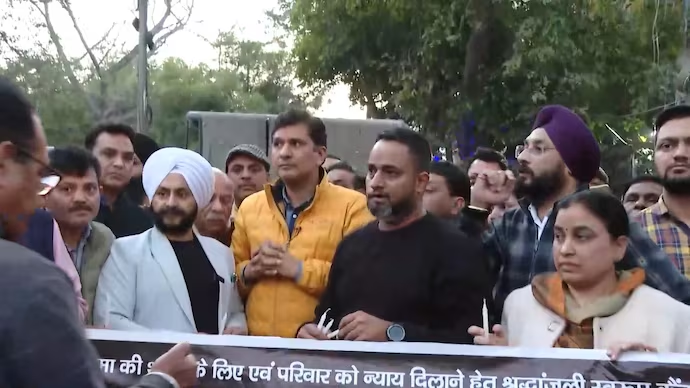
On Sunday evening, Saurabh Bhardwaj, accompanied by several AAP legislators and party workers, set out on a candle march toward the Janakpuri site where Kamal Dhyani lost his life after his motorcycle plunged into a 15-foot-deep pit. The pit, reportedly excavated for a sewer pipeline restoration project, was allegedly left unguarded and unmarked, creating what critics have described as a lethal hazard in a residential area.
Before the group could reach the location, Delhi Police intervened, erecting barricades and detaining the AAP leaders. According to police officials, the action was preventive in nature, citing apprehensions that the gathering could turn into a protest. The detained leaders were taken to a nearby police station and later released without formal arrest or charges.
Bhardwaj, however, contested this narrative, asserting that the march was intended solely as a peaceful tribute. Speaking to the media during the detention, he alleged that the police action reflected a deeper pattern of intolerance toward opposition voices. He questioned how a silent act of remembrance could be construed as a law-and-order threat and accused authorities of criminalising empathy and mourning.
During the detention, Bhardwaj live-streamed videos from inside a police vehicle, claiming that police personnel had forcibly snatched and torn posters bearing the deceased biker’s name and photograph. In another statement, he questioned whether offering condolences had become an offence in Delhi, asserting that he had effectively been “arrested” despite the absence of any unlawful conduct.
The AAP leadership framed the detention as emblematic of what it described as shrinking democratic space. Party members argued that the police response stood in stark contrast to their handling of other public gatherings, alleging selective enforcement influenced by political considerations. The incident has since been amplified across social media platforms, further polarising public opinion on policing and protest rights.
Janakpuri Biker Death, Administrative Accountability, and Political Fallout
The catalyst for the candle march was the death of Kamal Dhyani, who was returning home on the night between Thursday and Friday when he fell into the open pit in Janakpuri. Reports indicate that nearly eight hours passed between the accident and the discovery of his body, during which no immediate assistance reached him. The delay has intensified allegations of systemic negligence and failure of civic safeguards.
The pit was reportedly dug as part of a Delhi Jal Board infrastructure project, bringing the spotlight onto inter-departmental responsibility and contractor oversight. Following public backlash, Delhi minister Ashish Sood and the DJB ordered an inquiry into possible safety lapses, with assurances that strict action would be taken if negligence was established.
For the Aam Aadmi Party, the tragedy has become a focal point to question the accountability of civic agencies and the responsiveness of law enforcement to citizen grievances. Bhardwaj highlighted claims that Dhyani’s parents had approached multiple police stations before any formal action was initiated, suggesting a pattern of administrative inertia that compounded the family’s suffering.
The detention of opposition leaders at a memorial event has further complicated the political landscape, turning a civic tragedy into a constitutional debate over freedom of assembly and expression. Legal observers note that while police possess preventive powers to maintain public order, the proportionality and intent behind such actions are critical in determining their legitimacy.
The episode has also reignited discussions on urban infrastructure safety in Delhi, where open pits, poor signage, and delayed responses have frequently been cited as recurring hazards. As inquiries proceed into the Janakpuri incident, the political ramifications continue to unfold, with opposition parties framing the detention as symptomatic of governance that prioritises control over accountability.