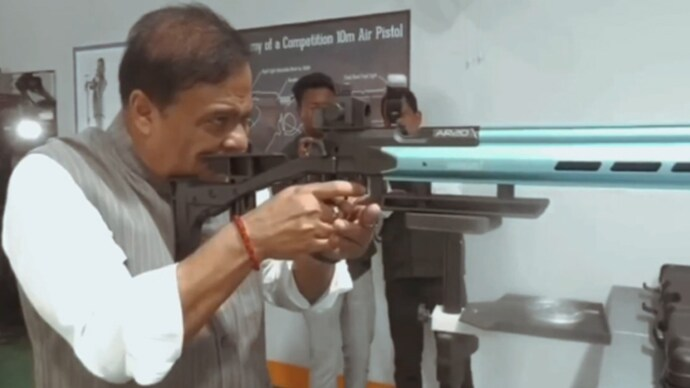
The political discourse in Assam and beyond has been sharply destabilised by the circulation and subsequent deletion of a controversial video posted on the official social media account of the Assam unit of the Bharatiya Janata Party. The video, which depicted Chief Minister Himanta Biswa Sarma symbolically firing at Muslim men at point-blank range, has drawn widespread condemnation from opposition parties, civil society voices, and legal commentators, transforming a digital post into a flashpoint for debates on communal harmony, state responsibility, and the limits of political messaging in a constitutional democracy.
The episode unfolded at a time of heightened sensitivity around demographic, linguistic, and religious identity in Assam, where political rhetoric concerning migration, citizenship, and national belonging has long carried deep social consequences. Although the video was eventually taken down following intense backlash, opposition leaders argue that deletion alone does not absolve responsibility, asserting that the imagery and messaging crossed legal and moral boundaries with potentially dangerous implications.
Video Content, Symbolism, and the Politics of Visual Messaging
The now-deleted video was shared through the Assam BJP’s official handle and prominently featured Himanta Biswa Sarma handling what appeared to be an air rifle. Interspersed with this footage were artificial intelligence-generated visuals showing bullets striking images of men wearing skull caps and beards, widely recognised visual markers associated with Muslim identity. The video carried the caption “point blank shot,” while accompanying text flashed phrases such as “foreigner free Assam” and “no mercy,” language that critics described as explicitly communal and threatening.
In several frames, the Chief Minister was stylised as a heroic figure reminiscent of Western action films, a cinematic framing that critics say glorified violence and reinforced an us-versus-them narrative. Assamese text embedded within the visuals reportedly included statements such as “why did you not go to Pakistan?” and “there is no forgiveness to Bangladeshis,” intensifying accusations that the content targeted Bengali-origin Muslims in the state.
The timing of the video further amplified its impact. Assam has witnessed sustained political rhetoric around alleged “foreigners,” particularly in relation to the National Register of Citizens and electoral rolls. Against this backdrop, opposition leaders argue that the video did not exist in a vacuum but tapped into existing anxieties and prejudices, potentially legitimising hostility toward an already vulnerable community.
The use of artificial intelligence-generated elements added another layer of controversy. While political parties increasingly employ digital tools for messaging, critics contend that the simulated violence depicted in the video blurred ethical lines and created imagery that could normalise or encourage real-world harm. The opposition has insisted that such visual narratives, when disseminated by a ruling party through official channels, carry a different and far more consequential weight than individual or unofficial posts.
Opposition Response, Legal Allegations, and Revival of Past Controversies
The reaction from opposition parties was swift and uncompromising. The Congress described the video as deeply disturbing and rejected any attempt to frame it as mere trolling or satire. In a statement issued through its official platform, the party alleged that the video amounted to a glorification of targeted violence against minorities and constituted a call to mass harm. Congress leaders urged judicial intervention, expressing skepticism that executive accountability would be forthcoming.
Senior Congress figures echoed these concerns, characterising the video as ideological “poison” emanating from the highest levels of power. They argued that deleting the content did not address the gravity of what had been shared and questioned whether institutions responsible for upholding constitutional values were responding with sufficient urgency.
The All India Trinamool Congress escalated the criticism, with its Assam unit describing the video as an expression of “performative bloodlust” and accusing the ruling party of normalising hatred through state-sanctioned communication. Party leaders argued that an elected Chief Minister being portrayed as miming point-blank shootings in an official party video reflected a dangerous collapse of ethical restraint.
Trinamool Congress parliamentarian Sagarika Ghose went further, asserting that the video constituted a criminal offence under multiple legal provisions. She argued that incitement to violence could not be neutralised by deletion and called for exemplary punishment to deter similar conduct in the future. Her remarks framed the controversy not merely as a political misstep but as a test of the rule of law.
Congress MP from Assam, Gaurav Gogoi, also weighed in, questioning the credibility of the Chief Minister following an extended press conference addressing the controversy. Gogoi suggested that the explanations offered failed to convince both journalists and the broader public. He further linked the episode to broader allegations concerning the Chief Minister’s conduct and accountability, including claims related to land holdings, asserting that the controversy underscored a wider pattern of governance issues.
The incident has also revived scrutiny of Himanta Biswa Sarma’s earlier remarks targeting the ‘Miya’ community, a term commonly used for Bengali-speaking Muslims of East Bengal origin in Assam. In past public statements, Sarma had spoken about making the community “suffer” and suggested discriminatory practices such as underpaying rickshaw drivers identified as Miya Muslims. He had also publicly claimed that large numbers of Muslim votes would be deleted ahead of state elections.
These resurfaced remarks have reinforced opposition arguments that the video was not an isolated lapse but part of a consistent rhetorical pattern. While supporters of the Chief Minister argue that his statements are often taken out of context, critics maintain that repeated references of this nature contribute to an environment of exclusion and fear.
As the controversy continues, the debate has shifted beyond a single deleted video to larger questions about political accountability, the ethical use of digital technology, and the responsibility of those in power to uphold constitutional guarantees of equality and safety. The episode has intensified calls for clearer legal standards governing political communication and has placed Assam’s political leadership under a national spotlight.