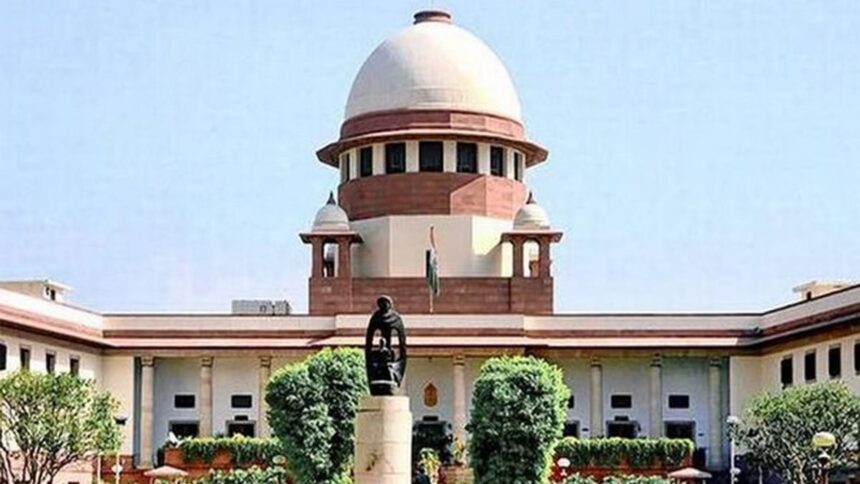
The Supreme Court is set to hear a crucial petition challenging the preventive detention of climate activist Sonam Wangchuk under the National Security Act, raising questions about democratic dissent, personal liberty, and the limits of state power.
The Supreme Court on Monday is scheduled to hear a plea challenging the detention of noted climate activist and education reformer Sonam Wangchuk under the National Security Act (NSA), a case that has drawn national attention for its broader implications on democratic protest and civil liberties. The petition has been filed by Wangchuk’s wife, Gitanjali J Angmo, who has questioned the legality and necessity of invoking preventive detention laws against a figure widely known for peaceful activism. The apex court, while hearing the matter earlier, had already taken note of Wangchuk’s deteriorating health conditions and ordered a medical examination by a specialist, adding a humanitarian dimension to a case that is otherwise deeply political and constitutional in nature.
Challenge to Preventive Detention and Allegations of Misuse
The case will be heard by a two-judge Bench of the Supreme Court comprising Justice Aravind Kumar and Justice Prashant B Varale. The plea contests Wangchuk’s detention under the NSA following protests in Leh in September 2025, where demonstrators demanded statehood for Ladakh and inclusion of the Union Territory under the Sixth Schedule of the Constitution. These demands, long-standing among sections of Ladakh’s population, were articulated through marches, hunger strikes, and public speeches, forms of protest that Wangchuk and his supporters insist were entirely peaceful.
During an earlier hearing on January 29, Wangchuk, through his legal counsel, strongly denied allegations that he had made inflammatory statements or called for the overthrow of the government. The detaining authority had reportedly relied on select statements attributed to Wangchuk, suggesting that his speeches posed a threat to national security. However, Wangchuk’s counsel argued before the court that these allegations were unfounded, exaggerated, and selectively extracted from larger contexts to justify preventive detention.
Senior advocate Kapil Sibal, appearing on behalf of Gitanjali J Angmo, told the Supreme Court that Wangchuk had never advocated violence or incited people against the state. He emphasised that criticism of government policy, even if sharp or uncomfortable, falls well within the ambit of democratic rights guaranteed under the Constitution. According to Sibal, expressing dissent or participating in protests does not automatically amount to a threat to public order or national security, which are the thresholds required for invoking the NSA.
Sibal further argued that Wangchuk’s entire public life has been rooted in non-violence and constructive engagement. He told the court that there was not a single instance of violence attributed to Wangchuk, nor any material evidence to suggest that his actions could lead to unrest or instability. The senior advocate stressed that preventive detention laws, being extraordinary in nature, must be applied with extreme caution and only in cases where there is a clear, imminent threat, something that was conspicuously absent in Wangchuk’s case.
A key point raised during the hearing was the alleged misrepresentation of Wangchuk’s statements. Sibal contended that several excerpts cited in the detention order were either misquoted, taken out of context, or wrongly attributed to him. He argued that a detaining authority cannot cherry-pick sentences from speeches or videos to build a case, while ignoring the broader message and intent behind them. According to him, such selective reliance reflects a mala fide approach and renders the detention order arbitrary and unconstitutional.
The senior advocate also addressed claims that Wangchuk had called for a plebiscite or instigated people along border areas. He categorically rejected these allegations, calling them baseless and unsupported by credible evidence. Sibal told the court that Wangchuk has, on multiple occasions, publicly praised the government and even acknowledged the Prime Minister’s initiatives, making it illogical to portray him as someone seeking to destabilise the state.
Drawing parallels with India’s freedom struggle, Sibal highlighted that Wangchuk’s methods of protest—hunger strikes and marches—are rooted in the Gandhian tradition of non-violent resistance. He argued that such forms of protest have historically been recognised as legitimate means of expressing dissent in a democracy. To classify them as threats to national security, he said, would set a dangerous precedent and have a chilling effect on free speech and peaceful assembly.
Health Concerns and Court’s Intervention
Beyond the legal and constitutional arguments, the case has also brought attention to Wangchuk’s health while in custody. During the previous hearing, Wangchuk complained of stomach-related issues, which his counsel attributed to allegedly contaminated drinking water at the jail where he is lodged. Taking note of this concern, the Supreme Court directed that Wangchuk be examined by a medical specialist, underlining the court’s role not just as an arbiter of law but also as a guardian of individual rights and dignity.
Wangchuk is currently lodged at Jodhpur Central Jail in Rajasthan, far from his home region of Ladakh. His wife’s plea has questioned not only the grounds of detention but also the conditions under which he is being held. The health-related directions issued by the apex court indicate that it is actively monitoring the situation and is sensitive to the human consequences of prolonged preventive detention.
Legal experts observing the case believe that the Supreme Court’s approach could have far-reaching implications. Preventive detention laws like the NSA allow the state to detain individuals without trial for extended periods, based on subjective satisfaction of authorities. While such laws are constitutionally permitted, the judiciary has repeatedly held that they must be used sparingly and are subject to strict judicial scrutiny. In Wangchuk’s case, the court appears poised to closely examine whether the legal thresholds for invoking the NSA have genuinely been met.
The plea filed by Angmo challenges the detention order as illegal, arbitrary, and violative of fundamental rights. It argues that the grounds of detention do not disclose any proximate or compelling reason to justify preventive custody. The petition also points out that dissent against government policy, particularly when expressed peacefully, cannot be equated with actions that threaten the sovereignty or security of the nation.
The hearing on February 2 is expected to delve deeper into these issues, with the court likely to assess the material relied upon by the detaining authority. The judges may examine whether the alleged statements attributed to Wangchuk, even if taken at face value, meet the stringent standards required for preventive detention. They may also consider whether less restrictive measures could have addressed the state’s concerns, instead of resorting to the harsh step of detention under the NSA.
As the matter returns to the Supreme Court, it continues to resonate beyond the confines of the courtroom. For many, the case represents a test of India’s commitment to democratic values, particularly the right to peaceful protest and freedom of expression. For others, it raises questions about the balance between national security and civil liberties in a politically sensitive region like Ladakh.
The outcome of the hearing will not only determine Wangchuk’s immediate future but could also shape the legal discourse around preventive detention and dissent in the years to come. The Supreme Court’s scrutiny of the detention order, the allegations against Wangchuk, and the state’s justification for invoking the NSA will be closely watched, as the case sits at the intersection of constitutional rights, public order, and the fundamental principles of democracy.