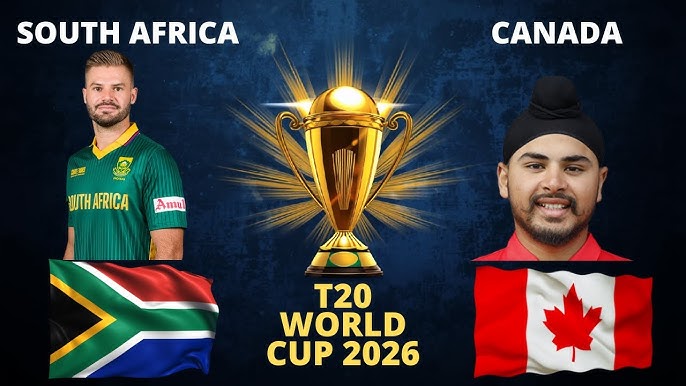
South Africa open their T20 World Cup 2026 journey against Canada in Ahmedabad with a mix of expectation, uncertainty, and renewed self-belief, as the side looks to assert its credentials in a tournament where early momentum often shapes long-term outcomes. Scheduled for a 7 PM start, the group-stage encounter places an established cricketing nation against a developing one, but the underlying narrative for South Africa is far more introspective, shaped by fluctuating form since the 2024 final loss to India and a conscious effort to redefine their competitive identity without being burdened by the past.
The Proteas arrive with uneven recent results, having won only 12 of their last 32 matches since the 2024 T20 World Cup final. That statistic reflects a phase of transition rather than outright decline, marked by experimentation, injury-driven adjustments, and a recalibration of roles. At the same time, South Africa carry the confidence of having ended a long-standing trophy drought by winning the World Test Championship last year, a triumph that restored institutional belief and altered the psychological framework within which this World Cup campaign unfolds.
Canada, meanwhile, enter their second consecutive T20 World Cup with limited exposure to top-tier international cricket in recent months but with a strong qualification record and a sense of purpose rooted in opportunity rather than expectation. Their presence in Ahmedabad represents an attempt to consolidate progress made over recent years and to demonstrate that their qualification is the result of sustained development rather than a momentary surge.
This opening fixture therefore functions as both a sporting contest and a narrative junction. For South Africa, it is about control, authority, and the translation of potential into performance. For Canada, it is about resistance, adaptability, and competitive credibility on the world stage.
South Africa’s Post-2024 Reset: Leadership, Selection Strategy, and the Search for Consistency
South Africa’s relationship with T20 World Cups has historically been complex, shaped by near-misses and matches that slipped away despite extended periods of dominance. The 2024 final against India was emblematic of this pattern, where control for much of the chase gave way to decisive moments that swung the outcome. While the team management has been clear in distancing the current campaign from that defeat, its shadow inevitably informs external expectations and internal accountability.
Captain Aiden Markram has consistently emphasised process-driven cricket over emotional motivation. His leadership approach seeks to frame the tournament as a sequence of earned performances rather than a redemptive mission. According to this outlook, progression is determined by discipline in the group stage, adaptability to conditions, and sustained execution rather than historical narratives.
Selection decisions underline this philosophy. Injuries to Donovan Ferreira and Tony de Zorzi necessitated changes, but the inclusion of Ryan Rickelton and Tristan Stubbs reflects more than contingency planning. Both players offer flexibility across the batting order and reinforce a broader intent to deepen resources rather than concentrate responsibility on a narrow core.
South Africa’s bowling unit remains its most reliable asset. Kagiso Rabada continues to be central to the attack, particularly on batting-friendly surfaces where early breakthroughs are essential to disrupt opposition momentum. Lungi Ngidi and Anrich Nortje complement him with contrasting styles, while Marco Jansen’s height and left-arm angle introduce variation that can be especially effective during powerplay and middle-over phases.
Spin responsibilities rest primarily with Keshav Maharaj, whose role extends beyond wicket-taking into controlling tempo and limiting risk. On Indian pitches, his ability to manage middle overs will be critical, supported by George Linde’s all-round utility.
Batting, while rich in individual talent, remains the area requiring cohesion. Quinton de Kock’s experience, Dewald Brevis’s explosiveness, David Miller’s finishing ability, and Markram’s composure form a formidable lineup on paper. However, recent inconsistency has highlighted the importance of role clarity and situational awareness, particularly in conditions where disciplined batting often outweighs brute force.
Against Canada, South Africa will be expected to assert dominance early, but the greater measure of success will lie in how methodically they execute plans and manage phases of the game without lapses in intensity.
Canada’s Developmental Challenge: Limited Exposure, New Leadership, and the Pursuit of Competitive Legitimacy
Canada enter the contest conscious of the disparity in experience but confident in the progress achieved through qualification and internal restructuring. Their recent calendar has lacked frequent high-level international fixtures, a gap that poses challenges in adapting to the pace and pressure of elite competition. Yet their unbeaten run through the Americas Regional qualification cycle underscores organisational discipline and tactical clarity within their competitive environment.
A significant feature of Canada’s campaign is the appointment of 23-year-old Dilpreet Bajwa as captain, succeeding Nicholas Kirton. This leadership transition signals a generational shift and a commitment to long-term development over short-term familiarity. Bajwa’s confidence in preparation reflects targeted efforts to mitigate exposure gaps, including preparatory tours designed to familiarise players with subcontinental conditions.
Canada’s squad blends experience with versatility, featuring players accustomed to adapting across formats and environments. Several members with roots in Indian cricket may find Ahmedabad’s conditions more familiar than anticipated, though familiarity alone will not neutralise the sustained pressure imposed by South Africa’s bowling attack.
Strategically, Canada’s objectives are layered. Avoiding early collapse, maintaining discipline in the field, and extending competitive phases will be central to their approach. Success will not be measured solely by the final scoreline but by the ability to challenge assumptions about associate teams and reinforce arguments for broader competitive inclusion.
For Canada, each over represents an opportunity to assert presence and purpose. For South Africa, dismantling that resistance without complacency will be essential in setting the tone for the remainder of the tournament.