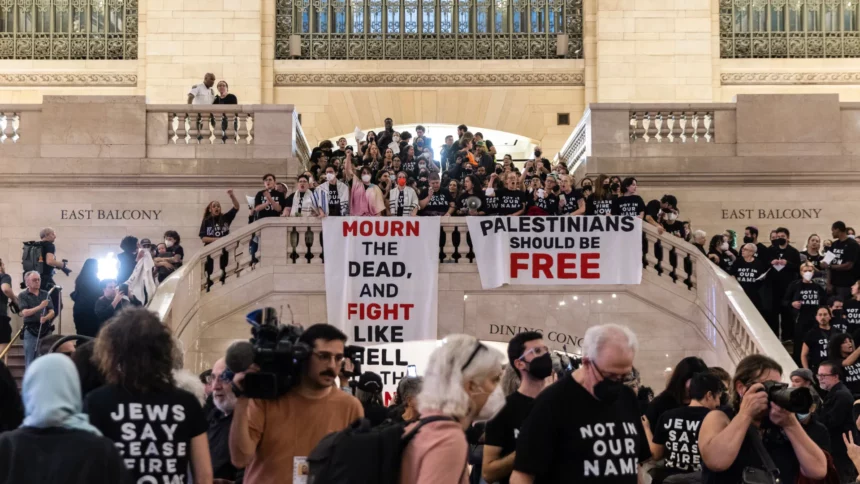
More than 40 demonstrators were arrested Monday night outside Trump International Hotel in New York City during a large protest against the ongoing war in Gaza and the growing humanitarian crisis. Organized by IfNotNow, a Jewish-American anti-occupation group, the demonstration drew hundreds of protesters calling on the U.S. government to pressure Israel into allowing more humanitarian aid into Gaza, where starvation and malnutrition have taken a deadly toll.
Chanting slogans and carrying placards that read “Stop Ethnic Cleansing,” “Stop Starving Gaza,” and “Not in Our Name,” the crowd rallied first at Columbus Circle before marching toward the Trump International Hotel. The protest unfolded under the banner, “Trump: Jews Say No More,” signifying a collective demand from members of the Jewish community to end the war and push for increased relief efforts.
Jewish Voices Rise Against War Policies
Speaking at the protest, Morriah Kaplan, interim executive director of IfNotNow, condemned Israel’s ongoing blockade of Gaza. “Let’s not mince words,” Kaplan said. “The Israeli government’s blockade of Gaza is a policy of ethnic cleansing by way of forced mass starvation.”
Kaplan highlighted how Jewish identity and tradition were being misused to justify the suffering in Gaza, saying, “It is an unbearable, unspeakable affront to our shared humanity. And it’s precisely because of our Judaism, not despite it, that we oppose these atrocities.”
Also among the speakers were prominent figures such as Ruth Messinger, Rabbi Jill Jacobs, CEO of the Jewish human rights group T’ruah, and New York City Comptroller Brad Lander. Lander, referencing the Jewish holiday of Tisha B’Av, drew a parallel between ancient Jewish suffering and the present-day destruction in Gaza, saying, “What we’re witnessing now is destruction caused by the State of Israel.”
He further added, “It is necessary for Jews to cry out louder, to organize more, and to demand that we stop sending offensive weapons that fuel this devastation.”
Diverse Attendance and Heightened Emotions
Lily Greenberg Call, a former special assistant at the U.S. Department of the Interior who resigned in May 2024 over the Biden administration’s support for Israel, also attended the protest. “I was the first, and unfortunately still the only Jewish official to publicly resign in protest of the administration’s unconditional support for Israel,” she said.
Speaking with strong conviction, Greenberg Call noted a shift in the crowd: “There is something shifting. Showing up is really important. Our tax dollars are funding this. We have an obligation, specifically as American Jews, to stand up against what’s happening in our name.”
Palestinian photojournalist Motaz Azaiza, a widely recognized voice documenting the crisis in Gaza, also addressed the crowd briefly, reinforcing the need for global solidarity and bearing witness to the suffering of those in the war-torn region.
As the group reached the Trump International Hotel around 8pm, they blocked the street by sitting and chanting, using peaceful civil disobedience to make their message heard. By 8:15pm, NYPD officers began arresting demonstrators for obstructing traffic. More than 40 protesters were taken into custody and loaded onto police vans. The crowd eventually dispersed without further incident.
In a statement released after the protest, IfNotNow called this demonstration “the broadest tent coalition in the Jewish community against the atrocities in Gaza in the last two years.” The organization emphasized that the majority of American Jews oppose the current actions of the Israeli government and demand that U.S. policy reflect their concerns.
The protest in New York was part of a larger wave of global demonstrations that have erupted in response to the deteriorating humanitarian conditions in Gaza. These actions represent a rising chorus of dissent, not only among activists and humanitarian organizations, but within Jewish communities worldwide, many of whom believe their religious and ethical traditions compel them to speak out against the violence.
By targeting Trump International Hotel, protesters sent a clear message connecting U.S. political leadership, both past and present, with the ongoing crisis. Their chants, signs, and unified presence echoed a growing demand that American foreign policy shift from uncritical support of Israel to active intervention for humanitarian relief.
The arrests may have concluded the night’s protest, but for many who attended, the movement is just beginning. With more Jewish voices joining in, the message from New York was resounding: in the face of immense suffering, silence is not an option.