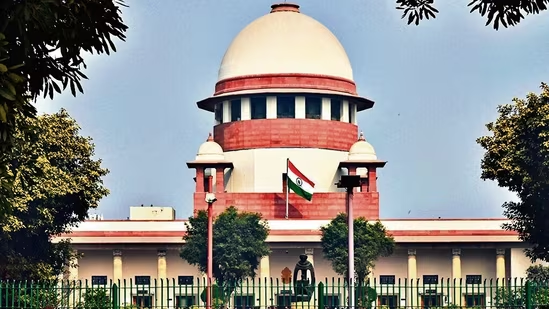
The Supreme Court of India on Friday indicated that it might temporarily relax the blanket ban on firecrackers in Delhi and the National Capital Region (NCR) during Diwali. The move comes amid the festive fervor and persistent concerns over worsening air quality, which tends to deteriorate sharply around Diwali due to firecrackers and stubble burning in nearby states. A bench comprising Chief Justice of India BR Gavai and Justice K Vinod Chandran stated that the court will decide on allowing limited use and sale of firecrackers during Diwali, potentially for a five-day period. The decision, which has been reserved for final orders, could shape the contours of how India balances tradition and environmental responsibility.
“For the time being, we will permit the ban lifting during Diwali,” the bench remarked, signaling a significant yet cautious shift from the absolute prohibition in place since 2018. The court’s statement has reignited public debate over the cultural significance of firecrackers versus the health hazards they bring each winter, especially in the densely populated and pollution-prone Delhi-NCR region.
Supreme Court Hints at Conditional Permission for Firecrackers
During the hearing, Solicitor General Tushar Mehta, appearing on behalf of the Central government, urged the bench to ease restrictions during Diwali to allow children and families to celebrate with enthusiasm. “It is a matter of a few days on Diwali. Let children celebrate Diwali with fervour,” Mehta said, requesting that the court consider expanding the permissible time window for bursting crackers beyond the earlier two-hour restriction.
The bench took note of the submissions and observed that the ban could be lifted temporarily “for the time being,” allowing firecracker use during the five days of Diwali on a trial basis. However, it emphasized that this relaxation would be subject to strict time limits and regulatory controls. The government proposed specific time slots — 8 pm to 10 pm on Diwali and other major festivals, 11:55 pm to 12:30 am for New Year’s Eve, and one-hour slots in the morning and evening during Gurpurab celebrations. Firecrackers could also be permitted for weddings and personal events, provided they comply with environmental safety norms.
Amicus Curiae, senior advocate Aparajita Singh, who has been assisting the court on this issue, voiced serious concerns regarding the widespread sale of counterfeit “green crackers” in the market. She informed the court that despite the ban on polluting firecrackers, several manufacturers continue to sell products falsely labeled as “eco-friendly” or “green,” which still contain banned chemical compounds. Singh urged the court to ensure strict enforcement mechanisms to differentiate genuine green crackers from the illegal ones, warning that otherwise the relaxation could undo the progress made over the years in curbing pollution during winter.
The bench also sought data on the Air Quality Index (AQI) trends from 2018 to 2024 to assess whether restrictions on firecrackers had led to any measurable improvement in air quality. The judges asked both the central and state pollution control boards to present comparative statistics and scientific analyses before a final order is issued.
The proposed decision reflects an effort to balance the festive spirit of Diwali with the growing urgency to protect public health and the environment. The court’s remarks suggest that while it recognizes the cultural and emotional importance of celebrations, it remains mindful of the severe pollution crisis that grips Delhi each year in November.
Experts Warn of Environmental and Health Setbacks
The possible relaxation of the firecracker ban has drawn strong reactions from environmentalists and public health experts, many of whom argue that even temporary leniency could reverse years of progress in pollution control. According to experts, the air quality in Delhi and surrounding areas typically plunges to hazardous levels during the Diwali period, owing to the combined effect of stubble burning, low wind speeds, and the extensive use of firecrackers.
Sunil Dahiya, founder and lead analyst at the environmental think-tank Envirocatalysts, cautioned that permitting the use of green firecrackers could set back the fight against air pollution by nearly a decade. “We need to control all sources of pollution at the source, including episodic events such as firecracker bursting, which lead to a spike in air pollution,” Dahiya said. He added that if meteorological conditions are unfavorable, the impact of even limited firecracker use could linger for days, aggravating health risks across the region.
Dahiya emphasized that sustainable improvement in air quality requires a comprehensive approach targeting all major pollution sources — from stubble burning in Punjab and Haryana to vehicular emissions, industrial pollution, waste burning, and construction dust. “For long-term gains, we need to control both seasonal and perennial sources of pollution. Episodic events like firecracker use only add to the cumulative impact,” he said.
Environmentalists have also highlighted that the so-called “green crackers” introduced between 2018 and 2020 failed to deliver the intended results. Despite being marketed as less polluting, these crackers reduced emissions only by about 30% compared to conventional ones and were often indistinguishable from banned variants. Studies conducted during those years revealed no significant reduction in particulate matter or toxic gases during Diwali, raising doubts about the effectiveness of green alternatives in India’s unregulated marketplace.
The Central Pollution Control Board (CPCB) has previously noted that even limited firecracker use can increase PM2.5 levels — the fine particles that penetrate deep into the lungs — by up to 50% in certain localities, especially under stagnant weather conditions. Hospitals in Delhi also report a surge in cases of respiratory distress, asthma attacks, and eye irritation immediately after Diwali, underscoring the public health dimension of the issue.
However, proponents of lifting the ban argue that cultural traditions should be respected, particularly when limited within strict timeframes and environmental safeguards. They point out that festivals like Diwali hold deep emotional and spiritual significance, and that a blanket ban on celebrations can alienate sections of the population. Many believe that with better enforcement and awareness, a middle path can be achieved — one that allows celebration without compromising public health.
The debate also touches upon issues of social equity. While elite sections of society can afford air purifiers and sealed homes, poorer communities bear the brunt of deteriorating air quality. Experts warn that a policy reversal favoring even limited firecracker use could deepen health inequalities, disproportionately affecting children, the elderly, and those with pre-existing respiratory conditions.
Revisiting the Past: Lessons from the 2018-2020 Experience
The ongoing deliberations bring back memories of the 2018 Supreme Court order that first imposed a comprehensive ban on polluting firecrackers in Delhi-NCR. At that time, the court had allowed only certified “green crackers” to be sold, aiming to strike a balance between cultural practices and environmental concerns. However, the subsequent two-year period revealed major enforcement challenges.
Despite the availability of green crackers developed by the Council of Scientific and Industrial Research (CSIR), black-market sales of banned varieties continued unabated. Local authorities struggled to monitor and control illegal manufacturing and distribution, especially during the festive season. As a result, air quality levels during Diwali in 2019 and 2020 remained largely unchanged, with the Air Quality Index (AQI) consistently falling in the “severe” category.
Environmental experts argue that any new policy must learn from these past failures. Without robust on-ground enforcement and real-time tracking mechanisms, even well-intentioned regulations can fall apart. “Merely labeling a firecracker as ‘green’ does not make it safe,” said a senior environmental scientist associated with the Delhi Pollution Control Committee. “Unless the chemical composition is independently verified, manufacturers will continue to exploit loopholes for profit.”
Adding to the complexity is the recurring problem of stubble burning in neighboring states like Punjab and Haryana, which coincides with Diwali. The smoke from these fires travels into Delhi due to wind patterns, significantly worsening pollution levels. Combined with local emissions from vehicles and construction, the situation becomes unmanageable, leading to an annual public health emergency.
The Supreme Court’s willingness to revisit the ban suggests a shift toward more flexible and context-based governance, possibly driven by public pressure and political considerations. However, the court has made it clear that the trial relaxation will come with strict limitations and ongoing evaluation of its environmental impact.
As the nation awaits the final verdict, the debate over firecrackers has once again become a symbol of India’s larger struggle — how to celebrate tradition responsibly in an era of growing environmental crises. The five-day relaxation, if granted, may serve as a litmus test for whether society can exercise restraint and respect ecological boundaries even during moments of joy.
While the court’s final decision is yet to be announced, one thing remains certain: the question of balancing cultural freedom with environmental sustainability will continue to shape public policy long after this Diwali.