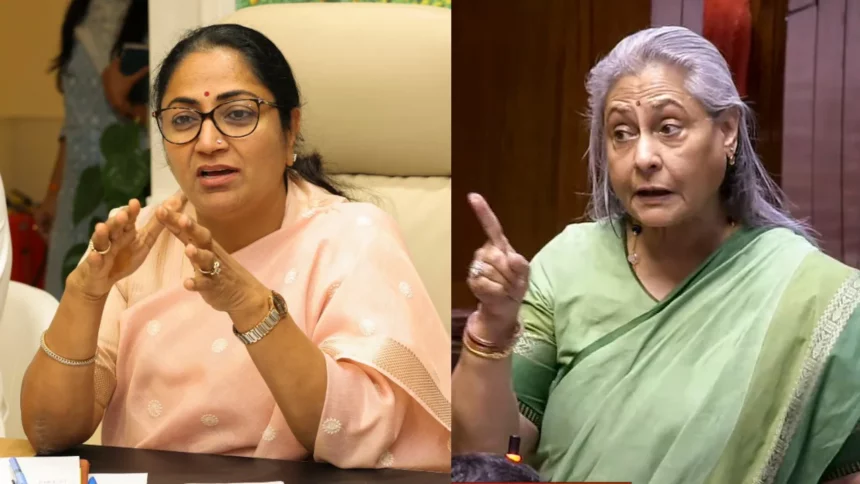
In a fiery exchange of political and ideological views, Delhi Chief Minister Rekha Gupta took sharp aim at Bollywood veteran and Rajya Sabha MP Jaya Bachchan, criticizing her remarks over the name of “Operation Sindoor” — India’s military retaliation against Pakistan following the deadly Pahalgam terror attack. Rekha Gupta’s passionate response, delivered in the Delhi Legislative Assembly, drew both from patriotic sentiment and Bollywood irony, sparking renewed debate over political narratives surrounding national security.
Operation Sindoor, launched in response to the April 22 Pahalgam terror attack that killed at least 26 people including foreign tourists, has become the center of a war of words between the ruling and opposition camps. During a debate in the Delhi Assembly, CM Rekha Gupta addressed Jaya Bachchan’s criticism of the operation’s name, invoking a dramatic line inspired by Bollywood itself: “Ek chutki sindoor ki kimat aap kya jano Jaya madam? Aap toh filmon ki duniya jaanti hai, desh ki sachchai nahi.” With this statement, Rekha Gupta accused the Samajwadi Party MP of being disconnected from the harsh realities facing the nation.
Political Heat Over Operation’s Name
The controversy began when Jaya Bachchan expressed her disapproval of naming the mission “Sindoor,” saying it was insensitive given the context. She argued that the attack had taken away the “sindoor” — symbolic of marital status — from many women whose husbands were killed. Her comments, intended as a critique of what she described as performative nationalism, drew sharp criticism from the BJP and especially from CM Rekha Gupta, who saw the remarks as undermining the solemn and symbolic intent behind the operation’s name.
Rekha Gupta, during her address, did not hold back. She framed Jaya Bachchan’s views as emblematic of a broader attitude in the opposition that she believes aligns more with adversaries of India than with its citizens. “These people do not love Bharat, they love anti-national forces,” she said. “They have named themselves INDIA, but when they speak, it feels like they are spokespersons for Pakistan.”
The comment was clearly a reference to the opposition bloc that has adopted the acronym INDIA (Indian National Developmental Inclusive Alliance), which Rekha Gupta suggested was ironic given their alleged stance on national security matters. She further alleged that the same opposition leaders had cast doubts on the credibility of Operation Sindoor even in Parliament, questioning the Indian Army and the Prime Minister rather than the perpetrators of terrorism.
Military Action and Government’s Stand
On May 7, in a carefully planned pre-dawn military operation named Operation Sindoor, India targeted and bombed nine terrorist camps across Pakistan and Pakistan-occupied Kashmir. The operation was seen as a strong response to the April 22 Pahalgam massacre, which had shaken the nation. Lashkar-linked terrorists, under the banner of The Resistance Front (TRF), had launched a brutal attack on a group of Indian and foreign tourists in the popular Kashmir destination.
According to official statements, over 100 militants were neutralized in the course of India’s military retaliation, which included a four-day-long cross-border engagement involving fighter jets, artillery, and missiles. The Indian government positioned the operation as a decisive message to terror outfits and their backers, and as a show of India’s strategic readiness.
Rekha Gupta lauded the bravery of the Indian armed forces and praised Prime Minister Narendra Modi’s leadership during this critical juncture. She described the Prime Minister as a “courageous father, a compassionate brother, and a resolute national leader” who, according to her, ensured that the pain of the victims’ families was not ignored. “Operation Sindoor was a befitting reply to Pakistan after the attack in Pahalgam, where many women lost their loved ones,” she added.
While defending the naming of the mission, Rekha Gupta pointed to the cultural and emotional symbolism of “sindoor” in Indian society, associating it with honor, sacrifice, and the strength of Indian women. Her stance was that the operation name was a tribute to those who lost everything, not a mockery of their grief.
Jaya Bachchan’s comments, however, had highlighted the emotional trauma faced by the widows of the victims. “Sindoor toh ujad gaya,” she had said, in a somber tone, questioning the appropriateness of using such a term for a military operation. Her statement quickly drew flak from the treasury benches and became a political flashpoint.
The exchange underscores the growing political divide over how acts of terrorism and national responses are framed in the public discourse. While the government has opted for symbolism that blends cultural and military narratives, some opposition voices remain skeptical of what they perceive as an increasing use of nationalist sentiment for political mileage.
Rekha Gupta’s comments in the Assembly were not limited to Jaya Bachchan alone. She broadened her critique to the opposition at large, accusing them of eroding national morale and questioning the armed forces. By painting the opposition as unpatriotic or disconnected from ground realities, the BJP aims to consolidate nationalist sentiment, especially in the wake of recent terrorist attacks.
The political temperature continues to rise as debates over names, symbols, and ideologies increasingly dominate India’s political stage. Whether such disputes serve to inform or inflame public opinion remains to be seen, but the passion with which leaders like Rekha Gupta have responded ensures that Operation Sindoor will remain in public and political memory for some time.