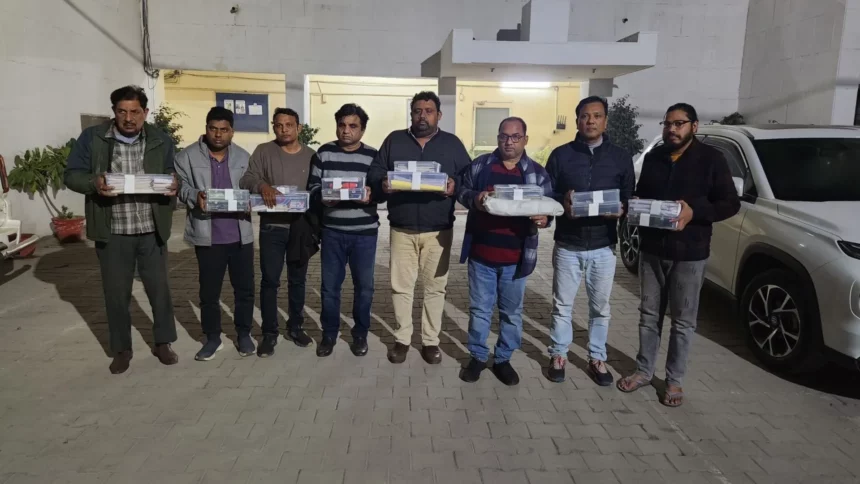
A massive home-loan fraud involving over ₹100 crore has been uncovered by the Noida unit of the Special Task Force (STF), revealing an elaborate network of fraudsters operating across Delhi, Uttar Pradesh, Uttarakhand, Chandigarh, and Gurugram. The gang allegedly floated fake companies, appointed fictitious directors and employees, and used forged Aadhaar, PAN, and property documents to cheat banks through home and property loan schemes. STF officials have frozen more than ₹15 lakh found in 11 accounts so far, and the wider probe continues. Eight accused were arrested earlier, while another bank employee was taken into custody this week.
Investigators said the gang managed to open more than 250 bank accounts in 29 public and private banks across four states. These accounts were operated using forged identities and fraudulent documentation to execute large-scale financial fraud. The operation relied heavily on collusion with bank officials, builders, and document forgers, enabling the accused to transfer loan amounts, forge property registries, and redirect funds using fake profiles.
Scam Spanned 29 Banks; Fake Companies, Directors Used to Extract Crores in Loans
According to the STF, the accused created multiple fake companies and positioned hired individuals as directors and employees. Using forged documents—including Aadhaar cards, PAN cards, property papers, and fabricated employment proof—the gang applied for high-value loans, primarily home and property loans, from several banks. Investigators allege that certain bank officials played a key role by ignoring discrepancies, clearing loan applications, and facilitating the transfer of funds into fraudulent accounts.
On December 4, the STF arrested eight members of the gang. These include Ramkumar, a resident of Shaktikhand, Indirapuram, who worked as a loan executive at HDFC and Axis Bank; Nitin Jain of Delhi; Mohd. Wasi of Jharkhand; Shamshad Alam of Bihar; Indra Kumar Karmakar of Gurugram; Anuj Yadav of Sahibabad; Ashok Kumar alias Deepak Jain of West Patel Nagar, Delhi; and Tahir Hussain of Sambhal. Preliminary findings suggest that Tahir, Ashok, and Shamshad have been active together since 2015, while others were involved due to familial or professional connections. One of the accused, Nitin, was identified as an employee of Ashok Kumar.
Investigations reveal that the gang often used identities of deceased individuals to secure property transfers and loans. In one instance, the identity of Delhi resident Ratna Vasudeva—now deceased—was misused to obtain a loan of ₹4.8 crore from HDFC Bank. According to the investigation, the accused prepared forged documents in the name of one Shahida Ahmed, altering her identity to match that of Ratna Vasudeva. The forged biometric details and fingerprints were allegedly prepared by an associate named Aman Sharma. A Federal Bank account was then opened under the impersonated identity.
After the fraudulent HDFC loan amount was transferred into this fake account, the accused arranged a property registry dated December 5, 2024, in the name of a man identified as Sanaullah. Investigators discovered that Sanaullah was not present during the registry process; instead, accused Mohd. Wasi impersonated him by giving biometrics and photographs.
The gang’s network extended to eight builders, who allegedly helped the group in preparing fraudulent real-estate documents required for loan processing. The STF stated that these builders provided forged property details, valuation reports, and related paperwork to ease loan approvals.
The banks in which the fraudulent accounts were opened include: Airtel Payments Bank, AU Small Finance Bank, Axis Bank, Bandhan Bank, Bank of Baroda, Bank of Maharashtra, Canara Bank, Capital First Ltd., CBS Bank Ltd., Central Bank of India, Equitas Small Finance Bank, Federal Bank, HDFC Bank, ICICI Bank, IDBI Bank, IDFC Bank Ltd., IDFC First Bank, Indian Bank, Indian Overseas Bank, IndusInd Bank, J&K Bank, Kotak Mahindra Bank, Punjab National Bank, RBL Bank Ltd., Standard Chartered Bank, State Bank of India, UCO Bank, Ujjivan Small Finance Bank, and Union Bank of India.
All banks have been notified by the STF to freeze accounts linked to the accused. Detailed information from 11 accounts has been received so far, leading to the freezing of more than ₹15 lakh. More accounts are under review.
Another Bank Employee Arrested; Seizures Include Luxury Cars, Forged IDs, and Loan Records
In a fresh development, a joint operation by the STF and Surajpur Police arrested another accused—Shubham Saxena, a resident of Sadopur Jhal near Badalpur—on Monday. Saxena has previously worked as a sales executive in the HDFC home loan division and is currently employed as a team manager with SBI Home Loans in Delhi. Investigators believe he played a critical role in verifying fake loan applications, enabling fraudulent loan disbursals, and facilitating account operations.
During the crackdown, the STF recovered a significant volume of incriminating evidence including:
* Bank chequebooks and passbooks
* Multiple ATM cards
* A large number of forged Aadhaar cards, PAN cards, and voter IDs
* Mobile phones and laptops
* Luxury vehicles
* Fake property registries and agreements
Officers also seized a diary containing detailed records of transactions linked to fake employee salaries, movement of funds, and loan profiles created over several months. This diary is expected to serve as a key piece of evidence in establishing the operational structure of the gang.
Officials said the fraud network was meticulously planned, relying on coordinated roles. Forgers produced counterfeit documents, bank insiders facilitated approvals, and field operatives recruited impersonators for biometric verifications. In several cases, beneficiaries of fraudulent loans never existed—identities were created solely to siphon funds.
The STF continues to interrogate the arrested accused while verifying additional financial links, property transactions, and bank officers involved in the conspiracy. More arrests are expected as the investigation expands into multiple states. Authorities also indicated that a comprehensive audit of loan applications processed by private housing finance divisions may be initiated.
The case highlights growing concerns about large-scale financial fraud enabled through collusion between bank employees, builders, and document forgers. With the scam involving over 100 crore and multiple states, investigators believe this could be one of the largest home-loan frauds exposed in recent years.