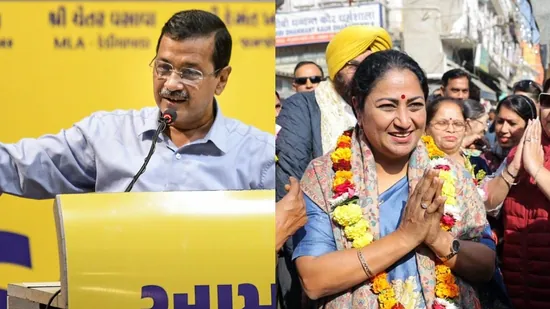
A political dispute over Delhi’s air quality management intensified after former chief minister Arvind Kejriwal criticised incumbent chief minister Rekha Gupta’s statement describing the Air Quality Index (AQI) as “like temperature.” The comment, made during a public interaction at the Hindustan Times Leadership Summit 2025, triggered widespread debate about the scientific understanding behind the government’s pollution measures and allegations of manipulating AQI readings by spraying water near monitoring stations. Kejriwal publicly questioned the logic of Gupta’s analogy and accused the government of attempting to suppress pollution data, escalating an already tense political environment amid worsening air quality levels in the national capital.
Kejriwal Accuses Delhi Government of Data Suppression and Seeks Clarification on “New Science” Behind AQI Comparison
Arvind Kejriwal, national convenor of the Aam Aadmi Party and former chief minister of Delhi, launched a pointed critique of CM Rekha Gupta’s comments on AQI, asking when the “new science” emerged that equated air pollution levels to temperature readings. His remarks came through a detailed post on X (formerly Twitter), in which he argued that Gupta’s explanation revealed a deeper problem: an alleged attempt by the government to artificially reduce AQI readings in areas where monitors are installed.
Kejriwal claimed that the chief minister’s response amounted to an acknowledgment that water was indeed being sprayed around AQI monitoring stations, a practice widely criticised on social media after videos emerged showing tankers and water jets operating directly near official pollution sensors. He argued that such actions are meant to distort actual data, preventing Delhi residents from understanding the severity of air pollution.
He wrote that “the chief minister has at least accepted” that targeted spraying occurs at monitoring locations, which, according to him, amounts to a mechanism for hiding the truth and presenting an artificially positive picture of air quality. Kejriwal framed this not just as a political issue but as a deliberate manipulation of environmental information that directly affects public health.
The former chief minister further questioned the scientific merit of Gupta’s analogy equating AQI to temperature. He demanded an explanation of what scientific framework suggests that the two are similar, pointing out that AQI represents particulate matter and toxic pollutants in the air, not a climate parameter like heat. His statements sparked larger conversations among environmental experts, citizens, and political leaders about scientific literacy and its role in governance.
Kejriwal’s criticism emerged at a time when Delhi’s AQI had again crossed the 300 mark, placing it firmly in the “very poor” category. According to the Central Pollution Control Board (CPCB), the 24-hour average AQI measured 314 at 4 pm, worsening slightly from the previous day. Forecast models suggested further deterioration, raising concerns about public health impacts, especially for children, the elderly, and individuals with respiratory conditions.
The controversy deepened as political opponents accused the Delhi government of prioritising public relations over transparent environmental governance. Several environmental groups also expressed alarm at the idea that AQI readings could be manipulated through superficial measures rather than addressing systemic pollution sources such as vehicular emissions, industrial activity, biomass burning, and construction dust.
Reports of deliberate spraying near monitoring stations brought additional scrutiny, with critics asserting that such tactics undermine the credibility of air quality data and hinder evidence-based policymaking. As pollution levels climbed and public frustration grew, the debate surrounding Gupta’s remarks expanded beyond political circles into broader discussions on scientific accountability.
Rekha Gupta Defends Water Spraying as Pollution Mitigation, Sparks Debate Over Hotspots and Measurement Methods
The controversy originated during Rekha Gupta’s appearance at the Hindustan Times Leadership Summit 2025, where she was asked about allegations that the government was manipulating AQI data by spraying water around pollution monitors located in hotspots. Gupta responded by explaining that hotspots are areas with the highest pollution concentration, and mitigation efforts—such as spraying water—are therefore naturally directed to those locations.
She argued that water spraying is a legitimate method for reducing dust levels, which contribute significantly to particulate pollution in Delhi. In her explanation, she compared AQI readings to temperature readings, stating that neither can be changed by merely using a monitoring device; they only reflect existing environmental conditions. Consequently, Gupta asserted that spraying or “watering” is the only meaningful action they could take in those zones to mitigate pollution.
Her analogy drew immediate criticism from scientists and environmental activists who clarified that AQI is not comparable to temperature. Temperature is a physical measure with stable and universal parameters, whereas AQI is a composite index that quantifies multiple pollutants such as PM2.5, PM10, nitrogen dioxide, ozone, carbon monoxide, and sulfur dioxide. They argued that while temperature may vary based on natural factors, AQI can be artificially influenced by localised actions that affect particulate distribution around monitoring devices.
The chief minister’s remarks also came at a time when Delhi’s AQI remained persistently high, creating public anxiety and triggering debate about whether water spraying—typically effective only for suppressing dust—was being selectively implemented near monitors rather than across the city. Critics also suggested that such measures fail to address other major pollution contributors such as emissions from traffic and industries, or seasonal sources like stubble burning.
Social media platforms circulated videos that appeared to show water tankers spraying directly at air monitors, prompting concerns that the intention was less about mitigation and more about altering reading accuracy. Gupta’s analogy elevated these concerns into national discussions, prompting opposition leaders to label the explanation as pseudoscientific and misleading.
Environmental experts emphasized that while dust suppression is a valid short-term tool, it must be part of a broader strategy involving emissions control, transport regulation, and long-term behavioural change. They also stressed that AQI monitoring must remain transparent, consistent, and free from artificial manipulation to guide policymaking effectively.
Amid this debate, Delhi continued experiencing severe pollution peaks. Health advisories encouraged residents to limit outdoor exposure, especially vulnerable populations. Multiple forecasts indicated that air quality was likely to decline further, shifting from very poor to potentially severe levels depending on meteorological conditions.