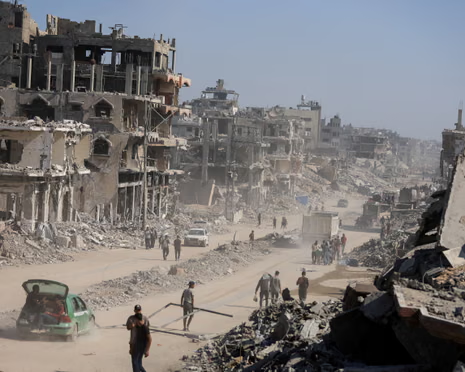
In a development underscoring the fragile calm in the ongoing Israel-Hamas conflict, Israel received the body of another hostage from Gaza on Wednesday. The remains were handed over to the Red Cross by Hamas’ armed wing and later transferred to Israeli authorities for forensic verification. The process comes as both sides continue to navigate a tense and uneasy truce, brokered under U.S. mediation, that has allowed limited exchanges of hostages and detainees while attempts to stabilize the region remain uncertain.
Recovery of Hostage Remains Continues Under Ceasefire
According to the Israeli Prime Minister’s Office, the remains were discovered near Gaza City and subsequently delivered to Israel. Forensic experts are now working to confirm the identity of the body. If confirmed to belong to one of the hostages, Israel would still have six known deceased captives remaining in Gaza.
The recovery of hostage remains has continued even amid sporadic violence across the region. Since the ceasefire took effect on October 10, Hamas has turned over all 20 living hostages in exchange for nearly 2,000 Palestinian prisoners and wartime detainees held in Israeli facilities. However, the militant group also pledged to hand over the remains of 28 deceased hostages, a process that has faced delays due to widespread destruction across Gaza.
Hamas has argued that the devastation caused by months of bombardment has made it extremely difficult to locate and identify bodies buried under rubble. Israel, however, has accused the group of deliberate stalling and using the issue for political leverage.
Despite these tensions, humanitarian coordination through international mediators such as the Red Cross and the United States has allowed for a gradual continuation of the exchange process. The effort is seen as one of the few functioning mechanisms still active between the two sides, reflecting a narrow space for negotiation amid broader hostilities.
Continuing Violence Despite a Ceasefire
Even as the ceasefire has led to a notable reduction in direct clashes, violence persists in several areas of Gaza. On Wednesday, Gaza health authorities reported that Israeli fire killed a Palestinian man who was collecting firewood in central Gaza. The Israeli military said it was not aware of any such incident, highlighting the continuing confusion and lack of coordination in certain conflict zones.
The ceasefire, in effect since October 10, has brought a temporary lull in full-scale fighting but has not stopped all hostilities. Israeli strikes, though intermittent, continue to target what it describes as militant positions within Gaza, while Hamas and smaller factions have maintained sporadic resistance activities.
Since the truce began, Israel has withdrawn troops from heavily populated urban centers to positions behind a designated yellow demarcation line. The move has enabled hundreds of thousands of displaced Palestinians to cautiously return to what remains of their homes. Aid convoys have also increased, bringing much-needed food, fuel, and medical supplies into Gaza, though humanitarian agencies warn that the relief is far from sufficient to meet the overwhelming demand.
The ongoing humanitarian crisis in Gaza has drawn international concern, with aid organizations reporting that living conditions remain dire. Many areas still lack access to clean water, electricity, and basic health services. Reconstruction efforts have been slow due to continuous restrictions on materials entering the enclave and the lingering threat of renewed hostilities.
At the same time, Israel continues to face internal pressure from families of hostages and political groups demanding a more comprehensive resolution to the hostage crisis. Public sentiment remains divided—while many call for continued negotiation to recover all hostages, others insist that any compromise with Hamas undermines Israel’s long-term security objectives.
The delicate ceasefire, though holding in broad terms, remains under constant strain. Isolated incidents of gunfire, drone surveillance, and localized clashes have raised fears that the fragile truce could unravel if trust continues to erode.
The Human Cost and Political Tensions
The war, now in its second year, has left deep scars on both sides. Gaza’s infrastructure lies in ruins after relentless airstrikes, while Israeli communities near the border continue to live under the shadow of potential rocket fire and militant infiltration.
For Israel, the recovery of hostage remains symbolizes both closure and pain—a reminder of the human toll the conflict has exacted. Families continue to hold vigils, demanding transparency and accountability from their government. The Israeli authorities have pledged to continue efforts until every hostage—living or deceased—is returned.
In Gaza, the civilian population bears the brunt of the ongoing turmoil. Reports indicate widespread displacement, malnutrition, and psychological trauma, particularly among children. The destruction of schools, hospitals, and residential neighborhoods has forced many to live in makeshift shelters or among the ruins of their former homes.
The ceasefire, although technically in place, has failed to bring meaningful political progress. Diplomatic channels remain constrained, with neither side showing readiness for substantive negotiations beyond humanitarian exchanges. Israel insists on complete disarmament and demilitarization of Hamas before any long-term peace arrangement, while Hamas demands the lifting of the blockade and recognition of Palestinian political rights.
In this tense environment, the return of another hostage’s body highlights the complex intersection of humanitarian necessity and political posturing. Each exchange, while providing temporary relief to grieving families, also exposes the limitations of the current ceasefire framework.
As both sides navigate this uneasy peace, the broader question remains unanswered—whether the ongoing cycle of violence, retaliation, and fragile truces will eventually lead to a sustainable resolution or merely postpone the next inevitable confrontation.
For now, the transfer of the hostage’s remains stands as a somber reminder of the enduring human suffering beneath the diplomatic negotiations, military maneuvers, and political rhetoric defining one of the world’s most intractable conflicts.