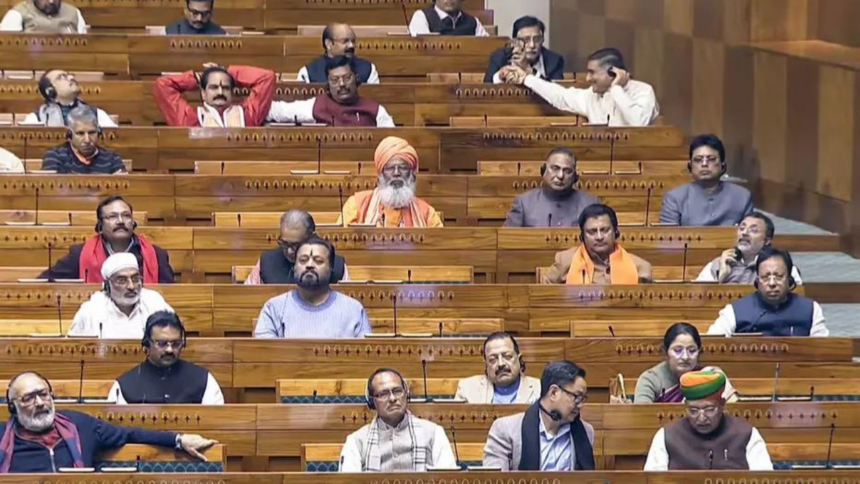
The Winter Session of Parliament in 2025 moved into a decisive stage on its thirteenth sitting as the government sought to advance major legislative business in the Lok Sabha, even as political contestation intensified with the opposition sharpening its strategy. Beginning on December 1 and scheduled to conclude on December 19, the session has been marked by sharp debates, repeated disruptions, and competing priorities, but its final days are now focused on the passage of key Bills that could have long-term implications for India’s energy security, employment policy, and governance framework.
Government pushes key bills as Winter Session nears conclusion
With only a few sittings remaining, the government has placed a packed legislative agenda before the Lok Sabha, signalling its intent to move forward with reforms it considers central to India’s development trajectory. Wednesday’s proceedings assumed particular significance as Union Minister of State for Atomic Energy Dr Jitendra Singh moved the Sustainable Harnessing and Advancement of Nuclear Energy for Transforming India, or shanti, Bill 2025 for consideration and passage. The Bill represents a sweeping overhaul of India’s nuclear energy framework and is being projected as a cornerstone reform aimed at modernising the sector and aligning it with emerging national and global needs.
The shanti Bill seeks to promote and expand the use of nuclear energy and ionising radiation across a wide range of applications, including power generation, healthcare, agriculture, industry, research, environmental management, and innovation in nuclear science and technology. It also aims to establish a robust regulatory structure to ensure the safe, secure, and responsible utilisation of nuclear resources, with the stated objective of safeguarding public welfare while enabling technological progress. By opening the civil nuclear sector to greater participation, including from private entities, the Bill signals a significant shift from the existing framework that has largely kept nuclear energy under tight state control.
Discussion on the Bill began in the Lok Sabha amid heightened political attention, with members raising questions about safety, regulation, accountability, and the broader implications of allowing private participation in a sensitive sector. The government has argued that modernising nuclear laws is essential for meeting India’s growing energy demands, reducing dependence on fossil fuels, and achieving long-term climate goals. It has also stressed that nuclear technology today extends far beyond electricity generation and plays a critical role in medicine, food preservation, water management, and scientific research.
Alongside the nuclear energy legislation, the Lok Sabha’s agenda also includes the proposed Viksit Bharat–Guarantee for Rozgar and Ajeevika Mission (Gramin) Bill 2025. This Bill seeks to replace the two-decade-old Mahatma Gandhi National Rural Employment Guarantee Act and proposes a statutory guarantee of 125 days of wage employment per financial year to rural households. The proposed law is being framed as part of the broader vision of viksit bharat @2047, with the government positioning it as an updated and more ambitious framework for rural employment and livelihood security.
Union Minister Shivraj Singh Chouhan is expected to move the rural employment Bill for consideration and passage, adding to the legislative weight of the session’s final phase. The proposal has already generated political debate, with supporters arguing that it reflects evolving economic realities and employment needs, while critics have expressed concerns about implementation, funding, and the future of existing welfare guarantees. The Bill’s introduction comes at a time when rural distress, employment generation, and social protection remain central themes in national political discourse.
Beyond these two major pieces of legislation, the Lok Sabha is also scheduled to take up matters under Rule 377, lay papers presented by various ministries, and consider a series of parliamentary committee reports. Ministers from departments ranging from science and technology to railways, information and broadcasting, consumer affairs, and corporate affairs are slated to table documents and respond to committee recommendations, underscoring the breadth of oversight and legislative activity compressed into the session’s closing days.
Political contestation, committee reports, and rising opposition pressure
While the government is pushing ahead with its legislative agenda, the political atmosphere inside Parliament remains charged. The opposition has stepped up its efforts to influence proceedings, raising concerns over policy direction, procedural issues, and broader questions of democratic accountability. The Congress has issued a whip directing all its Lok Sabha members to be present in the House for the next three days, signalling its intent to actively engage in debates and voting as key Bills come up for consideration.
Earlier days of the Winter Session witnessed sharp exchanges between the ruling party and the Congress-led opposition on issues ranging from electoral reforms to symbolic and ideological questions. These confrontations have set the tone for the session’s final phase, with both sides acutely aware that time is limited and legislative outcomes are at stake. The opposition has also sought to use parliamentary procedures to draw attention to pressing issues, including funds owed to states, environmental pollution, and social welfare concerns.
In the Rajya Sabha, opposition members have submitted notices for Calling Attention motions on state dues and rising pollution levels, expressing hope that the Chair would allow discussions on these urgent matters. The Upper House has seen its own share of adjournments and procedural interruptions, reflecting the broader challenges of managing a heavy agenda amid political differences. On Wednesday, the Rajya Sabha was adjourned until the afternoon after completing part of its Question Hour and Zero Hour proceedings.
Parliamentary oversight has also been in focus through the presentation of multiple committee reports. The Committee on the Welfare of Other Backward Classes is set to present action taken statements on the implementation of welfare schemes and reservation policies in posts and services under the government of India and Union Territories. At the same time, the Committee on Empowerment of Women is scheduled to present its third report for 2025–26, focusing on the safety and protection of women in the unorganised sector. These reports add a social policy dimension to the legislative proceedings and are expected to inform future debates and policy interventions.
Question Hour sessions in both Houses have featured ministers responding to a wide range of issues, from train accidents and coal gasification projects to telecommunications initiatives and the promotion of Indian languages on social media platforms. Members have used these opportunities to raise constituency-specific concerns as well as broader national issues, reflecting the diverse priorities that Parliament must address even as major Bills dominate the agenda.
As the Winter Session approaches its scheduled conclusion, the coming days are likely to test Parliament’s ability to balance debate, dissent, and decision-making. Whether consensus can be forged on contentious legislation or whether political divisions will further slow proceedings remains an open question. What is clear, however, is that the thirteenth day of the session marked a pivotal moment, with the government moving decisively to place its key reforms before the House and the opposition mobilising to scrutinise and challenge them within the limited time available.