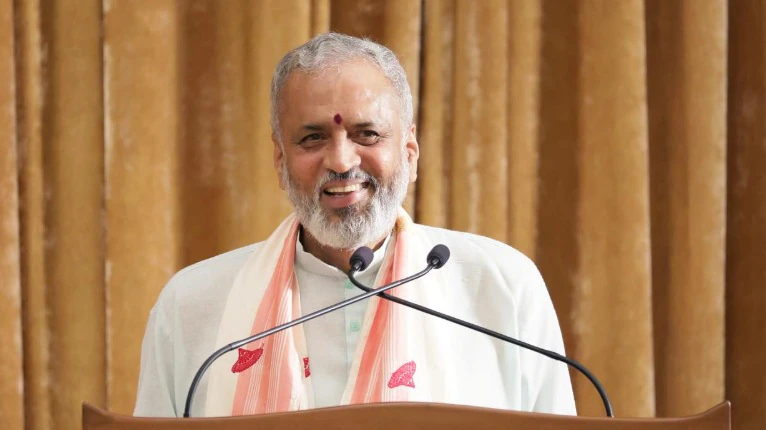
In a controversy that has reignited debates over the origin and meaning of India’s national anthem, BJP MP and former Karnataka Assembly Speaker Vishweshwar Hegde Kageri’s claim that *Jana Gana Mana* was written to “welcome the British” has drawn sharp criticism from the Congress. Kageri’s remarks have been fact-checked and ridiculed by Congress leader Priyank Kharge, who described them as “WhatsApp history lessons” and “utter nonsense,” accusing the BJP and RSS of distorting historical facts for political narratives.
Kageri’s Remark and His Defence of Vande Mataram
Speaking at an event in Honnavara, Karwar, Vishweshwar Hegde Kageri sparked outrage with his interpretation of the national anthem’s history. “There was a strong chorus to make *Vande Mataram* the national anthem,” he said. “However, our ancestors decided that along with *Vande Mataram*, *Jana Gana Mana*, which was composed to welcome the British, should also be included. Today, we have accepted it and continue to follow it.”
Kageri’s comments came as he was emphasizing the importance of *Vande Mataram* during the commemoration of its 150th year, describing it as a “great source of inspiration” in India’s freedom struggle. He urged that the song should be sung widely across schools and colleges, especially by the younger generation. “As we mark its 150th year, we must ensure that *Vande Mataram* is sung by everyone,” he said, reinforcing his belief in its symbolic importance to India’s national identity.
While Kageri attempted to downplay his remarks by saying he did not wish to “revisit history,” his suggestion that *Jana Gana Mana* was composed in praise of the British reignited a long-standing myth — one that historians and scholars have repeatedly debunked. The statement immediately triggered backlash from opposition parties and academics alike, accusing the BJP MP of spreading misinformation.
Congress’s Strong Response and Historical Clarifications
Congress leader and Karnataka minister Priyank Kharge wasted no time in countering Kageri’s claim. Taking to social media platform X, Kharge called out what he described as another instance of “RSS WhatsApp history.” In his post, Kharge wrote, “Another day, another RSS ‘WhatsApp history’ lesson. @BJP4Karnataka MP Sri Kageri now claims our National Anthem is ‘British.’ Utter nonsense.”
Kharge provided a detailed rebuttal, reminding the public of the verified historical context. “Sri Tagore wrote the hymn *Bharoto Bhagyo Bidhata* in 1911; its first stanza became *Jana Gana Mana*. It was first sung on 27 December 1911 at the Indian National Congress session in Calcutta — not as a royal tribute,” he clarified.
He went on to quote Rabindranath Tagore’s own explanation from 1937 and 1939, where the Nobel laureate explicitly stated that the song hailed “the Dispenser of India’s destiny” and “could never be George V, George VI, or any other George.” Kharge used these references to underline that Kageri’s claim was historically baseless and politically motivated.
In a sharply worded post, Kharge accused the BJP and RSS of having a legacy of disrespecting national symbols. “The MP says he doesn’t want to revisit history. But I strongly urge every BJP, RSS leader, worker, and ‘swayamsevak’ to revisit history by reading the editorials of RSS mouthpiece *Organizer* and learn that RSS has a great tradition of disrespecting the Constitution, the Tricolour, and the National Anthem. This viRSS needs to be cured,” he wrote, turning the controversy into a broader ideological critique of the ruling party and its parent organization.
Debunking the ‘Jana Gana Mana’ Myth
The debate surrounding the origin of *Jana Gana Mana* is not new. For decades, a section of politicians and public figures have claimed that the anthem was written to honor the British monarch. However, historical records and Tagore’s own words refute this interpretation.
Rabindranath Tagore wrote *Bharoto Bhagyo Bidhata* on December 11, 1911. The following day, the Delhi Durbar was held at Coronation Park to proclaim King George V as Emperor of India, which coincidentally led to the misconception that the song was written for that event. However, evidence clearly shows that the song was first sung on December 27, 1911, during the Indian National Congress session in Calcutta — a nationalist platform opposed to colonial rule. It was again performed at the foundation day event of Adi Brahma Samaj in February 1912, further proving its spiritual and patriotic nature rather than any colonial allegiance.
The confusion primarily stems from the word “adhinayaka” used in the lyrics, which some have misinterpreted to mean “the ruler” or “the emperor.” In 1937, Tagore addressed this misunderstanding in a letter, writing that “neither the Fifth nor the Sixth nor any George could be the maker of human destiny through the ages.” He clarified that the song celebrated “the Dispenser of India’s destiny” — the divine spirit that guides the nation through its struggles, triumphs, and transitions.
Tagore’s clarification not only dismisses the colonial interpretation but also highlights his deep sense of faith and nationalism. Far from being a tribute to imperial power, *Jana Gana Mana* was an invocation of India’s collective destiny, its resilience, and its faith in divine justice. It embodied Tagore’s vision of a country united by cultural and spiritual values, not by political domination.
Over time, this misinterpretation has resurfaced repeatedly, often fueled by political motives. Each time, historians have reaffirmed that the song’s meaning lies in its invocation of India’s eternal journey and not in servitude to any ruler.
Political Undertones and the Recurring Debate
The latest controversy surrounding Kageri’s remarks fits into a broader pattern of ideological disputes over India’s national symbols — from the national flag to the Constitution to the national anthem itself. The remarks reveal an ongoing attempt by some political groups to reinterpret historical narratives in line with their own ideological leanings.
For the Congress, the issue has provided an opportunity to challenge the BJP’s claims to cultural nationalism. By highlighting factual inaccuracies and quoting Tagore himself, the opposition has sought to portray the BJP’s statements as not only false but disrespectful to India’s literary and nationalist heritage.
Meanwhile, the BJP has not issued a formal response to Kharge’s rebuttal, but party supporters have defended Kageri’s emphasis on *Vande Mataram*, framing it as an expression of patriotism rather than an attack on *Jana Gana Mana*. Political analysts suggest that this reflects a deeper ideological contest between the inclusive nationalism espoused by the Congress during the freedom movement and the cultural nationalism promoted by the RSS and its affiliates.
The timing of Kageri’s comments, coinciding with the 150th anniversary of *Vande Mataram*, also adds a layer of political symbolism. For many within the BJP, *Vande Mataram* is seen as an emotionally charged patriotic hymn that connects directly with the freedom struggle. However, attempts to elevate it by undermining *Jana Gana Mana* risk deepening cultural divisions and rewriting well-documented history.
This controversy has also reignited discussions within academic and literary circles about the politicization of cultural icons. Tagore’s legacy, rooted in universalism and spiritual nationalism, stands in contrast to the binary narratives of colonial versus nationalist sentiments that modern politics often imposes. By reviving old misconceptions, critics argue, politicians risk reducing Tagore’s vision to a caricature shaped by contemporary ideological battles.
The broader debate reflects a recurring pattern in India’s political discourse — where historical symbols become tools in the contest for ideological supremacy. While *Vande Mataram* and *Jana Gana Mana* both hold deep emotional and cultural significance, pitting one against the other distorts the inclusive spirit that defined India’s freedom movement.
For now, Vishweshwar Hegde Kageri’s remarks have reignited an old controversy that refuses to fade away. The exchange between him and Priyank Kharge once again highlights how interpretations of national identity and history continue to shape India’s political battles, decades after independence.