New Delhi | January 29, 2026
The three-day International Conference on Emerging Trends and Challenges in Open, Distance, Digital and Blended Learning (ODDBL 2026) was inaugurated today at Vigyan Bhawan, New Delhi, marking a major global dialogue on the future of education. The conference is being organised by the Department of Distance and Continuing Education, School of Open Learning (SOL), University of Delhi, and has drawn participation from leading national and international academicians, policymakers, education administrators, researchers and students.

The inaugural session witnessed the launch of several key initiatives, including COL Radio and the COL Gram Grievance Portal, along with the release of the Conference Proceedings Book. These initiatives reflect the School of Open Learning’s growing focus on digital outreach, learner engagement, transparent grievance redressal mechanisms and the dissemination of academic research through technology-enabled platforms.
Delivering the welcome address, Prof. Payal Mago, Director, Campus of Open Learning, University of Delhi, highlighted the rapidly increasing relevance of open, distance, digital and blended learning in the context of technological advancement and changing learner needs. She emphasised the responsible use of digital tools, data analytics and artificial intelligence to enhance accessibility, quality and learner support, reaffirming SOL’s commitment to inclusive and future-oriented education.
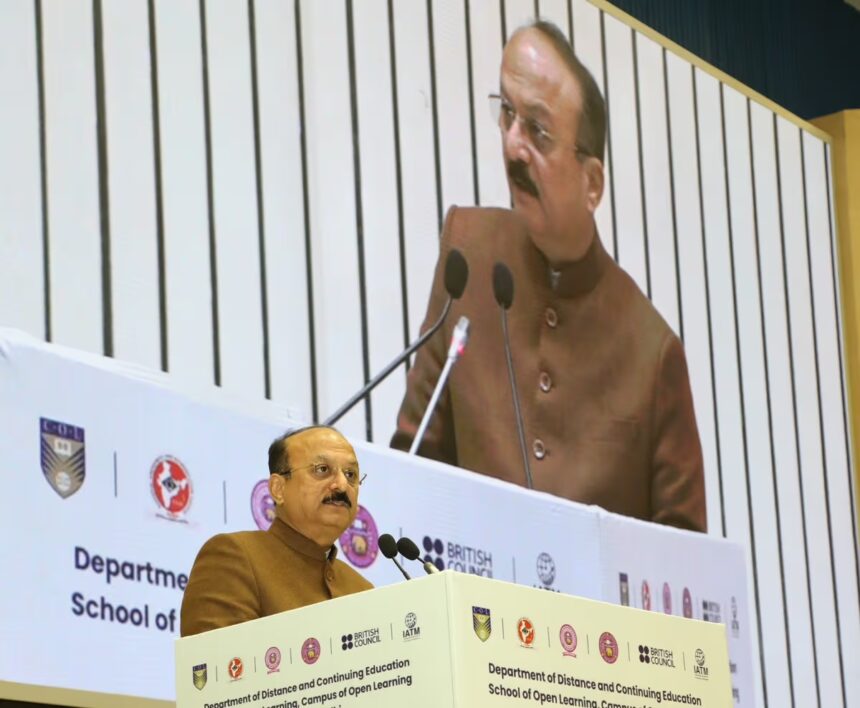
Addressing the international gathering, Delhi’s Minister for Education, Ashish Sood, reiterated the Delhi Government’s commitment to building a human-centric, inclusive and ethical digital education ecosystem. He welcomed representatives from global institutions including the British Council, the International Council for Open and Distance Education (ICDE), the Commonwealth of Learning, vice chancellors of various universities, faculty members and students.
The Education Minister said that education today carries a national responsibility where policy meets philosophy and technology must remain aligned with humanity. He cautioned that while technology can assist learning, wisdom and meaning come from human experience. “Knowledge without responsibility is incomplete, and power without wisdom is dangerous. Every idea discussed here must serve the nation,” he said.
Highlighting the realities of digital education, Sood pointed out that millions of students face challenges such as unstable internet connectivity, shared digital devices and real-life constraints. He said the government’s responsibility is to ensure that learning remains continuous, meaningful and dignified for every learner, regardless of circumstance.
Referring to the National Education Policy (NEP) 2020, Sood described it as a civilisational correction rather than merely a policy document. He said the NEP shifts education from rote learning to critical thinking, from credentials to capabilities, and from access to agency. He also noted that India’s tradition of open education dates back thousands of years through the spirit of ‘Vidya Daan’.
The Education Minister highlighted that the Delhi Government has allocated ₹19,291 crore to education in the Delhi Budget 2025–26. This includes the establishment of 175 new computer laboratories, the upgradation of 7,000 classrooms into modern learning spaces, and the setting up of 100 Dr A.P.J. Abdul Kalam Language Laboratories to teach foreign languages using AI-enabled tools.
He further emphasised the government’s focus on teacher dignity, strong learning foundations, institutional capacity building, zero-waste campuses and the integration of green and circular economy principles in education. He stressed that while infrastructure alone does not educate children, inadequate infrastructure discourages learning and must be addressed.
Calling upon global institutions to collaborate, Sood urged collective action to bridge the digital divide, ensure academic integrity in the age of artificial intelligence and prevent technology from isolating learners. “We must raise thinkers who use machines, not thinkers replaced by them,” he said.
Vice Chancellor of the University of Delhi, Prof. Yogesh Singh, highlighted the strategic role of digital innovation and blended learning in expanding access to higher education and promoting lifelong learning. He underlined the university’s initiatives to strengthen teaching, assessment and learner services across multiple modes of education.
The conference is expected to serve as a significant platform for global collaboration and knowledge-sharing, contributing to India’s vision of Viksit Bharat 2047.