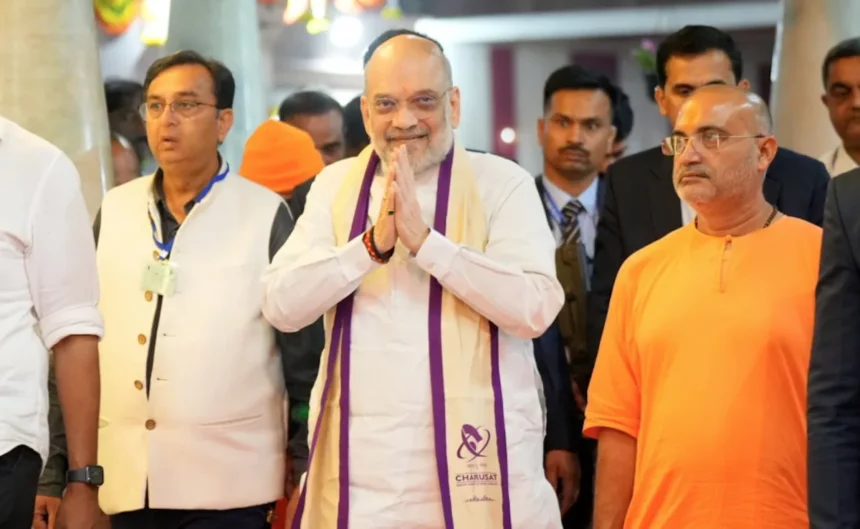
Union Home Minister Amit Shah’s arrival in Dibrugarh late on January 29 marked the beginning of a tightly scheduled two-day visit to Assam, underscoring the Centre’s focus on infrastructure expansion, sports development, wildlife conservation and cultural engagement in the state at a politically significant moment ahead of the upcoming Assembly elections.
Amit Shah was received at the airport by Assam Chief Minister Himanta Biswa Sarma, who personally oversaw preparations for the minister’s engagements through the night. The visit, concentrated largely in Upper Assam, combines high-value development announcements with public outreach and political consultations, reflecting both governance priorities and the broader electoral context in which the tour is taking place.
Major Infrastructure and Development Projects Take Centre Stage
A central highlight of the visit is the foundation stone laying ceremony for the second Assam Legislative Assembly complex in Dibrugarh, scheduled for January 30 at 11 am. The project, with an estimated cost of ₹284 crore, is envisioned as a major institutional expansion that will strengthen Dibrugarh’s role as a key administrative hub in Upper Assam. According to officials from the Directorate of Information and Public Relations, the new complex will comprise a modern Assembly building, a dedicated MLA hostel, an 800-seat auditorium and barracks with a capacity to accommodate 400 personnel. The project is expected to be completed within a 30-month timeframe, reflecting the state government’s emphasis on time-bound execution of large infrastructure initiatives.
The decision to locate a second Assembly complex in Dibrugarh is being viewed as both a functional and symbolic move. Functionally, it is aimed at easing administrative pressure on existing facilities and improving accessibility for legislators and officials from Upper Assam. Symbolically, it reinforces the government’s stated intent to promote balanced regional development by decentralising key institutions beyond Dispur and Guwahati.
Alongside legislative infrastructure, sports development features prominently in Amit Shah’s itinerary. He is scheduled to inaugurate the first phase of a modern multi-disciplinary sports complex in Dibrugarh, constructed at a cost of ₹238 crore. The complex includes a wide range of facilities such as an indoor stadium, a swimming pool, a football field, courts for tennis, volleyball and basketball, residential hostels and a main spectator gallery. State officials have described the project as a significant step towards creating world-class sports infrastructure in Upper Assam and nurturing local talent across multiple disciplines.
In addition to inaugurating the first phase, Amit Shah will also lay the foundation stone for the second phase of the sports complex, which involves an additional investment of ₹209 crore. This phase is set to substantially expand the facility’s scale and capacity, adding seating for nearly 30,000 spectators, a central playground, an athletic track and lifts to improve accessibility. Together, the two phases are expected to transform the complex into one of the largest sports hubs in the region, capable of hosting major state-level and national sporting events.
Another major announcement during the visit is the launch of the Institute of Wildlife Health and Research at Dinjan. The institute is designed to strengthen Assam’s capacity in wildlife research, disease diagnosis and scientific policy support, particularly critical in a state that is home to diverse ecosystems and iconic species such as the one-horned rhinoceros and Asian elephant. Officials have said the institute will play a key role in addressing emerging challenges related to wildlife health, zoonotic diseases and conservation management, while also supporting evidence-based policymaking.
Amit Shah is also set to virtually inaugurate projects aimed at the restoration and rejuvenation of wetlands across Assam under the National Disaster Mitigation Fund scheme. These initiatives are intended to address multiple concerns simultaneously, including flood mitigation, biodiversity conservation and sustainable livelihoods for communities dependent on wetland ecosystems. The emphasis on wetlands reflects a growing recognition of their role in climate resilience, particularly in a flood-prone state like Assam.
All major programmes in Dibrugarh are being held at the Khanikar Parade Ground, where Amit Shah is also scheduled to address a large public rally after unveiling the various projects. The rally is expected to serve as a platform for highlighting the Centre’s development agenda in Assam and reiterating commitments made to the region over the past several years.
Cultural Engagement and Political Context Ahead of State Elections
Beyond infrastructure and development, Amit Shah’s visit also places a strong emphasis on cultural engagement, particularly with indigenous communities in Upper Assam. Following his programmes in Dibrugarh, he is scheduled to travel to Dhemaji district to attend the Takam Mising Porin Kebang Youth Festival as the chief guest. The festival is a significant cultural event for the Mising community, one of the largest indigenous groups in Assam, and Amit Shah’s participation is being seen as an effort to engage directly with community traditions, youth and cultural institutions.
Such engagements have become a recurring feature of high-level visits to the Northeast, reflecting a broader strategy of combining development initiatives with cultural outreach. By attending the festival, Amit Shah is expected to signal the government’s recognition of the cultural identity and aspirations of indigenous communities, while also reinforcing political messaging around inclusion and regional representation.
Later in the evening, Amit Shah is scheduled to visit the Bharatiya Janata Party’s Assam headquarters in Guwahati, where he will hold discussions with senior party leaders on the state’s political situation. These meetings are particularly significant given that elections to Assam’s 126-member Legislative Assembly are expected to be held in March–April. While the official focus of the visit is on governance and development, its political undertones are evident, especially as the BJP prepares to defend its position in the state.
Union Minister Sarbananda Sonowal and several other senior BJP leaders are accompanying Amit Shah during the visit, underscoring its importance within the party’s broader organisational and electoral strategy. The presence of top leadership is also aimed at projecting unity and momentum as the party gears up for the upcoming polls.
This is Amit Shah’s second visit to Assam since December 29 last year, when he undertook a one-day tour to launch multiple government projects. The frequency of his visits has been interpreted as an indication of the state’s strategic importance within the BJP’s national framework, as well as the Centre’s intent to maintain a strong development narrative in the run-up to elections.
Taken together, the visit reflects a multi-layered approach that blends infrastructure expansion, sector-specific investments in sports and wildlife research, cultural engagement with indigenous communities and behind-the-scenes political consultations. By anchoring the visit in Upper Assam and Dibrugarh, the government appears to be emphasising regional balance while also reinforcing its development credentials at a crucial political juncture.