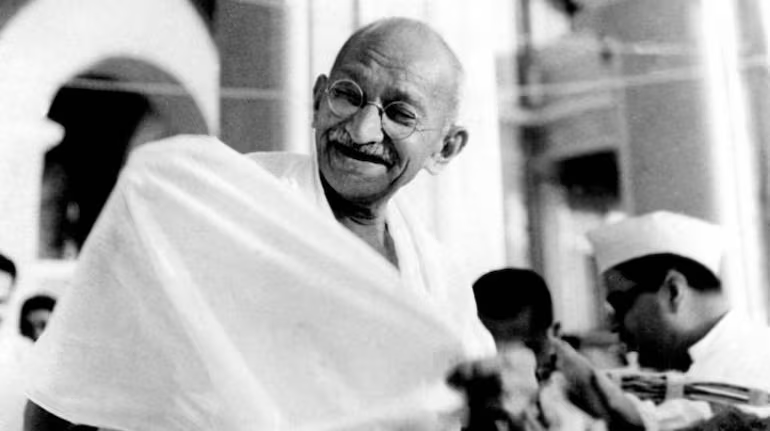
On January 30, 2026, India observes Gandhi Samaadhi, marking the 78th anniversary of Mahatma Gandhi’s martyrdom, a day that invites the nation to pause, remember and reflect on the enduring values of truth, non-violence and moral courage that continue to shape India’s conscience and global identity.
Every year, January 30 stands apart in India’s national calendar as Martyrs’ Day, also known as Shaheed Diwas. It is a day marked not by celebration, but by solemn remembrance and quiet introspection. The assassination of Mahatma Gandhi on this date in 1948 was not merely the loss of a leader but a moment that deeply shook the moral foundation of a newly independent nation. In 2026, as India commemorates the 78th anniversary of that tragic evening, Gandhi Samaadhi once again becomes a focal point for national unity, ethical reflection and collective remembrance in a world that often seems increasingly fragmented.
Gandhi’s life and death remain inseparable from the idea of India itself. His principles of Satya and Ahimsa were not abstract philosophies but lived practices that guided one of the most remarkable freedom movements in history. As India observes Gandhi Samaadhi in 2026, the occasion carries renewed relevance, not only as a tribute to the Father of the Nation but also as an opportunity to reassess the values that define public life, governance and personal conduct in the present era.
National Observance at Raj Ghat and the Spirit of Collective Remembrance
The heart of the national observance on Gandhi Samaadhi lies at Raj Ghat in New Delhi, the serene black marble memorial that marks the cremation site of Mahatma Gandhi. Each year, the simplicity of Raj Ghat reflects the simplicity that Gandhi himself embodied throughout his life. Inscribed with his last words, “Hey Ram,” the memorial becomes a place where history, emotion and moral reflection converge.
On the morning of January 30, 2026, the nation’s highest constitutional authorities are expected to assemble at Raj Ghat to pay homage. The President, Vice President, Prime Minister and senior leaders from across the political spectrum traditionally gather to offer floral tributes and bow their heads in silent respect. Chiefs of the armed forces also participate, underscoring the universal respect accorded to Gandhi across institutions and ideologies. The ceremony is marked by restraint and dignity, mirroring the values that Gandhi stood for.
Beyond Raj Ghat, the observance of Martyrs’ Day extends across the length and breadth of the country. At 11:00 a.m., a two-minute silence is observed nationwide. Traffic comes to a halt, public offices pause their work, schools and colleges stand still, and homes fall quiet. This collective silence is one of the most powerful aspects of Gandhi Samaadhi, transforming a vast and diverse nation into a single moment of shared reflection. It is a reminder that Gandhi’s sacrifice was not his alone, but part of a larger struggle that claimed countless lives in the pursuit of freedom.
Educational institutions play a significant role in keeping the spirit of the day alive. Schools and universities organise prayer meetings, readings from Gandhi’s writings and discussions on his relevance in contemporary society. Cultural programmes, bhajans and recitations of Gandhian thought help younger generations connect with a legacy that might otherwise feel distant in an age dominated by technology and rapid change. Museums and memorials associated with Gandhi, including Mani Bhavan in Mumbai, observe the day with special remembrance programmes that draw citizens into Gandhi’s personal journey and public life.
Gandhi Samaadhi is also a moment when the nation reflects on the broader meaning of martyrdom. While the day centres on Gandhi, it honours all those who sacrificed their lives for India’s freedom and democratic values. The observance thus transcends individual remembrance and becomes a reaffirmation of the ideals upon which the nation was built. In a time when public discourse is often polarised, Martyrs’ Day offers a rare moment of consensus rooted in shared history and collective gratitude.
The Legacy of January 30, 1948 and Gandhi’s Enduring Relevance
The events of January 30, 1948, remain etched in India’s collective memory. On that evening, Mahatma Gandhi was assassinated at Birla House in New Delhi, just months after India had gained independence. The shock of his death reverberated across the country and the world, leaving behind a profound sense of loss and disbelief. Gandhi’s martyrdom was not only a personal tragedy but a symbolic rupture at a moment when the nation was still grappling with the challenges of Partition, violence and rebuilding.
Gandhi’s assassination marked the end of a life dedicated to moral experimentation and public service. He had demonstrated that political resistance need not rely on violence, that ethical means were as important as political ends, and that individual discipline could become a force for mass transformation. His death elevated these ideas from principles to moral imperatives, challenging future generations to live up to the standards he set.
The influence of Gandhi’s philosophy has extended far beyond India’s borders. Leaders and movements across the world have drawn inspiration from his methods of non-violent resistance and civil disobedience. From the American civil rights movement to struggles against apartheid in South Africa, Gandhi’s ideas found new expression in different cultural and political contexts. His insistence on moral consistency, empathy for the oppressed and courage in the face of injustice continues to resonate globally.
In contemporary times, Gandhi Samaadhi invites reflection on how these ideals apply to modern challenges. The world today faces conflicts, social divisions, environmental crises and a pervasive sense of anxiety driven by speed and competition. Against this backdrop, Gandhi’s emphasis on patience, restraint and inner discipline appears both countercultural and urgently necessary. His belief that lasting change begins with self-transformation offers a powerful lens through which to examine personal and collective choices.
Beyond public ceremonies, Gandhi Samaadhi also encourages personal introspection. Many individuals observe the day by adopting simple practices inspired by Gandhi’s life. Moments of silence, prayer or meditation allow people to step back from daily routines and reconnect with a sense of purpose. Reading Gandhi’s words often reveals their continued relevance, whether in reflections on harmony between thought, speech and action or his insistence that means must justify ends.
Acts of selfless service, however small, are another way in which Gandhi’s legacy is kept alive. Helping a neighbour, contributing to a social cause or extending compassion to those in need reflects Gandhi’s belief that service is a form of spiritual strength. Such gestures transform remembrance into action, ensuring that Gandhi Samaadhi is not confined to symbolism but expressed through everyday conduct.
The relevance of Gandhi Samaadhi in 2026 is also shaped by the nature of public life in the digital age. Instant communication and constant connectivity often leave little room for reflection. In this context, a day dedicated to silence, restraint and moral inquiry serves as a necessary counterbalance. It reminds society that progress is not measured solely by speed or scale but by the ethical foundations upon which it rests.
Spiritual thinkers and social commentators often note that observances like Gandhi Samaadhi encourage a shift from external ambition to internal order. By focusing on values such as non-violence, truth and compassion, the day subtly challenges individuals and institutions to re-evaluate priorities. It underscores the idea that strength lies not in domination but in self-control, not in aggression but in understanding.
As India marks Gandhi Samaadhi in 2026, the observance stands as more than a ritual of remembrance. It functions as a moral checkpoint, urging the nation to ask difficult questions about justice, coexistence and responsibility. Gandhi’s life offers no easy answers, but it provides a framework grounded in conscience and courage. In remembering his martyrdom, the nation is reminded that freedom carries with it an ongoing obligation to uphold the values for which it was won, and that the true measure of progress lies in the ability to remain humane in an increasingly complex world.