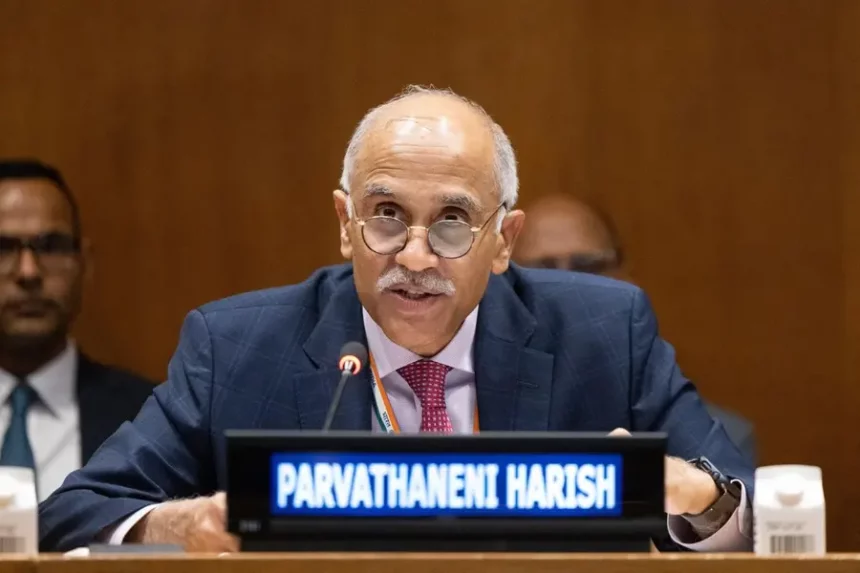
In a powerful call for peace amid one of the most severe humanitarian crises in Gaza, India has urged the global community to pursue purposeful dialogue and diplomacy, reiterating its unwavering support for a two-state solution to resolve the Israel-Palestine conflict. This statement was delivered by Ambassador Parvathaneni Harish, India’s Permanent Representative to the United Nations, during a high-level conference aimed at promoting peaceful settlement in the region. His speech comes at a time when Gaza continues to suffer extensive damage, civilian casualties, and looming famine due to the ongoing conflict.
India’s statement underscored the need to move beyond rhetoric and embrace actionable solutions that genuinely impact the lives of Palestinians. Ambassador Harish highlighted the gravity of the crisis, noting the extensive loss of life, destruction of critical infrastructure, and the deepening plight of Gaza’s civilian population.
Urgent Need for Humanitarian Relief and Ceasefire
India’s appeal was rooted in the immediate necessity to end the violence and open channels for unhindered humanitarian assistance. Harish emphasized that India believes humanitarian aid must remain separate from politics or military agendas. He stressed the need for urgent access to food, medical supplies, fuel, and basic resources for Palestinians, particularly those trapped in war-hit areas of Gaza.
“Children have not attended school for over 20 months. Tens of thousands have died. Hospitals have been destroyed. The situation is heartbreaking,” said Harish, painting a grim picture of the human suffering that continues to unfold. He reiterated India’s consistent stand that an immediate ceasefire, release of all hostages, and uninterrupted humanitarian access were non-negotiable steps toward stability.
India also called on all stakeholders, including Israel, to uphold international humanitarian law. While recognizing Israel’s right to defend itself from terrorist attacks, the Indian envoy maintained that civilian lives must be protected and infrastructure essential to survival must not be targeted. This careful diplomatic stance continues India’s delicate balancing act between its deepening strategic ties with Israel and its historic support for Palestinian rights.
Commitment to Two-State Solution and Diplomatic Engagement
Ambassador Harish stated that India’s position has always favored a negotiated two-state solution that guarantees the establishment of a sovereign, viable, and independent Palestinian state living peacefully alongside Israel within secure and recognized borders. He said the way forward must include genuine diplomatic engagement between both sides.
“Bringing the parties directly into dialogue is essential,” Harish said, highlighting the futility of external discussions that fail to involve the actual stakeholders. He insisted that paper resolutions and symbolic commitments would not be enough. Instead, real progress depends on implementing practical measures that reflect the aspirations and dignity of the Palestinian people.
India has also voted in favor of a UN General Assembly resolution supporting the convening of an international summit in 2025 to deliberate on the implementation of the two-state formula. This further illustrates its proactive stance in shaping a peaceful resolution through multilateral cooperation.
Beyond speeches and votes, India pledged its readiness to play a constructive role in diplomatic efforts and peace-building initiatives. Harish emphasized that any credible peace process must not only address immediate security concerns but also restore a sense of justice and human dignity to those affected by decades of conflict.
The Ministry of External Affairs reaffirmed this position domestically, stating in Parliament that India’s policy consistently promotes peaceful coexistence through a negotiated settlement based on mutual respect, international law, and historical legitimacy. India also reiterated its historical bond with the Palestinian people, affirming that its support remains deeply rooted and unchanged.
Through this carefully crafted message at the United Nations, India has reinforced its role as a responsible global actor, advocating a fair, balanced, and humane resolution to one of the world’s most protracted conflicts.