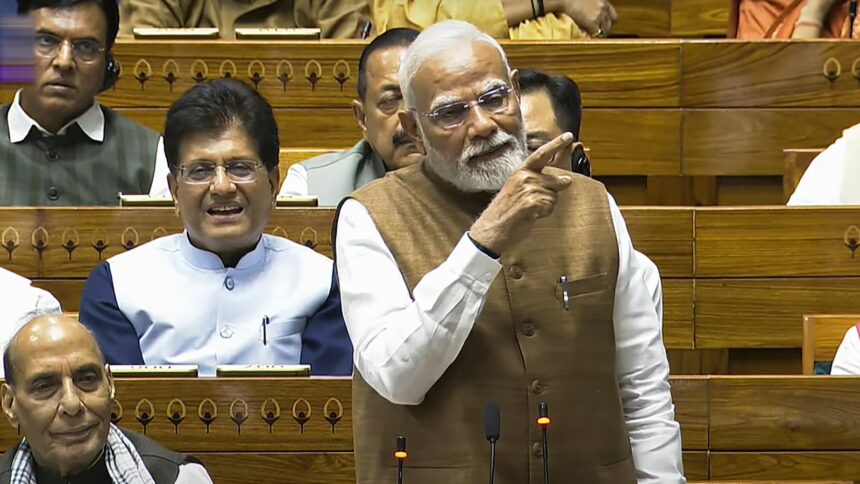
Prime Minister Narendra Modi delivered a strongly-worded address in the Lok Sabha, responding to the opposition’s skepticism over “Operation Sindoor”—India’s retaliatory military operation following the deadly terror attack in Pahalgam that claimed 26 lives. Speaking passionately during the monsoon session, PM Modi accused the Congress of undermining the armed forces and refusing to stand with the nation during moments of crisis. The speech, filled with sharp rebukes, patriotic undertones, and personal reflections, framed a narrative of India as a nation standing strong against terror while battling internal political cynicism.
PM Modi began by acknowledging the severity of the Pahalgam terror attack, calling it a deliberate and barbaric attempt to provoke communal tension. He noted that the terrorists had specifically asked for the religion of victims before executing them, describing it as a calculated move to incite riots. He credited the people of India for resisting such provocations and remaining united during the difficult time.
Operation Sindoor and National Security
PM Modi emphasized that India’s military action, codenamed “Operation Sindoor,” was swift and precise. He revealed that Indian forces carried out targeted strikes within 22 minutes of the terror attack, inflicting significant damage to Pakistani military assets and terror camps. According to the Prime Minister, key terror hubs in Bahawalpur and Muridke were completely destroyed, demonstrating India’s enhanced technical and strategic capabilities.
He also shared that Pakistan had begun issuing nuclear threats immediately after the Pahalgam attack, anticipating a strong Indian response. However, PM Modi asserted that India had shattered the illusion of nuclear blackmail. “India has proved that nuclear blackmailing will not work anymore,” he declared, adding that many Pakistani airbases remain incapacitated even now.
The Prime Minister said the strikes sent a strong message, both to Pakistan and the international community, that India will not hesitate to defend itself and dismantle terror infrastructures regardless of where they are located. He said this action marked a “new normal” in India’s defense posture—one of assertiveness, clarity, and strategic depth.
Opposition’s Response and Political Rhetoric
PM Modi reserved his sharpest criticism for the Congress party. He accused them of questioning the validity and intent of the armed forces’ operations. “First, they refused to accept that Operation Sindoor even happened. Now they are asking why it was stopped,” he said, calling the behavior disrespectful and dangerous.
PM Modi mocked the Congress for its repeated attempts to find fault with military decisions, referencing their earlier skepticism during the surgical and air strikes in previous years. He said, “Terrorists are crying, their masterminds are crying, and seeing them cry, some people here are crying too.”
He highlighted how Congress leaders began questioning his leadership just days after the attack, using rhetoric like “Where is the 56-inch chest now?” PM Modi criticized such remarks as political opportunism, accusing the opposition of using national tragedies for electoral gain.
Reclaiming Historical Narratives and Policy Critique
PM Modi also reflected on historical events, such as the 1971 war, saying that India missed a strategic opportunity to reclaim Pakistan-occupied Kashmir (PoK) despite capturing over 1,000 Pakistani soldiers. He blamed a lack of vision and political will during earlier Congress regimes for missing this chance.
Further, he criticized the Indus Waters Treaty signed in 1961, stating that 80% of the water was given to Pakistan, leaving Indian farmers short-changed. He questioned the diplomatic judgment of then Prime Minister Jawaharlal Nehru and said it set a precedent of compromising national interests.
In an emotional tone, PM Modi stressed the importance of aligning political disagreements with national interests. “We may not see eye to eye on party interests, but our hearts must come together for the good of the nation,” he urged.
Global Diplomacy and Strategic Communications
PM Modi spoke about his interaction with U.S. Vice President JD Vance on May 9, revealing that the latter had tried contacting him urgently following intelligence of a potential Pakistani counterstrike. PM Modi said he assured Vance that India was prepared and any aggression would be met with decisive consequences.
He also praised the efforts of Indian delegations that visited other countries to present evidence of Pakistan’s terror links. He called this act a reflection of “Sindoor spirit” — a term he coined to describe India’s unified resolve and moral authority.
Make in India and Defense Capabilities
The Prime Minister hailed India’s evolving defense capabilities, pointing to the success of domestically made weapons and technologies used during Operation Sindoor. He credited the young engineers and defense personnel working in private sectors for their contribution to national security.
He detailed how India’s air defense systems successfully neutralized nearly 1,000 drones and missiles launched by Pakistan during retaliatory strikes. PM Modi added that many of the weapons used were manufactured under the “Make in India” initiative, which he said had come of age in this mission.
He lamented that India’s defense manufacturing sector had been deliberately weakened post-independence and reiterated his government’s commitment to building a self-reliant military-industrial complex.
National Unity Over Partisan Interests
Ending on a poetic and emotional note, PM Modi appealed for unity in matters of national security. He spoke of the symbolism of “sindoor,” representing both sacrifice and strength. “Debate intensely, challenge each other politically, but never question the dignity of a soldier or a mother’s sindoor,” he said.
Through this fiery yet resolute speech, Prime Minister Narendra Modi aimed to not only defend the legitimacy and success of Operation Sindoor but also draw a stark contrast between his government’s approach to national security and what he portrayed as the Congress party’s chronic indecisiveness and lack of commitment to India’s sovereignty.