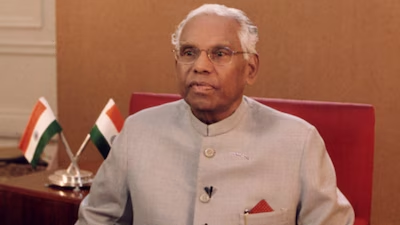
In the annals of Indian democracy, elections often come with their own tales of drama, deviation, and human stories behind the numbers. As India approaches its 17th Vice Presidential election in 2025, a look back at the 1992 election reminds us that even a single vote can rewrite what might have been an unopposed outcome. That year, KR Narayanan, the ruling Congress party’s candidate, appeared poised to be elected without contest. But an unexpected nomination from an eccentric serial candidate, Kaka Joginder Singh, ensured a contest, turning what could’ve been a quiet transition into a memorable anecdote in India’s political journey.
Out of the 16 Vice Presidential elections held till now, only four have seen candidates elected unopposed. These occurred in 1952, 1957, 1979, and 1987. The 1992 election was on track to join that exclusive club until Singh, also known as “Dharti Pakad,” stepped in. Famous for filing nominations in hundreds of elections across the country, Singh rarely campaigned and never won. But by merely being on the ballot, he ensured that Narayanan would not be elected without a contest.
The 1992 Vice Presidential Election: One Vote and a Record Margin
The 1992 Vice Presidential election saw only two candidates: KR Narayanan and Kaka Joginder Singh. Of the 790 electors, 711 turned out to vote, a commendable participation rate of 90 percent. Out of the total, 10 votes were declared invalid, resulting in 701 valid votes.
Narayanan won by a landslide, securing 700 out of the 701 valid votes. Singh received just one vote, likely his own. Despite the overwhelming victory, Narayanan could not claim an uncontested election, solely due to Singh’s nomination. That solitary vote gave the election a unique place in history: the largest margin of victory in Vice Presidential elections, yet technically contested.
Singh’s candidacy, while not politically threatening, served as a potent reminder of how democratic space in India allows even the most unusual contenders to participate. Often described as a symbol of grassroots participation, Singh reportedly contested over 300 elections in his lifetime, never winning but always showing up—from local panchayat elections to the presidency. He passed away in 1998, but his legacy lives on as a footnote that altered the course of one of India’s highest constitutional elections.
A Glimpse Into the 2025 Vice Presidential Polls
The upcoming 2025 Vice Presidential election is already under public scrutiny following the sudden resignation of Vice President Jagdeep Dhankhar. With the post now vacant, the Election Commission of India has taken steps to educate the electorate and the general public about the significance and process of the election.
In an effort to make the intricate constitutional framework more accessible, the Election Commission has published a booklet titled “Election to the Office of Vice-President of India, 2025.” This guide outlines every major aspect of the election process, from eligibility requirements and nomination rules to voting procedures and dispute resolution mechanisms.
It emphasizes that, unlike general elections to the Lok Sabha or State Assemblies, the Vice Presidential election is unique in terms of its electorate, which consists solely of members from both houses of Parliament. The method of voting follows a system of proportional representation through a single transferable vote, ensuring fair representation for all political voices.
Tracing the Journey of India’s Vice Presidential Elections
Since the first Vice Presidential election in 1952, India has witnessed a diverse range of contests, from unopposed wins to multi-cornered battles. Sarvepalli Radhakrishnan, who went on to become President, was elected unopposed in both 1952 and 1957. In 1952, the only other nomination was disqualified, clearing the path for Radhakrishnan’s unchallenged ascent.
The first actual contest took place in 1962, when Dr Zakir Hussain defeated NC Samantsinhar with a margin of 554 votes, then the highest until KR Narayanan’s landslide in 1992. The 1967 election saw VV Giri win, only for him to resign two years later to contest the Presidential election. That year, the Vice Presidential election drew six candidates—the highest in any VP poll—with GS Pathak emerging victorious.
In 1979, Mohammad Hidayatullah was elected unopposed. The 1987 poll echoed a similar narrative when 27 nominations were filed, but only one—that of Dr Shankar Dayal Sharma—was deemed valid after scrutiny. It marked the last uncontested Vice Presidential election in India’s history.
Since 2012, each Vice Presidential election has been a straightforward two-person contest, showing a pattern of minimal but consistent competition. As India gears up for its 17th such election, all eyes will be on whether history repeats itself in the form of another overwhelming victory or a surprise turn from an unexpected candidate.
The legacy of India’s Vice Presidential elections is rich with both symbolism and substance. From towering intellectuals to unlikely challengers like Joginder Singh, each has contributed to the democratic narrative in their own way. As the 2025 election approaches, voters and legislators alike are reminded that in Indian democracy, every candidate and every vote has the potential to make history.