New Delhi, 17 January 2026
“Forgetting one’s history not only weakens democracy but also erodes moral direction. History is not merely a record of the past; it is the foundation of democratic institutions, public consciousness, and national character. Reviving the legacy of Veer Vitthalbhai Patel is therefore not an academic exercise, but a democratic responsibility,” said Harivansh Narayan Singh, Deputy Chairman of the Rajya Sabha, while addressing a seminar at the World Book Fair held at Bharat Mandapam, Pragati Maidan, New Delhi.
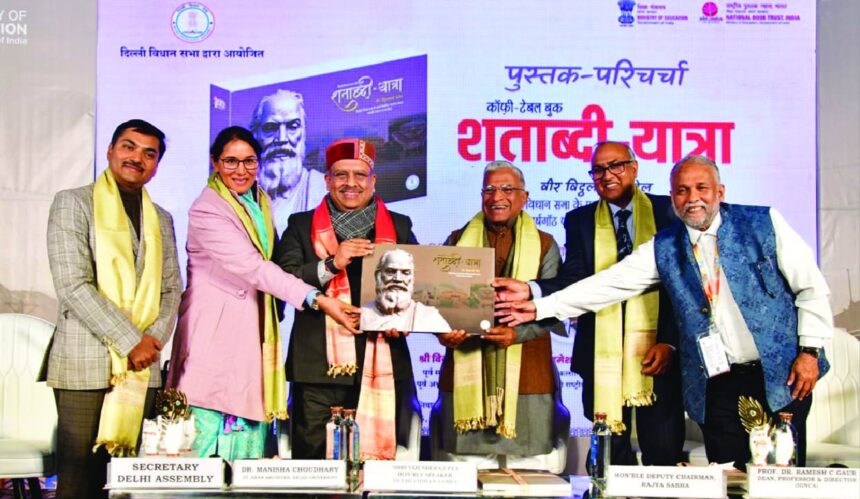
The seminar was organised by the Delhi Legislative Assembly Secretariat on the coffee table book Veer Vitthalbhai Patel: A Glorious Saga – A Centenary Journey. The event was attended by Vijender Gupta, Speaker of the Delhi Legislative Assembly, former Rajya Sabha member and former ICCR Chairperson Vinay Sahasrabuddhe, Prof. Ramesh Chandra Gaur, Chairperson of the Kala Nidhi Trust, Indira Gandhi National Centre for the Arts, Associate Professor Manisha Chaudhary from the Department of History, University of Delhi, along with academicians, historians, students and a large number of citizens.
Speaking on the occasion, Harivansh Narayan Singh praised the efforts of the Delhi Legislative Assembly Secretariat to revive a relatively forgotten but crucial chapter of India’s freedom struggle. He described the publication as an authentic and vivid document of a decisive period in Indian history. Referring to the period of the Rowlatt Act, he said that Veer Vitthalbhai Patel introduced more than 220 amendments in the Legislative Council and became its first Indian President. He highlighted how principled legislative action can strengthen democratic values and public awareness. He also recalled Patel’s personal integrity, his refusal to compromise with colonial authority, his guidance to Netaji Subhas Chandra Bose, and his decision to dedicate his will and resources to the freedom movement.
In his address, Speaker Vijender Gupta said that the period from 1912 to 1933 represented the most decisive phase of India’s freedom movement, culminating with the demise of Vitthalbhai Patel on 22 October 1933. He described Patel as a revolutionary, freedom fighter and legislative leader who laid the institutional foundations of India’s parliamentary democracy. He noted that Patel mentored leaders such as Sardar Vallabhbhai Patel and Netaji Subhas Chandra Bose, who later emerged as architects of independent India. Gupta emphasised that the publication is intended not only for academic circles but also for the general public, and to this end, a QR code was launched during the programme to broaden public access.
The Speaker further stated that active efforts are being made to develop the Delhi Legislative Assembly complex as a cultural and heritage site. The objective, he said, is to enable future generations to meaningfully engage with India’s legislative history, democratic traditions and the freedom struggle.
Former Rajya Sabha member and former ICCR Chairperson Vinay Sahasrabuddhe observed that democratic traditions are strengthened through serious discourse on history and institutions. Referring to the Prime Minister’s statement that India is the mother of democracy, he said leaders like Veer Vitthalbhai Patel shaped the country’s legislative and democratic consciousness. Congratulating the Assembly Speaker on the centenary journey initiative, he remarked that the effort goes beyond remembrance and reintroduces enduring inspiration for contemporary society. He also stressed the need to include such themes in academic curricula to connect young people with democratic values.
Prof. Ramesh Chandra Gaur said that the Delhi Assembly building should not be viewed merely as a colonial-era structure, but as a living site of democratic consciousness and national awakening. He emphasised the need to engage young audiences through interpretation centres, museums, archives, digital repositories, and light-and-sound shows.
Associate Professor Manisha Chaudhary described the publication as far more than a conventional coffee table book. She noted that it includes rare photographs along with in-depth archival research, genealogical details, private correspondence, financial records and legislative proceedings. She highlighted Veer Vitthalbhai Patel’s financial transparency, public ethics and unwavering commitment to the nation.
During the seminar, a documentary titled Veer Vitthalbhai Patel: A Glorious Saga, narrated in the voice of Anupam Kher, was screened and received an enthusiastic response from the audience. The QR code for wider public access to the book was also formally launched.
The seminar and publication represent a sustained institutional effort by the Delhi Legislative Assembly to preserve and promote India’s democratic and legislative heritage. The initiative seeks to restore foundational figures like Veer Vitthalbhai Patel to their rightful place in the nation’s collective memory and to inspire present and future generations towards informed and active democratic participation.