New 47 km Metro Network to Be Laid at a Cost of ₹14,630 Crore, Government Releases Funds
Clearance for New Metro Lines from Rithala to Kundli, Lajpat Nagar to Saket, Inderlok to Indraprastha
Metro Expansion to Reduce Traffic Congestion and Pollution, Delhi to Become More Modern: CM Rekha Gupta
New Delhi, 18 January 2026
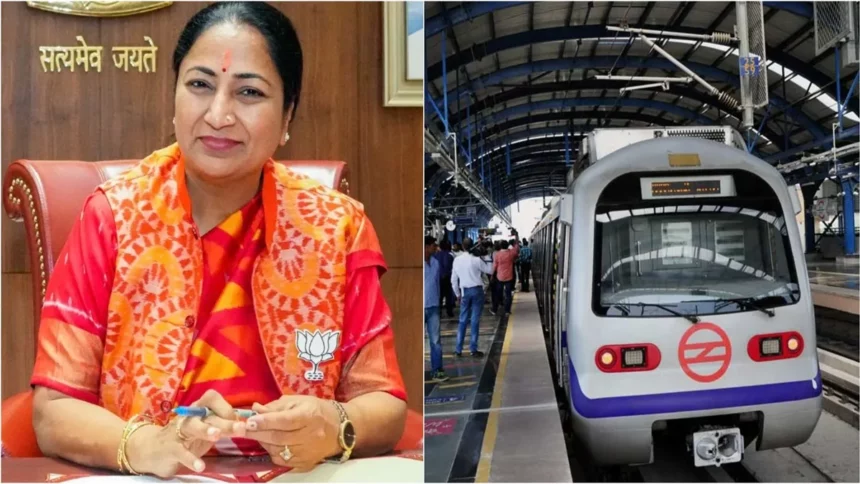
Under the leadership of Delhi Chief Minister Rekha Gupta, the Delhi Government has taken a major decision to further expand the metro network in the national capital. The government has released its share of funds for the remaining three corridors of Phase-IV of the Delhi Metro Rail Transit System. According to the Chief Minister, these projects will significantly improve metro connectivity across various parts of Delhi and further strengthen the public transport system. The completion of these corridors is expected within four years. Improved metro operations will also play an important role in controlling pollution in the city.
The decision marks a crucial step in accelerating long-pending metro expansion plans and reflects the government’s commitment to developing a modern, efficient, and sustainable urban transport network. With the release of funds, the remaining Phase-IV corridors are now set to move forward at an accelerated pace.
Total Length 47.225 Kilometres
The three Phase-IV metro corridors together will have a total length of 47.225 kilometres. The total estimated cost of these projects is ₹14,630.80 crore. Out of this amount, the Delhi Government will bear a share of ₹3,386.18 crore. The remaining cost will be funded through the approved financial structure involving multiple stakeholders.
The scale of investment underlines the importance of metro expansion in meeting Delhi’s growing transportation needs. The extended network is expected to cater to increasing commuter demand while easing pressure on road-based transport systems.
Three Metro Corridors Approved Under Phase-IV
The Chief Minister stated that the first corridor under Phase-IV will run from Lajpat Nagar to Saket G-Block. This corridor will have a length of 8.385 kilometres and will include eight elevated metro stations. The second corridor is proposed from Inderlok to Indraprastha, with a total length of 12.377 kilometres. This line will have a total of ten stations, including one elevated station and nine underground stations.
The Inderlok–Indraprastha corridor has been included in a combined financial framework along with the Lajpat Nagar–Saket G-Block corridor. The combined project cost of these two corridors is ₹8,399.81 crore, out of which the Delhi Government’s share will be ₹1,987.86 crore.
The third and longest corridor under Phase-IV will run from Rithala to Kundli, extending metro connectivity to the neighbouring state of Haryana. This corridor will have a total length of 26.463 kilometres and will include 21 stations. The total cost of this project is estimated at ₹6,230.99 crore, with the Delhi Government contributing ₹1,398.32 crore. Of the total cost, ₹5,685.22 crore will be spent on the Delhi portion, while ₹545.77 crore will be allocated to the Haryana portion.
Relief for Residents of These Areas
The three corridors will provide improved travel facilities to residents across several parts of Delhi. The Lajpat Nagar–Saket G-Block corridor will pass through areas such as Lajpat Nagar, Andrews Ganj, Greater Kailash-1, Chirag Delhi, Pushp Bhawan, Saket District Centre, and Pushp Vihar.
The Inderlok–Indraprastha corridor will serve areas including Inderlok, Daya Basti, Sarai Rohilla, Ajmal Khan Park, Jhandewalan, Nabi Karim, New Delhi Railway Station, Delhi Gate, and Delhi Secretariat–IG Stadium.
The largest Rithala–Kundli corridor will pass through Rithala, Rohini Sector-25, Sector-26, Sector-31, Sector-32, Sector-36, Barwala, Rohini Sector-35, Sector-34, Bawana Industrial Area Phase-I (Sectors 3–4 and 1–2), Bawana JJ Colony, Sanoth, New Sanoth, Bhorgarh Village, Narela Grain Market, Narela DDA Sports Complex, Narela, Narela Sector-5, Kundli, and Nathupur.
Transport System to Get a Major Boost
The tender process for these corridors is currently underway, and basic work has already begun on some stretches. All three corridors are expected to be completed within four years. Once operational, they will provide enhanced metro connectivity to northern, central, and southern parts of Delhi, as well as key areas in the Delhi-NCR region.
The expansion will help reduce traffic congestion on roads, save commuting time for passengers, and promote the use of public transport. With better connectivity and reliable services, dependence on private vehicles is expected to decline significantly.
System Aligned With Future Needs: CM Rekha Gupta
Chief Minister Rekha Gupta stated that the three Phase-IV metro corridors will provide Delhi with a modern and robust public transport system aligned with future needs. She said the project will ensure safe, convenient, and time-bound travel for commuters, reduce dependence on private vehicles, and contribute to pollution control.
She added that the Delhi Government is consistently taking concrete steps to transform the capital into a world-class city, and the expansion of the metro network is an integral part of this commitment.