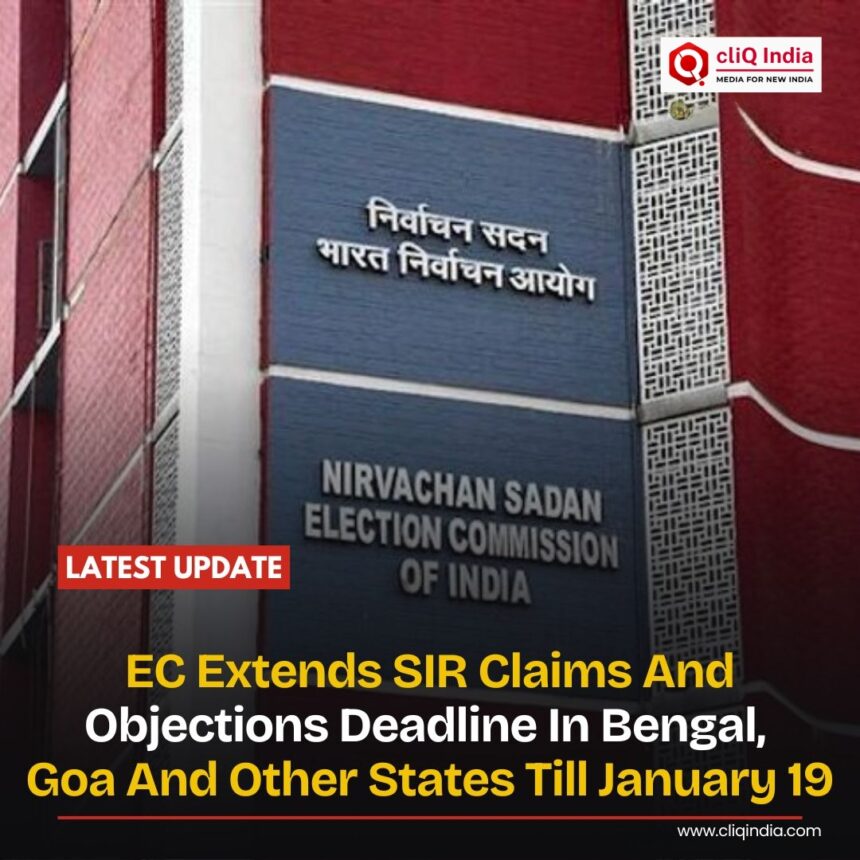
The Election Commission of India has extended the deadline for filing claims and objections under the Special Intensive Revision of electoral rolls in West Bengal, Goa, Puducherry, Lakshadweep and Rajasthan, granting voters additional time to verify and correct their details. The revised deadline of January 19, 2026, is aimed at ensuring comprehensive inclusion of all eligible voters while maintaining accuracy and transparency in the electoral rolls ahead of key assembly elections scheduled later in the year.
The decision was communicated through an official notification issued late on January 15 and updated shortly after midnight on January 16. It follows representations from chief electoral officers of the concerned states and Union Territories, who sought more time to complete the intensive verification process effectively. By allowing an extended window for claims and objections, the commission has underlined its focus on inclusivity, error correction and public confidence in the electoral process.
Extended timeline to help voters verify details and file claims accurately
The extension specifically applies to the period during which voters can submit claims for inclusion or correction and raise objections to existing entries in the electoral rolls. Eligible citizens now have additional days to check their details, submit Form 6 for inclusion as new voters, or request corrections with the required declarations. This move is particularly significant for first-time voters, migrants, and citizens whose records may require updating due to changes in address, age eligibility or clerical errors.
According to the notification, the extension builds on the earlier schedule issued on December 27, 2025, which set January 1, 2026, as the qualifying date for voter eligibility. While key milestones such as enumeration and draft roll publication had already been completed in December, the claims and objections phase was identified as requiring more flexibility. The commission noted that additional time would help avoid inadvertent exclusions and ensure that genuine voters are not left out due to procedural or logistical constraints.
Chief electoral officers in the five states and Union Territories have been directed to ensure that information about the extended deadline reaches the widest possible audience. This includes publicity through print and electronic media, social media platforms, booth level officers, and official digital channels such as the voters.eci.gov.in portal and the ECINet mobile application. The commission has emphasised that public awareness is essential for the success of the Special Intensive Revision exercise.
The directive also requires immediate publication of the extension notification in the extraordinary issues of the respective state gazettes. Copies of the notification are to be sent to the commission for record-keeping, ensuring procedural compliance and uniformity across regions. Election officials at all levels have been instructed to strictly adhere to the revised schedule so that transparency and credibility of the electoral rolls are preserved.
Special intensive revision seen as crucial ahead of upcoming assembly elections
The Special Intensive Revision is part of a broader nationwide effort to update and cleanse electoral rolls ahead of the 2026 assembly elections in several states, including West Bengal and Puducherry. The exercise is designed to include every eligible citizen while removing ineligible entries caused by factors such as migration, death, duplication or other discrepancies. Accurate electoral rolls are considered fundamental to free and fair elections, and the commission has repeatedly stressed zero tolerance for errors that could undermine voter confidence.
Earlier stages of the revision process involved house-to-house enumeration and verification, which concluded for most of the concerned states by December 11, 2025. Draft electoral rolls were published on December 16, 2025, allowing voters and political parties to review the preliminary lists. The final electoral rolls are scheduled to be published in February 2026, after all claims and objections are addressed and disposed of in accordance with the law.
The commission has urged eligible citizens, especially new voters who have recently attained the age of 18, to take advantage of the extended deadline. They can submit Form 6 either through booth level officers or online platforms, ensuring that their names are included in the final rolls. Officials have reiterated that timely participation by voters is critical to preventing last-minute disputes and ensuring smooth conduct of elections.
Political parties and civil society organisations have largely welcomed the extension, viewing it as an additional safeguard against errors in the intensive verification process. Many have argued that the complexity of large-scale revisions, especially in densely populated or highly mobile regions, necessitates flexibility in timelines. By accommodating these concerns, the commission has sought to balance administrative efficiency with democratic inclusiveness.
The extension also reflects the commission’s broader approach of responsiveness to ground-level feedback. By considering requests from state election machinery and factoring in local conditions, the ECI has demonstrated a willingness to adapt procedures to ensure better outcomes. At the same time, officials have cautioned that the revised deadline should be utilised responsibly and that all stakeholders must cooperate to complete the process within the stipulated timeframe.
As the claims and objections window remains open until January 19, the focus now shifts to effective outreach and prompt disposal of applications. Election officials will be expected to verify submissions swiftly and transparently so that the final rolls, due in February, accurately reflect the electorate. The outcome of this exercise will play a critical role in shaping the credibility of the upcoming elections and reinforcing public trust in India’s electoral system.