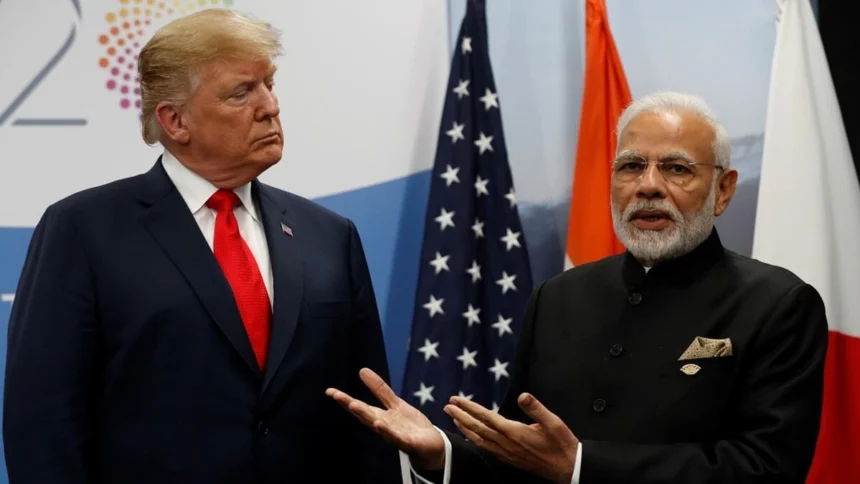
In a sharp turn of events that sent political shockwaves across India, U.S. President Donald Trump announced a 25% tariff on Indian imports along with penalties for continued trade ties with Russia. This move has ignited a wave of criticism from India’s opposition party, Congress, which blames the PM Modi government for what it calls a catastrophic failure of foreign policy and over-personalized diplomacy. Senior Congress leaders, including P. Chidambaram, Jairam Ramesh, Pawan Khera, Gaurav Gogoi, and Supriya Shrinate, have voiced strong disapproval, arguing that the PM Modi-led administration’s obsession with image and optics has undermined the nation’s strategic interests and global standing.
Congress slams failed diplomacy and Donald Trump friendship
P. Chidambaram, former Finance Minister and senior Congress figure, termed Donald Trump’s decision a “big blow” to India’s trade with the U.S., citing not only the steep tariff but also penalties linked to India’s oil imports from Russia. He criticized the PM Modi government’s approach, remarking, “Dosti is no substitute for diplomacy and painstaking negotiations.” He also labeled the tariff as a violation of WTO rules, referencing the now-mocked slogan “MIGA + MAGA = MEGA.”
Congress spokesperson Pawan Khera launched a caustic attack on the PM Modi government, accusing it of abandoning long-standing allies in pursuit of U.S. validation. Khera pointed to America’s warming ties with Pakistan, referencing Donald Trump’s deal with Islamabad over oil and sarcastically remarking that Pakistan may soon be in a position to sell oil to India. He accused the government of chasing headlines at the cost of stable and strategic diplomacy.
Jairam Ramesh echoed similar concerns in a lengthy statement detailing what he described as a “pattern of hostility” from Donald Trump toward India. He noted Donald Trump’s repeated boasts about halting “Op Sindoor,” his meetings with Pakistani military leaders at the White House, and the imposition of sanctions on Indian companies tied to Iran. Ramesh accused Prime Minister Modi of misplacing trust in Donald Trump, just as he had done earlier with China’s Xi Jinping, framing both as errors of judgment rooted in ego-centric diplomacy.
Concerns over economic impact and silence from government
Supriya Shrinate, another senior Congress leader, raised alarms over the economic repercussions of the new U.S. tariff policy. She noted that sectors like pharmaceuticals would be particularly hard-hit, with export costs rising and global competitiveness declining. She also connected the move to potential job losses and reduced production across industries. Shrinate questioned the lack of preparation by the PM Modi administration and ridiculed its earlier support for Donald Trump, recalling the controversial slogan, “Abki Baar, Donald Trump Sarkar.”
Congress MP Gaurav Gogoi also joined the criticism, taking aim at the PM Modi government’s muted response to Donald Trump’s recent remarks about the Indian Air Force and overt gestures toward Pakistan’s military leadership. He questioned whether silence was a strategic choice aimed at avoiding conflict, and if so, whether it had backfired.
Donald Trump, in a lengthy post on his Truth Social platform, justified the tariff by citing India’s high trade barriers, continued reliance on Russian military hardware, and energy imports despite global calls to isolate Russia amid the Ukraine war. He asserted that while India is “a friend,” its policies are “not good” for American interests and therefore merit a firm response. Donald Trump concluded by announcing that the 25% tariff would come into effect on August 1, along with penalties tied to oil and defense purchases from Russia.
As the date approaches, concerns are mounting within Indian political circles and among business leaders about the far-reaching impact of these tariffs. Opposition leaders are demanding accountability from the government, which they say has relied too heavily on personality-driven foreign policy and neglected long-term strategic planning. The fallout from Donald Trump’s announcement may force a broader reckoning on how India balances its geopolitical relationships while safeguarding its economic interests.