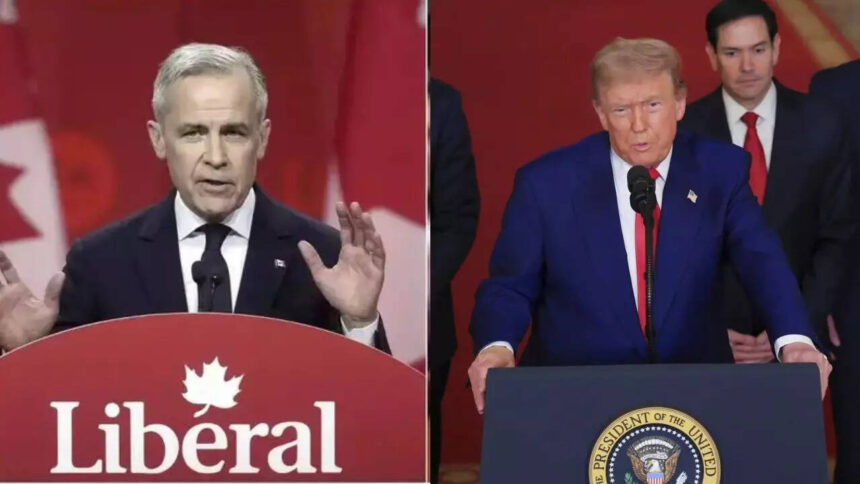
In a sharp escalation of diplomatic tensions, U.S. President Donald Trump has threatened to halt progress on trade negotiations with Canada following its recent decision to recognize Palestine as a sovereign state at the United Nations. Donald Trump’s response, delivered in characteristic bluntness on his Truth Social platform, has further strained already rocky ties between the neighboring nations, with the specter of a 35% tariff now looming over Canadian exports to the U.S.
Donald Trump reacts to Canada’s Palestine recognition
Donald Trump’s statement came in response to Canadian Prime Minister Mark Carney’s announcement that Canada would formally recognize the statehood of Palestine during the upcoming United Nations General Assembly session in September. The move, backed by the UK and France, marks a significant shift in Canada’s foreign policy and could potentially impact the broader stance of G7 countries on the Gaza conflict.
“Wow! Canada has just announced that it is backing statehood for Palestine. That will make it very hard for us to make a Trade Deal with them. Oh’ Canada!!!” Donald Trump posted on Truth Social. His reaction underscores the deepening diplomatic divide, particularly in light of the U.S.’s longstanding support for Israel in the ongoing war in Gaza.
Donald Trump’s response is also consistent with his previous rhetoric about Canada. Just weeks ago, he described Canada as a country that has been “very difficult to deal with over the years” and once even suggested that it should become a part of the United States. The latest development adds another layer to Trump’s history of unpredictable foreign policy decisions, particularly concerning America’s closest allies.
Canada to face stiff tariffs
Adding further weight to his warning, Donald Trump has signaled the imposition of a 35% tariff on Canadian exports unless a revised trade agreement is reached. While Donald Trump has previously used tariff threats as a negotiating tool with countries like China and Mexico, this is one of the most aggressive stances he has taken against Canada in recent years.
The former U.S. president has also declined to extend a deadline related to tariff hikes for multiple nations, pushing them to either accept increased U.S. market access or face heightened duties. Several countries have since struck new deals to avoid punitive tariffs, but Donald Trump appears unwilling to offer Canada the same leniency, citing its recent position on the Israel-Palestine issue.
Palestine move could reshape G7 dynamics
Prime Minister Carney, in his statement, stressed the urgency of Canada’s decision, stating, “The deepening suffering of civilians leaves no room for delay in co-ordinated international action to support peace, security, and the dignity of all human life.” He emphasized that recognizing Palestine was an essential step in preserving the possibility of a two-state solution, and a declaration of support for peaceful coexistence between Israelis and Palestinians.
Carney’s announcement is likely to have ripple effects within the G7, where consensus on the Gaza war remains fragile. The UK and France have also expressed openness to recognizing Palestinian statehood, but Canada’s formal stance marks a bold departure that could influence other Western powers.
The move is being seen by some observers as a direct challenge to the U.S. administration’s current foreign policy, which continues to provide strong backing to Israel. With Donald Trump now ramping up his criticism and trade threats, Canada may face both economic and diplomatic isolation if other allies do not rally behind its position.
U.S.-Canada ties under renewed strain
Canada’s relationship with the U.S. has seen multiple points of friction during Donald Trump’s tenure, and the current situation has brought those tensions back to the forefront. Trade negotiations that had shown some signs of recovery now appear to be at risk of derailment, as Donald Trump shows little appetite for compromise.
The potential tariff imposition could hit key Canadian industries, including automotive, dairy, and timber exports—sectors that heavily depend on access to the U.S. market. Canadian officials are reportedly preparing contingency plans, but the lack of clarity from the U.S. side has added to the uncertainty.
Meanwhile, Canadian leadership is standing firm on its foreign policy direction. Mark Carney’s stance is being interpreted as both a humanitarian and geopolitical signal, asserting Canada’s intent to engage more assertively in international peace-building efforts, even at the cost of friction with its most powerful trading partner.
As the UN General Assembly in September approaches, all eyes will be on how this diplomatic standoff unfolds. Whether Canada’s bold move will influence other nations or isolate it on the global stage remains to be seen, but what is clear is that U.S.-Canada relations have entered yet another turbulent chapter under Donald Donald Trump’s watchful eye.