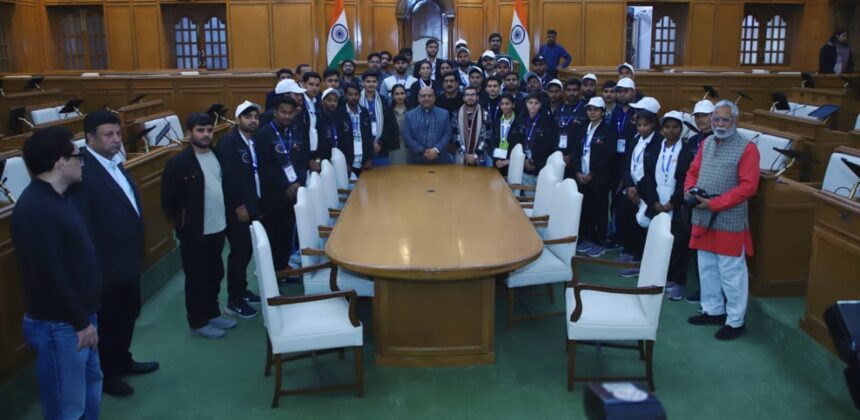
New Delhi, 24 December 2025: Delhi Legislative Assembly Speaker Vijender Gupta engaged with 40 youth participants from Rajasthan today as part of the Inter-State Youth Exchange Programme organized by MYBharat in collaboration with CCRT, Dwarka. The young visitors, representing districts including Dausa, Sikar, Bharatpur, Jhunjhunu, and Alwar, were introduced to the workings of parliamentary democracy and the historic legacy of the Delhi Vidhan Sabha.
Addressing the participants, Gupta said, “You have come to a place often described as the temple of democracy. In a democratic system, the people are supreme, and it is through dialogue, debate, and discussion in the House that governance truly takes shape.” He emphasized that dialogue remains the soul of democracy and that the House serves as the central forum for discussion, accountability, and public representation.
The programme began with a documentary screening on Veer Vithalbhai Patel, India’s first elected Speaker, narrated by Padma Bhushan awardee Anupam Kher. The film highlighted India’s parliamentary heritage and served as a foundation for discussions on democratic values.
During the interaction, Gupta elaborated on the evolution of democracy, contrasting historical monarchical systems with modern parliamentary democracy, where citizens elect their representatives and governments serve as public servants. He highlighted the symbolic significance of renaming Rajpath as Kartavya Path, reflecting the ethos of duty and public service central to democratic governance.
Gupta provided detailed insights into parliamentary functioning, explaining how elected representatives assemble in the House to debate, deliberate, and enact laws. He stressed that active engagement in dialogue strengthens democratic governance and allows citizens’ voices to be represented effectively.
Highlighting the historical importance of the Delhi Vidhan Sabha, Gupta described it as a living heritage site with over 113 years of history. He recounted that following the shifting of India’s capital from Calcutta to Delhi in 1911, legislative proceedings began in this building in 1912. Gupta also noted that the House has been associated with eminent national leaders such as Gopal Krishna Gokhale, Lala Lajpat Rai, Madan Mohan Malaviya, and Veer Vithalbhai Patel, and that debates and struggles within its walls contributed significantly to India’s freedom movement.
As part of the programme, students had the opportunity to interact with the Speaker in a one-on-one format, sharing their learnings, experiences, and reflections. This session allowed the youth to engage directly with Gupta, ask questions, and gain a deeper understanding of the principles and practices of parliamentary democracy.
The visit also included a guided tour of the House of the Delhi Legislative Assembly, where participants were acquainted with its procedures, functioning, and historical legacy. The tour and interactive sessions aimed to foster a sense of civic awareness and democratic values among the youth, aligning with the objectives of the Inter-State Youth Exchange Programme.
Through this initiative, MYBharat and collaborating organizations seek to encourage young citizens to understand and appreciate democratic institutions, parliamentary processes, and the responsibilities of governance. Gupta’s engagement with the participants underscored the role of education, dialogue, and exposure in building an informed and responsible citizenry capable of contributing meaningfully to India’s democratic system.
The programme concluded with the youth expressing their appreciation for the opportunity to visit the Delhi Vidhan Sabha and interact with the Speaker, highlighting the significance of such exchanges in broadening their understanding of India’s legislative processes and democratic heritage.