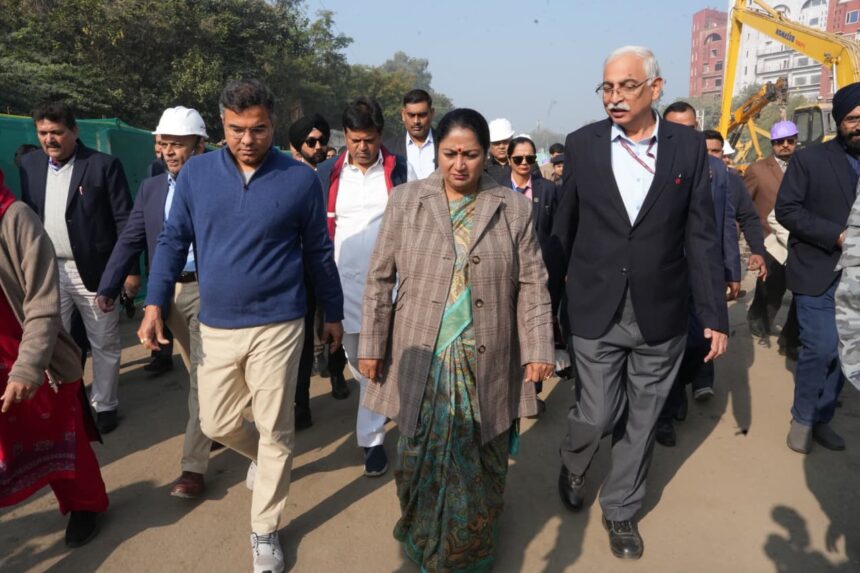
New Delhi, December 30, 2025:
The Delhi Government has unveiled a twin-pronged strategy to tackle air pollution in the national capital, focusing on large-scale road construction and the expansion of mist spray systems to control dust and vehicular emissions. Chief Minister Rekha Gupta said the government is taking strong and coordinated action on multiple fronts to ensure both immediate and long-term improvements in air quality across the city.
Addressing the issue, the Chief Minister said that construction work on nearly 400 kilometres of roads across Delhi will commence as soon as the Graded Response Action Plan (GRAP) restrictions are lifted. She said the roads will be built wall-to-wall, a method aimed at eliminating dust generation from road edges at the source, which has been a persistent contributor to air pollution in the city.
According to the Chief Minister, the new road infrastructure will play a crucial role in reducing dust pollution caused by damaged, uneven and worn-out roads. She said that smoother and well-maintained roads would not only improve traffic flow but also help curb emissions generated due to congestion and poor road conditions.
The Delhi Government said that the Central Government has already released budgetary allocations for the construction of 300 kilometres of the proposed 400 kilometres of roads. The remaining 100 kilometres will be built using funds from the Delhi Government’s own resources. Officials said this coordinated funding approach will allow work to be taken up simultaneously at multiple locations once GRAP restrictions are eased.
Chief Minister Rekha Gupta informed that all tenders and procedural formalities related to the road construction project have already been completed. She said the Public Works Department will begin work immediately after GRAP is lifted, adopting a war-footing approach to ensure rapid execution. Construction activities will be initiated across several parts of the city at the same time to minimise delays.
She added that roads constructed around five years ago, as well as those that have deteriorated significantly, will be taken up on priority. The government aims to complete a major portion of the road construction within the current financial year, and there is a strong possibility that the entire project could be completed within this timeframe, subject to weather conditions and regulatory clearances.
Alongside road construction, the Delhi Government is intensifying efforts to control dust pollution through the expansion of mist spray systems. As per directions issued by the Environment Department, mist spray systems are being installed on electric poles and other suitable structures located along central verges and road medians. These systems release fine water droplets that help suppress dust particles suspended in the air, particularly PM10 and PM2.5 pollutants.
Officials said that mist spray systems have emerged as an effective tool for dust control, especially in high-traffic and high-pollution zones. At present, around 340 mist spray systems are operational at hundreds of locations across Delhi. The coverage is being expanded in a phased manner, with priority being given to identified pollution hotspots and areas with high vehicular movement.
The Chief Minister said that, except during the monsoon season, the mist spray systems will remain operational throughout the year to ensure continuous dust suppression. She noted that one of the key advantages of these systems is that they do not require additional road construction or major infrastructure changes, making them a practical, cost-effective and scalable solution for pollution control.
Emphasising the need for sustained efforts, Rekha Gupta said that addressing air pollution in Delhi cannot be limited to seasonal or short-term measures. She stressed that long-term and structural interventions are essential to achieve lasting improvements in air quality. According to her, better road infrastructure, regular maintenance and the use of modern dust-control technologies must work together to deliver sustainable results.
The Chief Minister reiterated the government’s commitment to balancing development with environmental protection. She said the Delhi Government is determined to ensure that infrastructure development does not come at the cost of public health and environmental safety. “Our focus is on creating a cleaner, safer and healthier living environment for the people of Delhi through coordinated and long-term solutions,” she said.
Officials said the combined approach of improved road infrastructure and expanded dust suppression measures reflects the government’s intent to address both the root causes and visible sources of pollution. With preparations already in place, the government expects the initiatives to gather momentum immediately after GRAP restrictions are lifted, marking a significant step in Delhi’s ongoing fight against air pollution.