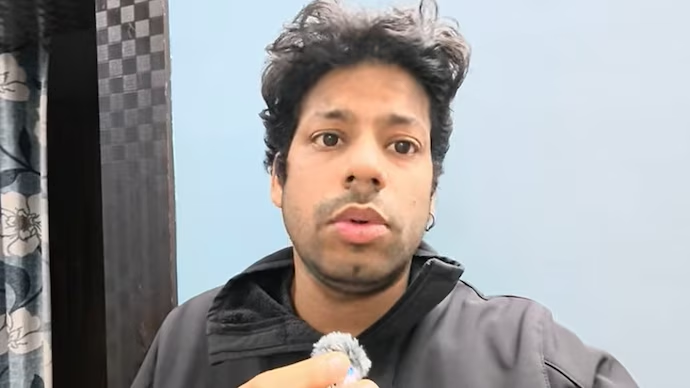
An Indian travel blogger has claimed he was detained for nearly fifteen hours at Guangzhou airport in China, alleging that the action was triggered by a YouTube video in which he referred to Arunachal Pradesh as part of India.
The incident, narrated publicly by New Delhi-based vlogger Anant Mittal, has drawn attention because of its political sensitivity, the treatment he describes during detention, and the absence of any official explanation from Chinese authorities. Mittal, who commands a large social media following through his travel channel, has said the experience left him mentally distressed and has prompted him to avoid political themes in future content. His account has also renewed discussion around travel risks, digital content scrutiny, and the broader geopolitical tensions that often intersect with individual experiences.
Detention at guangzhou airport and questioning over online content
According to Anant Mittal, a popular Indian travel vlogger behind the YouTube channel On Road Indian, the incident occurred when he arrived in China on November 16. Mittal said he was stopped at immigration at Guangzhou Baiyun International Airport, where officials took his passport, asked preliminary questions, and placed a sticker on it. Soon after, an alert reportedly appeared on the immigration system, following which he was taken aside for further checks.
Mittal has claimed that he was initially held with other foreign nationals before being escorted by two officers to a separate room. There, he was searched and questioned extensively about his education, personal background, and online activities. He alleged that airport officials confiscated his mobile phone, camera, and other electronic devices, effectively cutting him off from communication. He later said that an iPad was inadvertently left with him, which he used to document part of the incident.
In a video uploaded on December 23, Mittal said he was held for nearly fifteen hours and was not provided food or water despite repeatedly asking for it. He described the experience as mentally exhausting and humiliating, stating that he felt helpless during the prolonged questioning. According to him, officials went through his old videos and online posts, focusing on content he had created earlier while living in China.
Mittal believes the detention was directly linked to a video in which he had described Arunachal Pradesh as part of India. He has said that the video was not political in intent and stemmed from his personal connection with the region, where he studied for three years. He emphasised that he did not intend to provoke or challenge any political position, but merely spoke from his lived experience.
Chinese authorities have not issued any official statement regarding the incident, and no formal charges or reasons for the detention have been made public. Mittal was eventually allowed to proceed, but the lack of clarity surrounding the episode has raised questions about how digital content created outside a country’s borders can impact travellers upon arrival.
Social media reach, embassy outreach, and wider implications
Anant Mittal’s account has resonated widely due to his substantial online following. He has nearly four lakh subscribers on YouTube and over two lakh followers on Instagram, making his experience visible to a large audience. As a travel content creator, his videos typically focus on destinations, culture, and personal journeys rather than politics. Following the detention, however, he publicly stated that he would refrain from making political videos in the future, citing the stress and fear caused by the incident.
Mittal has also said that he approached the Indian Embassy in China for assistance, expressing concern that similar incidents could happen again either to him or to other Indian travellers and content creators. While there has been no public confirmation of diplomatic intervention in his specific case, his outreach highlights the importance of consular support when citizens face difficulties abroad.
The incident has sparked broader debate about freedom of expression, the reach of online content, and the risks faced by influencers and journalists while travelling internationally. In an era where digital footprints are permanent and easily accessible, content created years earlier can resurface in unexpected and potentially serious ways. For creators who travel frequently, this raises complex questions about self-censorship, safety, and the balance between personal expression and geopolitical sensitivities.
It also underscores the fragile nature of relations between India and China, particularly over issues related to territory and sovereignty. Arunachal Pradesh remains a sensitive subject in bilateral ties, and references to it can carry political weight far beyond the context in which they are made. While Mittal has insisted that his video had no political agenda, the reaction he describes reflects how individual speech can be interpreted through a geopolitical lens.
Travel experts and digital rights advocates note that such incidents may have a chilling effect on content creators, discouraging them from discussing certain topics even in non-political contexts. At the same time, they stress the need for travellers to be aware of local laws, sensitivities, and the potential scrutiny of digital devices at international borders.
As Mittal’s story continues to circulate online, it has become a cautionary tale for bloggers, vloggers, and social media users who cross borders with extensive digital histories. His experience highlights the growing intersection between online expression, national narratives, and personal security, reminding travellers that in a connected world, what is said online can have real-world consequences far from home.