New Delhi, December 20, 2025:
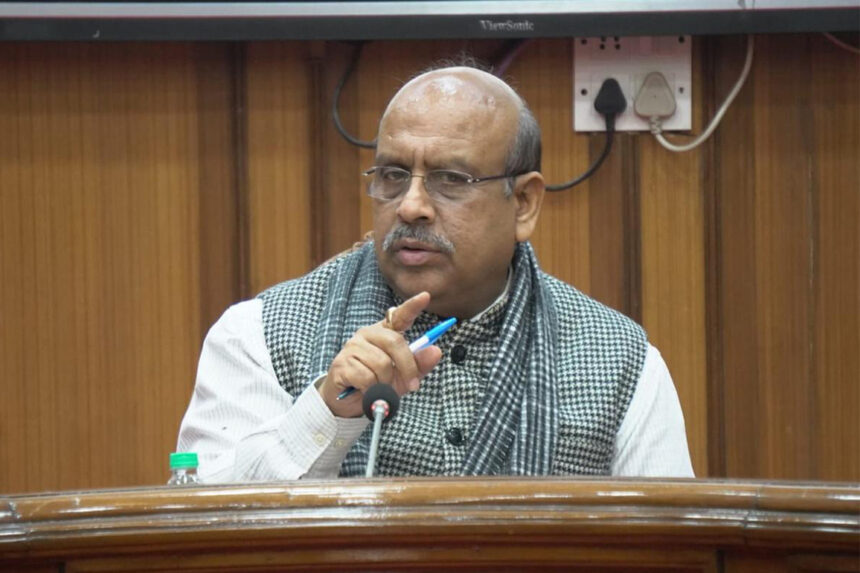
Delhi Assembly Speaker and local MLA Vijender Gupta on Friday conducted an on-site inspection of air pollution hotspots in Rohini, stressing that pollution caused by road dust and unfinished civic works is a preventable governance issue that requires time-bound action, coordinated administration and firm accountability.
During the inspection at Madhuban Chowk in Rohini Sector-8, Gupta said that air pollution linked to dug-up roads, loose soil and incomplete restoration work should not be treated as an unavoidable reality. He underlined that effective control depends on systematic planning, inter-agency coordination and strict monitoring rather than episodic enforcement.
The inspection followed recent assessments that identified several locations in Rohini as major dust-pollution hotspots. Officials observed that multiple roads in the area remain untarred, partially excavated or covered with loose soil. Continuous vehicular movement on these stretches has been causing repeated resuspension of dust, significantly contributing to local air pollution levels. At the same time, the suspension or delay of infrastructure projects, including drainage-related works halted under pollution-control measures, has left road surfaces untreated for prolonged periods.
Residents in the area have reportedly been exposed to persistent dust for several months, raising serious public health concerns, particularly for children, elderly people and those with respiratory ailments. Gupta noted that scientific studies consistently identify road dust as one of the largest contributors to particulate pollution in Delhi, accounting for a substantial share of PM10 and a significant portion of PM2.5, especially during the winter months when stagnant atmospheric conditions worsen pollution.
He observed that the problem is further aggravated by incomplete restoration after utility works, inadequate mechanised sweeping, insufficient dust-suppression measures, fragmented coordination among civic agencies and heavy traffic movement over damaged pavements. According to him, these factors together create a cycle of recurring dust pollution that remains unaddressed without sustained administrative focus.
Taking note of these findings, the Assembly Speaker directed immediate remedial action at identified dust hotspots in Rohini. He instructed civic agencies to implement daily mechanised sweeping and regular sprinkling of water or approved dust suppressants as part of a time-bound dust-control mandate. He also emphasised that where full-scale infrastructure work cannot resume due to regulatory or environmental restrictions, exposed road stretches must be temporarily paved or compacted to prevent further dust generation.
Special priority was directed for dust-control measures around school zones and market areas, particularly during peak traffic hours. Gupta further instructed that weekly joint inspections should be conducted by the Delhi Pollution Control Committee, Delhi Development Authority, Municipal Corporation of Delhi and the Traffic Police. These inspections are to be supported by geo-tagged reporting and clearly defined compliance timelines to ensure accountability.
To address coordination gaps, Gupta directed the establishment of a Rohini Dust Action Cell under the MLA’s office. The proposed cell will facilitate coordinated functioning among the DDA, MCD, DPCC and Traffic Police. He noted that the absence of a unified maintenance and enforcement mechanism has resulted in prolonged neglect of exposed road surfaces and stressed that such fragmentation must be corrected through structured inter-agency coordination and continuous monitoring.
Looking at long-term mitigation, Gupta emphasised the need for wall-to-wall paving or carpeting of all remaining untarred or frequently damaged roads in Rohini. He also highlighted the importance of constructing permanent road shoulders and footpaths to prevent repeated dust resuspension caused by traffic movement. He called for the conversion of vacant open plots into green buffers or paved community spaces to eliminate dust bowls and suggested deploying local particulate matter monitoring points near schools and high-traffic junctions to track measurable improvements in air quality.
Concluding the inspection, the Delhi Assembly Speaker said that effective air pollution control requires consistency and sustained governance rather than short-term or reactive measures. He stressed that public health must remain central to civic administration and assured residents that the implementation of pollution-control measures in Rohini would be closely monitored.
Gupta added that periodic reviews will be conducted to ensure timely execution of directives, inter-agency accountability and visible improvements in environmental conditions, with the aim of improving air quality and the overall quality of life for residents of Rohini.