New Delhi, December 23, 2025
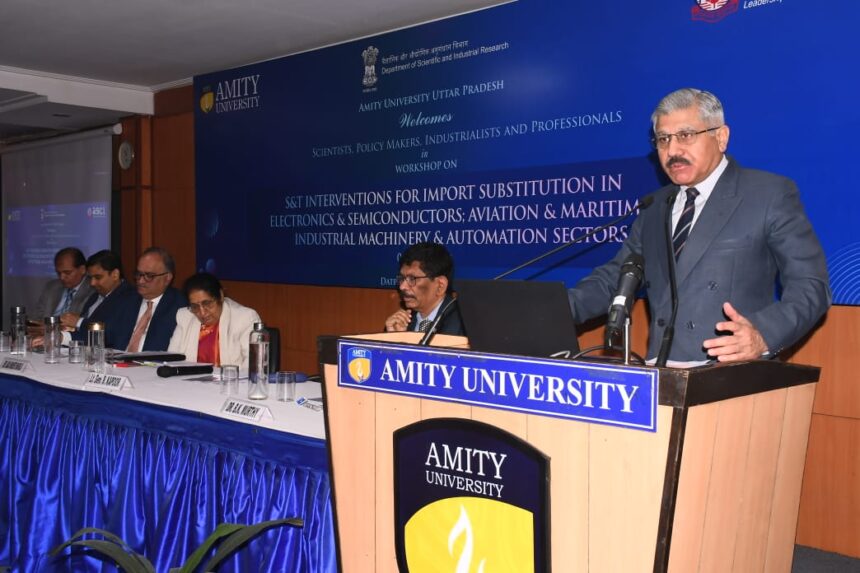
Amity University, through the Amity Foundation for Science, Technology and Innovation Advancement, in collaboration with the Administrative Staff College of India, Hyderabad, and under the aegis of the Department of Scientific and Industrial Research, Government of India, organized the second edition of the workshop on “Science and Technology Interventions for Import Substitution in Electronics and Semiconductors, Aviation and Maritime, Industrial Machinery, and Automation.”
The workshop was inaugurated by Retired Deputy Chief of Army Staff (Information Systems and Coordination) Lt. Gen. Rakesh Kapoor, Vice Chancellor of Amity University Dr. Balvinder Shukla, Chief Technology Officer of the National Mission on Electronics and Semiconductors, Ministry of Electronics and Information Technology, Sudhir Kumar Marwah, Dr. Karnak Roy from the Centre for Management Studies, Administrative Staff College of India, Hyderabad, Additional Pro Vice Chancellor Dr. Sanjeev Bansal, and Dr. B. K. Murthy from the Amity Foundation for Science, Technology and Innovation Advancement.

Delivering the inaugural address, Lt. Gen. Rakesh Kapoor emphasized that the workshop comes at a critical time. He noted that no country can progress or influence the global stage without technological advancement. Highlighting the strategic importance of technology, he said that many nations invest 4-5% of their GDP in research and development, while India invests only around 1%, limiting rapid advancement. He stressed that R&D cannot be driven solely by the government and requires active participation from the private sector. Highlighting India’s leading position in data generation, Kapoor emphasized the growing importance of AI, machine learning, robotics, and quantum technologies, adding that human capital must be harnessed for innovation to make India a global technology leader.

Vice Chancellor Dr. Balvinder Shukla underlined the need to develop secure and flexible Indian technologies in electronics and semiconductors, aviation and maritime, industrial machinery, and automation. She noted that these sectors are closely linked to defense priorities and stressed the importance of identifying focus areas. She added that Amity University not only provides quality education but also prepares students for nation-building.
Sudhir Kumar Marwah, CTO of the National Mission on Electronics and Semiconductors, highlighted the importance of reducing import dependency and making India self-reliant in semiconductors and display technologies. He explained that under the mission, India is being positioned as a global hub for electronics manufacturing and design, with financial support being provided to companies investing in semiconductor fabs, display fabs, and chip design. Marwah emphasized the need for collaborative efforts among all stakeholders.

Dr. Karnak Roy from the Centre for Management Studies, Administrative Staff College of India, highlighted the strategic significance of science and technology in reducing India’s import bill, addressing security risks, and achieving self-reliance in electronics, aviation, and industrial machinery. He explained the methodology for creating a comprehensive database of technological imports and identifying sectors with high import dependency.
Additional Pro Vice Chancellor Dr. Sanjeev Bansal stated that the workshop will include central and extensive discussion sessions to generate recommendations, share success stories, and propose policy interventions for reducing imports in the identified sectors. The suggestions will be forwarded to the concerned ministries for implementation.
Dr. B. K. Murthy welcomed participants and emphasized that a significant portion of India’s imports consists of high-value technology products such as electronics, industrial machinery, aviation components, and semiconductors. He highlighted key areas for strengthening the domestic technological ecosystem and reducing import dependency, including focusing on R&D commercialization, improving procurement, deepening the ecosystem, enhancing knowledge management, protecting intellectual property, and bridging talent gaps.
The workshop featured three technical sessions: the first focused on electronics and semiconductors, the second on aviation and maritime, and the third on industrial machinery and automation, discussing science and technology interventions for import substitution in each sector.
This initiative underscores the collaborative effort between academia, government, and industry to advance India’s technological self-reliance and innovation-driven growth.