Noida | January 29, 2026
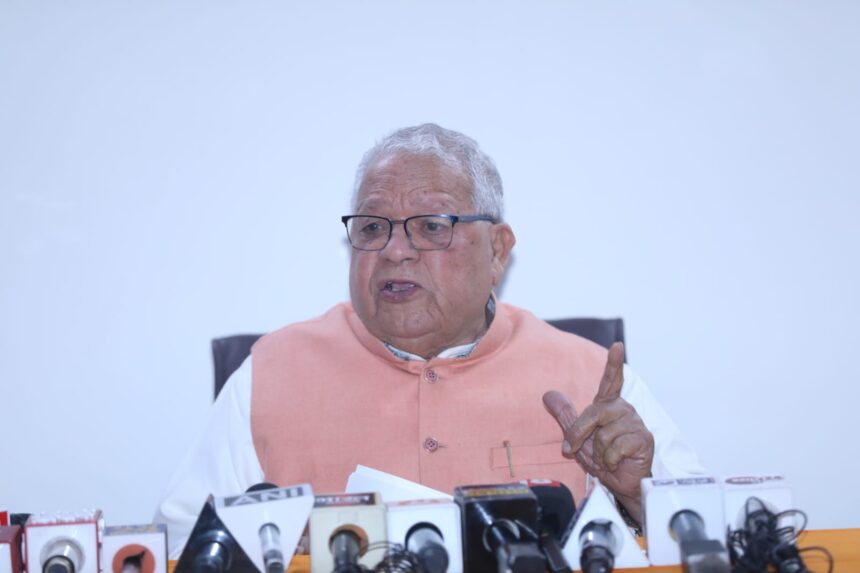
Kalraj Mishra, founder national president of the World Brahmin Welfare Council and former Governor of Rajasthan and Himachal Pradesh, on Wednesday expressed serious concerns over the University Grants Commission (Promotion of Equity in Higher Education Institutions) Regulations, 2026. He said the regulations undermine the core constitutional values of equality and fairness in educational institutions.
Mishra stated that while ensuring equality and justice in educational institutions is essential, creating monitoring and disciplinary mechanisms that place a particular section of society under constant suspicion is unconstitutional and socially harmful. He said equality cannot mean treating a specific group as inherently suspect.
Referring to the UGC regulations framed in 2012, Mishra pointed out that the earlier grievance redressal system was uniform and impartial for all sections. No student or staff member was treated as guilty on the basis of prejudice, a balance which, he said, has been disturbed by the new regulations.
He also cited a landmark Supreme Court judgment of 2019, in which the court emphasised that any inquiry process must be fair and balanced. Mishra said protecting innocent individuals from false or malicious complaints is an essential component of justice, which the new framework fails to adequately address.
Explaining the council’s vision, Mishra said the World Brahmin Welfare Council aims to promote social harmony with the Brahmin community as a unifying force. He alleged that the new UGC regulations work against this objective and risk creating deeper divisions within society.
Mishra further said that Articles 14, 15 and 21 of the Constitution guarantee equality, non-discrimination and dignity to all citizens. According to him, the proposed regulations directly violate these fundamental rights.
The council placed several demands before the government and the UGC, including immediate withdrawal of the regulations. Alternatively, it demanded the removal of caste-based unilateral punitive provisions and the inclusion of equal grievance redressal rights for all stakeholders, including students, teachers and staff members.
The council also called for a grievance redressal mechanism that is uniform, fair and transparent for all sections, punitive action against those filing false complaints, and inclusive representation of all groups in grievance committees.
In his concluding remarks, Mishra urged the Government of India to review the regulations and introduce prompt amendments. He warned that oppression of any section under the guise of justice is unacceptable.
Earlier in the day, a council delegation met Union Education Minister Dharmendra Pradhan and submitted a memorandum. The delegation included national executive president Satish Sharma, international vice-president KK Sharma, national vice-president Madhav Sharma, national treasurer Sharad Sharma, national publicity head Arvind Bhardwaj, Delhi state youth president Harish Sharma and Mukesh Sharma.