Gautam Buddh Nagar, April 10, 2026
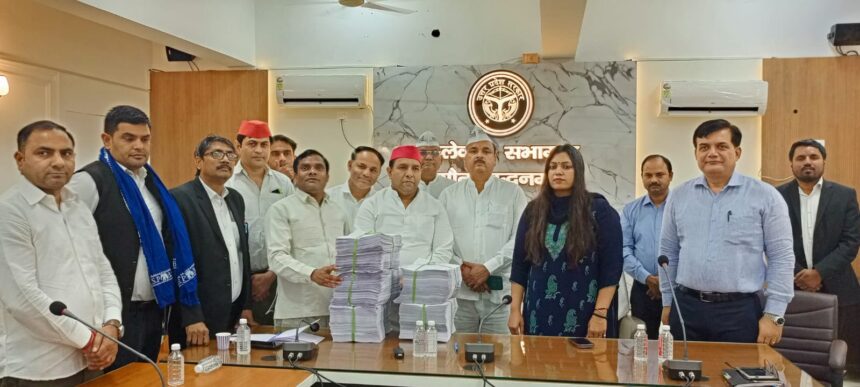
In accordance with the directions of the Election Commission of India, the Special Intensive Revision Programme 2026 was successfully completed, and the final publication of electoral rolls for all assembly constituencies was carried out on April 10, 2026. Following this, a crucial meeting was organized at 11:00 AM in the Collectorate auditorium under the chairmanship of the District Election Officer to formally share the final voter list with all recognized political parties.
During the meeting, the District Election Officer distributed the final electoral roll prepared under the provisions of the Election Commission of India guidelines and the Registration of Electors Rules, 1960. The objective of the exercise was to ensure transparency in the electoral process and provide verified voter data to all political stakeholders ahead of upcoming electoral activities.
Officials informed that the final voter list has now been published, and citizens can also inspect the electoral rolls at their respective polling stations for a period of one week. This provision allows voters to verify their details and ensure accuracy in the electoral database.
District-Wide Voter Statistics Presented
The Deputy District Election Officer and Additional District Magistrate (Finance and Revenue) provided detailed information regarding the voter population in the district. Gautam Buddh Nagar currently has a total of 15,05,082 registered voters, including 8,23,304 male voters, 6,81,728 female voters, and 50 transgender voters.
Breaking it down by assembly constituencies, Assembly Constituency 61-Noida has a total of 5,87,195 voters, comprising 3,24,477 male, 2,62,708 female, and 10 transgender voters. Assembly Constituency 62-Dadri has 6,05,204 voters, including 3,28,244 male, 2,76,926 female, and 34 transgender voters. Assembly Constituency 63-Jewar has 3,12,683 voters, consisting of 1,70,583 male, 1,42,094 female, and 06 transgender voters.
These figures reflect the updated and finalized electoral data after the completion of the revision exercise conducted under the Election Commission’s supervision.
Details of Polling Infrastructure in the District
Officials also shared updated information regarding polling infrastructure in the district. Gautam Buddh Nagar currently has a total of 743 polling stations. Among these, Noida constituency has 233 polling stations, Dadri has 303, and Jewar has 207 polling stations.
In addition, the district has a total of 2,024 polling booths (मतदेय स्थल). This includes 811 booths in Noida, 794 in Dadri, and 419 in Jewar constituency. These arrangements have been made to ensure smooth conduct of elections and easy accessibility for voters across all regions.
Meeting with Political Party Representatives
The meeting was attended by representatives of all major recognized political parties. Those present included Dharmendra Kori, District General Secretary of BJP; Sudhir Bhati, District President of Samajwadi Party; Anup Tiwari, Office In-charge; Rajkumar Gurjar, District General Secretary of BSP; Mukesh Rathi, Assembly Coordinator; Omprakash Singh, Assembly In-charge; Neeraj Lohia, District Vice President of Congress; Parshuram Chaudhary, District President of Aam Aadmi Party; Dildar Ansari; and Mukesh Kumar representing CPI(M).
The presence of multiple political representatives ensured that the electoral process remains transparent and inclusive, with all stakeholders being informed about the final voter list and related electoral details.
Commitment to Transparent Electoral Process
Officials reiterated that the publication and distribution of the final electoral roll is a key step in maintaining transparency and credibility in the democratic process. The administration emphasized that all citizens and political parties have equal access to verified voter data, ensuring fairness in the upcoming electoral cycle.
The meeting concluded with a reaffirmation of commitment to free, fair, and transparent elections in Gautam Buddh Nagar, with continued cooperation between the administration and political stakeholders.