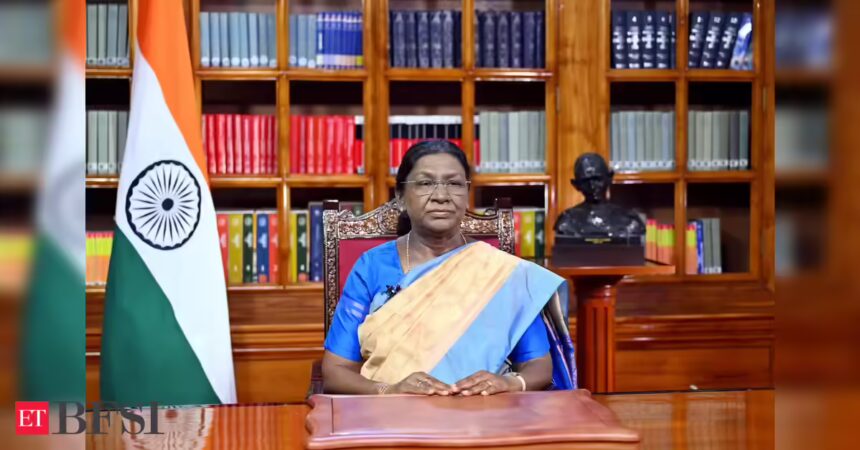
President Droupadi Murmu on Tuesday told Parliament that middle-class incomes in India have increased over the years, asserting that the government’s sustained efforts to control inflation and strengthen economic fundamentals have resulted in higher savings and improved purchasing power for ordinary citizens.
Addressing the joint sitting of Parliament, the President outlined the government’s economic journey over the past 11 years, describing it as a period of structural transformation and stability. She said India today stands on a much stronger economic foundation than it did a decade ago and has emerged as one of the fastest-growing major economies despite persistent global challenges. According to her, disciplined fiscal management and policy reforms have helped keep inflation under control, directly benefiting the poor and the middle class by reducing pressure on household budgets.
Murmu stressed that stable prices, combined with rising incomes, have ensured that people now have more disposable income. This, she said, has translated into greater savings, higher consumption, and a virtuous cycle of economic growth that supports both households and businesses.
Strong economic base, reforms, and tax relief drive household prosperity
The President noted that India’s economic resilience has been built through a combination of reforms and long-term policy decisions. She said people across the country are earning more and saving more, which has enhanced their purchasing power and improved overall living standards. This increase in disposable income, she added, not only supports families but also fuels demand across sectors, strengthening the broader economy.
Murmu highlighted the government’s continued push to modernise outdated laws and regulations through what she described as a “Reforms Express.” The objective, she explained, is to align governance frameworks with present-day realities, making it easier for businesses to operate while ensuring efficiency and transparency in economic activity.
A key reform cited by the President was the introduction of the Goods and Services Tax, which she called a major milestone in India’s economic transformation. The simplified tax regime has reduced complexities, improved compliance, and resulted in significant savings for citizens. According to Murmu, GST has led to savings estimated at nearly ₹1 lakh crore, easing the tax burden on consumers and businesses alike.
She also underscored recent income tax reforms aimed at providing direct relief to the middle class. The decision to exempt income up to ₹12 lakh from taxation, she said, has substantially reduced the financial burden on families, leaving more money in their hands and giving a boost to consumption and savings.
The President further spoke about labour reforms, noting that the government has consolidated numerous outdated labour laws into four comprehensive codes. These reforms, she said, are designed to protect workers’ rights while supporting the needs of a modern economy. By ensuring fair wages, social security, and benefits, the new framework is expected to particularly benefit youth and women entering the workforce.
Infrastructure push, farmer welfare, manufacturing, and India’s global rise
Murmu also focused on infrastructure development as a key driver of inclusive growth. She highlighted significant progress in improving connectivity, especially in the North-Eastern region. Over 7,200 kilometres of national highways have been constructed, improving access to remote areas. In addition, nearly 50,000 kilometres of rural roads have been built under the Pradhan Mantri Gram Sadak Yojana, connecting villages to markets, hospitals, and schools.
On agriculture, the President reiterated that farmer prosperity remains central to India’s development goals. She cited the PM Kisan Samman Nidhi as a flagship initiative that directly transfers financial support to farmers’ bank accounts. So far, over ₹4 lakh crore has been disbursed under the scheme, contributing to record production in food grains and horticulture crops.
Murmu said the government is also focused on strengthening India’s manufacturing base through the Production Linked Incentive scheme. The PLI programme has already attracted investments of around ₹2 lakh crore and generated production worth over ₹17 lakh crore, helping create jobs and reduce import dependence.
She added that India’s share in global investment and exports has been steadily rising. Over the last 11 years, the country has attracted nearly $750 billion in Foreign Direct Investment, reflecting growing global confidence in India’s economic prospects.
The President also spoke about the government’s push into new and strategic technologies. She highlighted efforts to build self-reliance in semiconductor manufacturing, noting that several new units have been approved and more are expected to begin operations soon, including facilities for advanced nano-chip production. To further reduce reliance on imports, the government has launched the National Critical Mineral Mission, aimed at securing essential minerals vital for future industries.
Addressing emerging challenges, Murmu expressed concern over the misuse of Artificial Intelligence. She warned that deepfakes, misinformation, and fake content pose serious threats to democracy and social harmony, stressing the need for global cooperation and responsible innovation.
Concluding her address, the President pointed to India’s expanding role on the global stage. She noted that India currently holds the presidency of BRICS and is being viewed with optimism by the international community. India is also set to host a Global AI Impact Summit, aimed at bringing nations together to address opportunities and risks associated with artificial intelligence.