In a tragic and alarming development amid the ongoing conflict in Gaza, Middle East Eye journalist Mohamed Salama was killed alongside fellow reporter Ahmed Abu Aziz and three other journalists while covering an Israeli strike on Nasser hospital in Khan Younis. Mohamed Salama’s death comes after revelations that US contractors working at Gaza aid centres interrogated one of his sources days before the attack, seeking information about the journalist’s identity and whereabouts. These revelations have raised serious concerns regarding the role of international aid contractors in endangering journalists, the militarization of humanitarian spaces, and the broader implications for press safety in conflict zones. The killing has drawn widespread international condemnation, highlighting the perilous conditions for media personnel reporting from Gaza, where access to aid, information, and security are all tightly controlled.
US Contractors’ Interrogation and the Risks to Journalists
According to Middle East Eye reporting, Mohamed Salama had been working on investigations anonymously due to security concerns, aware of the constant threats journalists face in Gaza. Days prior to his death, one of Mohamed Salama’s key sources revealed that they were detained at a Gaza Humanitarian Foundation (GHF) aid distribution centre, which is overseen by US security contractors, including Safe Reach Solutions and UG Solutions. During this detention, the source was interrogated about the identity of the reporter conducting the investigation, raising concerns that sensitive information about journalists was being collected in coordination with military or intelligence actors. Mohamed Salama later explained to colleagues that the source would not have contacted him unless they sensed serious danger, underscoring the risks journalists face when reporting on sensitive issues in the region.
Mohamed Salama had long warned that no journalist could ever feel safe in Gaza, and the incident at the aid centre exemplifies the extraordinary pressures and surveillance journalists experience while covering humanitarian crises. MEE contacted the contractors regarding their involvement in interrogations and whether intelligence about Palestinian journalists had been shared with Israeli authorities, but no response was received at the time of publication. These interrogations highlight the blurred lines between humanitarian work, security operations, and intelligence gathering in a region under a strict siege, controlled aid distribution, and ongoing military oversight.
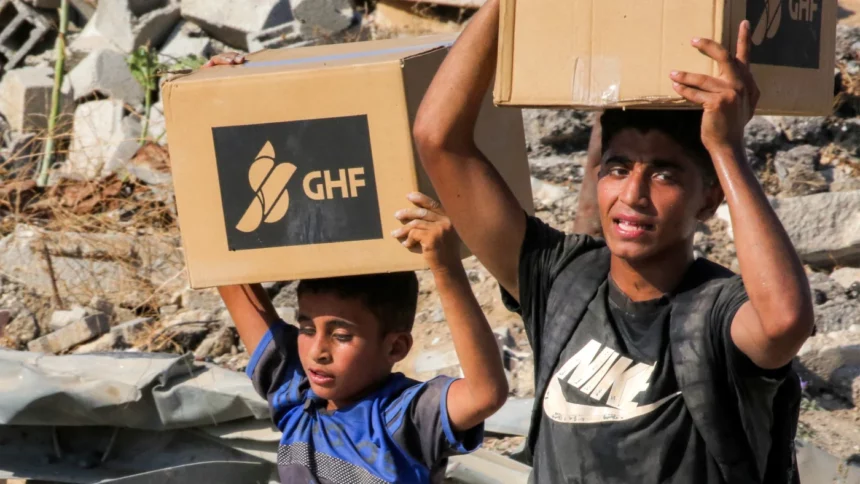
Since March, Israel has maintained a near-total siege on Gaza, monopolizing aid distribution through the GHF while largely sidelining UN channels. The UN reports that at least 1,760 Palestinians have been killed while attempting to access aid through GHF centres, with most deaths attributed to Israeli military actions. Witness testimonies from former contractor employees suggest that both Israeli soldiers and US security personnel were involved in shooting at civilians seeking aid, a claim the GHF has repeatedly denied. The lethal conditions surrounding aid distribution have amplified the dangers faced by journalists, who are often the only witnesses documenting atrocities and violations in real time.
Mohamed Salama, alongside other journalists, was killed while responding to an attack on Nasser hospital, which killed 20 Palestinians including medics and first responders. Israeli authorities claimed the strikes targeted Hamas infrastructure, with Prime Minister Benjamin Netanyahu calling the deaths a “tragic mishap.” However, military and media sources indicate that the hospital was targeted deliberately, with soldiers and command levels approving and coordinating the attacks in advance. Channel 14, a right-wing Israeli outlet, framed the victims as “terrorists disguised as journalists,” highlighting the ongoing discrediting of journalists in the region. Since October 2023, Israel has killed 246 Palestinian journalists in Gaza, often labeling them as Hamas operatives to justify attacks.
Mohamed Salama’s Investigative Work and International Reactions
Mohamed Salama’s reporting had garnered international attention, covering sensitive stories including the mass grave of 15 medics and the plight of children affected by Israeli military actions. His work often highlighted atrocities against civilians, bringing evidence and firsthand accounts to global audiences. Earlier this year, Mohamed Salama reported on a 10-year-old boy killed while seeking aid at a GHF distribution centre, exposing how families were left uninformed of the deaths of their children. His investigative work exemplified the risks undertaken by journalists in Gaza, where documenting civilian suffering, humanitarian failures, and military actions carries extreme danger.
International responses to the hospital attack and journalists’ deaths have been vociferous. Human rights organizations condemned the killing as a violation of international law and called for accountability. Meanwhile, Israeli media narratives have attempted to justify military actions as part of anti-terror operations, contrasting sharply with eyewitness accounts, video footage, and independent reporting. The divergence in narratives demonstrates how the targeting of journalists is often politicized, obscuring the humanitarian realities on the ground.
Mohamed Salama’s death underscores broader structural challenges in Gaza, where journalists operate under siege conditions, restricted aid flows, and constant military oversight. The GHF, despite being funded and backed by Israel and the US, functions in a militarized environment that endangers civilians and media personnel alike. The systematic intimidation and surveillance of journalists, combined with lethal strikes on medical facilities and civilian areas, reflect a growing trend in which humanitarian operations are entangled with security agendas.
The international community continues to grapple with these complex dynamics. Diplomatic statements have emphasized the need to protect journalists, maintain humanitarian access, and ensure accountability for attacks on civilian infrastructure. Meanwhile, the killing of Mohamed Salama and colleagues serves as a stark reminder of the inherent dangers in reporting from conflict zones, especially when aid distribution centres, hospitals, and other civilian spaces become military targets. Press freedom, already constrained in Gaza, faces heightened threats as journalists’ sources and investigative work are scrutinized, monitored, and potentially exposed to lethal retaliation.
Mohamed Salama’s reporting, which covered both human rights violations and war crimes, exemplified courageous journalism in extreme circumstances. From documenting mass killings and medical personnel targeted in hospitals to tracking the impact of siege policies on children and families, Mohamed Salama’s contributions provided essential evidence for international audiences. The pursuit of his sources by US contractors prior to his killing raises ethical and legal questions about the role of private security firms in conflict zones, particularly when their actions intersect with military operations and intelligence collection.
The targeting of journalists like Mohamed Salama, coupled with the larger context of Gaza’s humanitarian crisis, highlights the urgent need for international oversight of aid distribution, protection for media workers, and accountability for military actions. As Mohamed Salama’s death reverberates globally, it underscores the risks faced by reporters seeking to document the realities of war, the consequences of militarized humanitarian operations, and the increasingly blurred boundaries between civilians, journalists, and combatants in high-intensity conflict zones.
Through his work, Mohamed Salama consistently shed light on the human cost of the Gaza conflict, including the killing of medical personnel, the suffering of children, and the broader implications of military and aid-related policies. His investigative reporting demonstrated the essential role journalists play in providing transparency, documenting violations, and holding actors accountable amidst a humanitarian catastrophe. Yet, the risks journalists face are compounded by the complex security and political environment, where private contractors, military forces, and government actors may all converge in ways that threaten press freedom and personal safety.