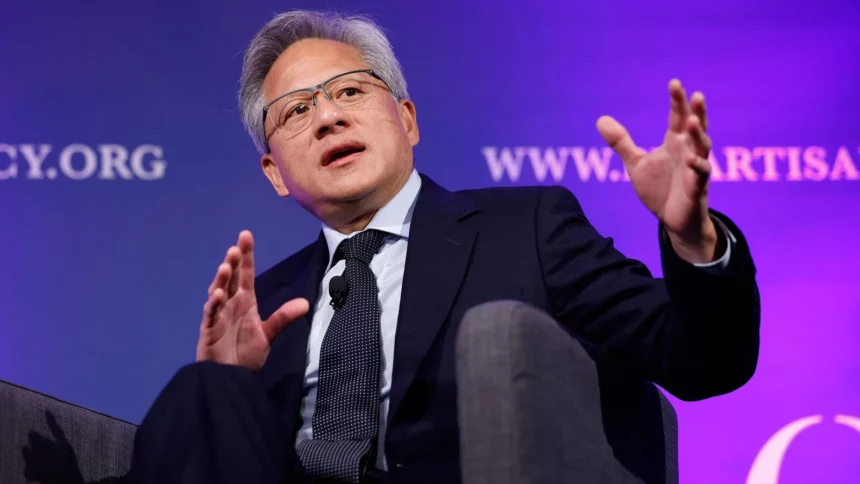
Nvidia CEO Jensen Huang has dismissed concerns about a slowdown in the artificial intelligence (AI) chip market, emphasizing that the AI-driven industrial revolution is only beginning. Speaking amid a period of heightened scrutiny over Nvidia’s growth projections, Jensen Huang painted a bullish picture for the company and the broader AI sector, projecting opportunities that could expand into a multi-trillion-dollar market by the end of the decade. Despite investor anxiety over signs of fatigue in AI-focused stocks and tempered revenue guidance, Jensen Huang expressed confidence that Nvidia remains at the forefront of technological innovation, benefitting from the ongoing surge in demand from hyperscalers, big tech firms, and global markets, including China. He argued that the AI infrastructure race is accelerating, and Nvidia’s chips, including its high-end Blackwell and Hopper processors, continue to be in extraordinary demand, positioning the company for sustained growth over the coming years.
AI Market Potential and Nvidia’s Strategic Positioning
Jensen Huang highlighted that the AI boom represents a fundamentally new industrial revolution, emphasizing the unprecedented scale of spending anticipated across AI infrastructure. He projected that global AI investments could reach between $3 trillion and $4 trillion by the end of the decade, fueled by technology-driven enterprises and massive data center capital expenditures. Despite tempered revenue expectations for Nvidia’s third quarter, which aligned with analyst estimates of around $54 billion, Jensen Huang underscored the continued durability and potential of the AI market. He explained that hyperscalers, large-scale data center operators, and prominent tech companies like Microsoft and Amazon are driving substantial demand for AI chips, a trend that allows Nvidia to maintain robust growth despite broader market fluctuations.
Jensen Huang emphasized that Nvidia’s technological innovations are central to the company’s long-term prospects. Advances in chip efficiency allow clients to process exponentially larger amounts of data while consuming less energy, a critical factor in scaling AI infrastructure. As evidence, Jensen Huang pointed to a recent $650 million purchase of Nvidia’s H20 chip outside China, designed for the Chinese market, demonstrating that international demand for AI hardware remains exceptionally strong. Moreover, Jensen Huang noted that Nvidia anticipates around $600 billion in data center capital expenditures from major customers this year, representing a significant opportunity for the company to capture a sizeable share of the AI infrastructure market. For instance, in data centers costing upwards of $60 billion, Nvidia estimates that it can secure around $35 billion in chip sales, underscoring the company’s pivotal role in enabling AI deployment on a massive scale.
Jensen Huang’s optimism contrasts with broader market sentiment, where AI-focused stocks have shown signs of fatigue, and industry leaders like OpenAI CEO Sam Altman have cautioned about investor overexcitement. However, Jensen Huang argued that these market dynamics do not diminish the underlying opportunity, noting that Nvidia’s product pipeline—including Blackwell and Hopper processors—is largely committed based on forecasts from key customers through 2026. He stressed that the company is in the early stages of an AI boom, suggesting that current market reactions are a reflection of growing pains rather than a structural slowdown.
Revenue Projections, Investor Sentiment, and Competitive Edge
While Nvidia’s third-quarter revenue forecast slightly exceeded analyst expectations, investors had anticipated higher growth due to the intense excitement surrounding AI. Jensen Huang, however, downplayed concerns about the moderation in forecasts, framing the numbers within the broader context of ongoing AI expansion. He emphasized that Nvidia’s strong performance is driven not only by existing demand but also by the anticipated acceleration of investments in AI infrastructure across hyperscalers and big tech. He noted that businesses operating at scale, such as major cloud providers and enterprise data centers, continue to announce significant capital expenditures, which directly benefit Nvidia’s sales and solidify its competitive advantage in the market.
Jensen Huang further addressed investor concerns by highlighting the scalability of Nvidia’s chips and the company’s ability to capture increasing value from data center investments. The Blackwell chips, designed for high-performance AI workloads, are already largely reserved for future orders, while Hopper processors are being adopted at a rapid pace, signaling sustained growth potential. By combining product innovation with an expansive customer base, Jensen Huang positioned Nvidia as uniquely capable of maintaining revenue momentum even amid broader market caution. He emphasized that the current AI market is not merely a speculative trend but a transformative technological shift, providing a durable foundation for long-term growth in both hardware sales and associated software and services.
Investor and analyst reactions to Nvidia’s projections have been mixed, reflecting the tension between market enthusiasm and realistic expectations. Matt Orton of Raymond James Investment Management noted that hyperscalers are driving much of the capital expenditure fueling Nvidia’s growth, suggesting that while the AI trade shows durability, investors should remain aware of the concentration of demand among a few large customers. Jensen Huang, however, remained unperturbed, emphasizing that Nvidia’s technological advantage allows it to capitalize on these trends effectively, providing a unique value proposition compared to competitors. He argued that the AI revolution is accelerating rapidly, and Nvidia’s products are integral to enabling the massive expansion of AI capabilities across sectors ranging from cloud computing to scientific research.
Jensen Huang also addressed environmental and operational efficiencies, noting that Nvidia chips enable customers to process exponentially greater volumes of data without proportional increases in energy consumption. This efficiency advantage not only lowers operational costs but also reinforces Nvidia’s attractiveness as a long-term partner for companies investing in AI infrastructure. The combination of superior technology, large-scale demand, and early positioning in the AI sector supports Jensen Huang’s bullish outlook, positioning Nvidia to capture a dominant share of the projected multi-trillion-dollar market.
The CEO highlighted specific deals and customer commitments as further evidence of the company’s robust pipeline. For example, major AI clients outside China made significant purchases of H20 chips, demonstrating global demand and confidence in Nvidia’s offerings. Additionally, Jensen Huang forecasted that as hyperscalers and enterprise clients continue to invest heavily in AI, Nvidia will benefit from increased sales, recurring revenue streams, and long-term contractual relationships that reinforce the company’s financial resilience.
Jensen Huang also addressed concerns regarding AI market hype, asserting that the growth trajectory is rooted in genuine technological and operational demand rather than speculative investor enthusiasm. By framing AI adoption as a structural shift in enterprise computing, he argued that Nvidia’s role extends beyond chip sales, encompassing the enabling of new business models, accelerated research capabilities, and enhanced productivity across industries. Analysts such as Thomas Martin from Globalt Investments noted that Nvidia is operating at the early stages of an industrial revolution, with AI adoption still ramping up, providing substantial long-term upside despite temporary market volatility.
The broader implications of Nvidia’s outlook extend beyond financial performance. As AI becomes increasingly integral to business operations, the ability to deploy powerful, energy-efficient chips will determine which companies can scale effectively. Nvidia’s leadership in chip development, combined with a robust product pipeline and strategic customer relationships, positions the company as a critical enabler of this technological transformation. Jensen Huang emphasized that the convergence of capital expenditures, technological innovation, and AI adoption creates a unique environment in which Nvidia can thrive, regardless of short-term fluctuations in market sentiment.
In conclusion, while Nvidia’s third-quarter revenue forecasts may have tempered investor expectations in the near term, Jensen Huang’s long-term vision remains unwavering. By emphasizing technological leadership, expanding customer demand, and a multi-trillion-dollar AI market opportunity, Jensen Huang articulated a compelling narrative for sustained growth. His perspective underscores that the AI boom is far from over, positioning Nvidia as a central player in the ongoing industrial and technological revolution, with the potential to reshape enterprise computing, data center infrastructure, and AI deployment globally.
The CEO’s optimism reflects a broader belief in the transformative potential of AI, suggesting that the market’s current fluctuations are merely temporary pauses in an otherwise historic period of technological expansion. By aligning product innovation with the accelerating needs of hyperscalers, big tech, and global AI initiatives, Nvidia is poised to maintain a competitive edge and continue delivering significant value to investors and stakeholders in the rapidly evolving AI ecosystem.