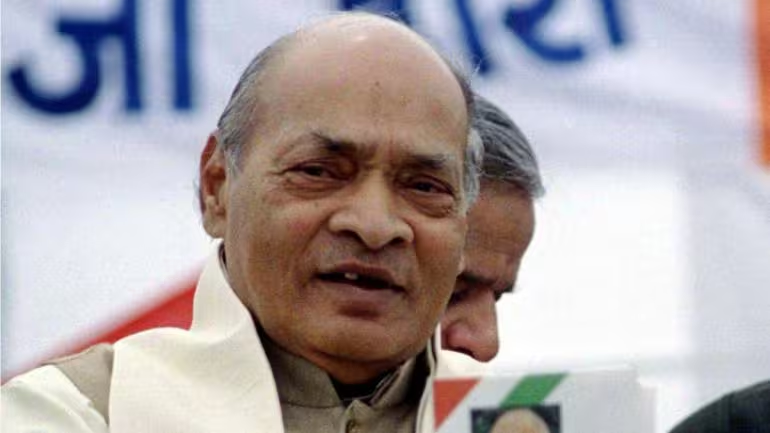
As India debates language policies and the question of Hindi imposition, Andhra Pradesh Chief Minister N Chandrababu N Chandrababu Naidu offered a timely reminder of former Prime Minister PV Narasimha Rao’s multilingual legacy, emphasizing how the leader’s command over 17 languages reflected his inclusive vision for the nation. At a time when discussions around the National Education Policy and the three-language formula continue to spark reactions across states, Naidu’s remarks highlighted how Rao’s linguistic mastery was a tool for unity, scholarship, and effective leadership rather than division.
Remembering a Scholar and Visionary
Speaking at a lecture on “The Life and Legacy of former PM Shri PV Narasimha Rao,” N Chandrababu Naidu described Rao as a “great statesman, visionary, and a pride of the Telugu community.” Recalling his personal association with Rao, N Chandrababu Naidu noted, “He was a student leader, a freedom fighter, a scholar fluent in 17 languages.” His reference to Rao’s multilingualism came as a counterpoint to the current discourse in India, where questions around why people should learn Hindi have emerged amid concerns of linguistic imposition in non-Hindi-speaking states.
N Chandrababu Naidu emphasized that Rao’s proficiency in 17 languages, including Hindi, was a testament to his commitment to understanding and engaging with diverse communities across India. “Now we are all talking about why you should learn Hindi. Not only did he learn Hindi, he learned 17 languages. That is how he became a great man,” Naidu remarked, underscoring that linguistic knowledge should be seen as a bridge, not a burden.
The former Prime Minister’s command over languages, N Chandrababu Naidu pointed out, played a critical role in shaping his policies and governance style, allowing him to communicate effectively with people across states, understand regional aspirations, and address concerns without alienating linguistic identities. This aspect of Rao’s leadership, N Chandrababu Naidu said, holds lessons for contemporary India as it navigates the complex terrain of language policies, education reforms, and regional aspirations.
Context of Ongoing Language Debates
N Chandrababu Naidu’s remarks arrive amid the ongoing debate over the three-language formula under the National Education Policy, which has faced opposition in states like Tamil Nadu, Karnataka, and Maharashtra. Leaders from southern states have often voiced concerns over what they describe as “Hindi imposition” by the Centre, arguing for the protection of regional languages and autonomy over educational curricula.
In Tamil Nadu, the resistance to the imposition of Hindi dates back decades, rooted in the state’s strong linguistic and cultural identity. Similarly, leaders in Karnataka and Maharashtra have emphasized the need to preserve the prominence of Kannada and Marathi in education and administration while opposing any forced inclusion of Hindi as a primary language in schools.
Against this backdrop, N Chandrababu Naidu’s highlighting of Rao’s multilingualism serves as a reminder that embracing multiple languages does not dilute regional identity but can, in fact, strengthen national unity while celebrating diversity. The example of Rao, who managed to connect with people from various linguistic backgrounds during his tenure, demonstrates how multilingualism can be a powerful tool for leadership in a country as diverse as India.
N Chandrababu Naidu’s message also aligns with the broader vision of the National Education Policy, which, while recommending the three-language formula, encourages flexibility for states and emphasizes the promotion of mother tongues alongside Hindi and English to foster multilingual competencies in students. As India progresses in implementing educational reforms, Rao’s legacy underscores the importance of striking a balance between national integration and respect for regional linguistic identities.
The lecture, organized to commemorate PV Narasimha Rao’s contributions, not only celebrated his achievements as a reformer who led India through critical economic transitions but also as a leader who understood the power of language in governance and diplomacy. N Chandrababu Naidu’s reflections on Rao’s linguistic prowess offered a nuanced perspective amid the often polarizing discussions on language, reminding the audience of the role that knowledge, adaptability, and cultural sensitivity play in leadership.
By spotlighting Rao’s multilingual capabilities, N Chandrababu Naidu has provided a constructive entry point into India’s language policy debates, suggesting that language learning, when pursued as a means to connect and communicate, can empower individuals and leaders alike, enabling them to engage with India’s diverse population with empathy and effectiveness.