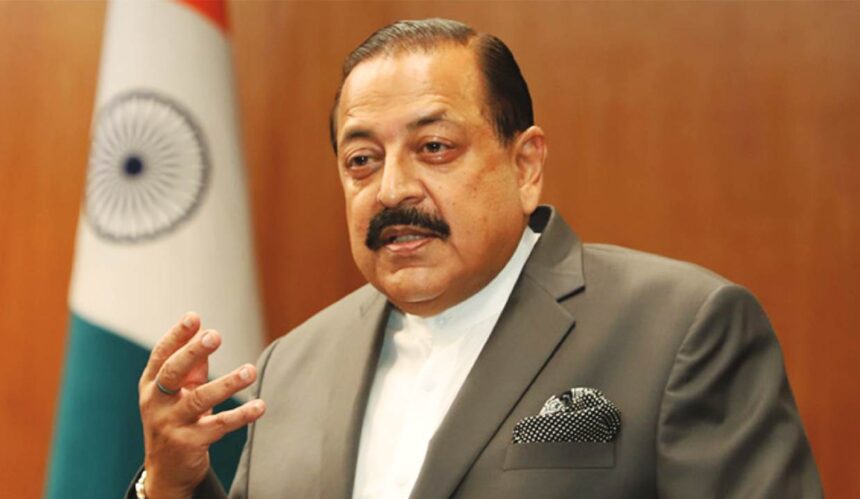
Union Minister of State with independent charge for science and technology and earth sciences, Jitendra Singh, is set to visit the Andaman and Nicobar Islands on January 17, with a focus on unlocking the region’s vast ocean-based economic potential. The visit is expected to centre on enhancing marine fisheries, promoting large-scale seaweed cultivation, and advancing deep-sea exploration initiatives that align with India’s long-term blue economy strategy. Through engagements with scientists and administrators, the minister will review ongoing projects and future plans aimed at increasing oceanic harvests, diversifying livelihoods for coastal communities, and strengthening India’s technological capabilities in marine sciences.
The Andaman and Nicobar Islands occupy a strategically and ecologically significant position in India’s maritime landscape. Despite possessing rich marine biodiversity and substantial untapped resources, the archipelago’s ocean economy remains underutilised. The minister’s visit reflects the government’s intent to bridge this gap by combining scientific innovation, policy support, and sustainable practices. Institutions such as the National Institute of Ocean Technology are expected to play a key role in translating research into scalable solutions that can boost production while preserving fragile marine ecosystems.
Focus on marine fin fish cultivation and seaweed farming to unlock fisheries potential
During his visit, Jitendra Singh will tour the National Institute of Ocean Technology and review a detailed project report on pilot-scale cultivation of marine fin fish, including tuna, cod, and snapper. The initiative is being developed at the Atal Centre for Ocean Science and Technology for Islands at Dollygunj in Sri Vijaya Puram. Officials are expected to brief the minister on how advanced technologies and scientific interventions can significantly increase the oceanic harvest of marine fin fishes, an area where the islands hold enormous untapped potential.
The Andaman and Nicobar archipelago is estimated to have sea harvesting assets of around 1,48,000 tonnes, yet the current annual harvest stands at just over 49,000 tonnes. The gap between potential and actual production is particularly stark in the case of tuna. While the current oceanic tuna harvest is about 4,420 tonnes per year, experts estimate that the region has the capacity to produce up to 60,000 tonnes annually. This disparity highlights both the opportunity and the urgency for targeted interventions in fisheries management, infrastructure, and technology.
Officials accompanying the minister are expected to demonstrate how modern fishing practices, better stock assessment, and offshore cultivation techniques can help close this gap. Increasing tuna and other fin fish production is seen not only as a means to improve food security but also as a way to enhance export earnings and strengthen India’s presence in global seafood markets. For local fishermen, improved harvests could translate into higher incomes and more stable livelihoods, reducing economic vulnerability in island communities.
Another major focus of the visit will be seaweed cultivation, which is emerging as a promising sector within the marine economy. Jitendra Singh will inquire about existing and proposed seaweed farming facilities in the islands, where natural conditions are considered highly favourable. Seaweed is a versatile resource used in a wide range of industries, including cosmetics, pharmaceuticals, food processing, and dye production. Its cultivation is relatively low-impact and can be carried out sustainably, making it an attractive option for coastal and island economies.
The Andaman and Nicobar Islands are home to 244 species of seaweed belonging to 100 genera. Out of these, nearly 58 types are recognised as highly useful and commercially viable. Officials have highlighted that large-scale seaweed farming can provide an alternative source of livelihood for fishermen, especially during off-season periods when fishing activity is limited. Beyond direct employment, seaweed processing, marketing, and trading have the potential to add significant value to the economy and contribute meaningfully to gross domestic product.
Seaweed also holds nutritional and medicinal importance. It contains essential nutrients and bioactive compounds that are believed to help combat diseases such as cancer, diabetes, arthritis, heart ailments, and internal infections. By promoting seaweed cultivation, the government aims to combine economic benefits with health and environmental advantages, positioning the sector as a key pillar of sustainable coastal development.
The government’s commitment to this sector is reflected in the Pradhan Mantri Matsya Sampada Yojana, under which ₹640 crore was earmarked between 2020 and 2025 specifically to promote seaweed culture. The scheme targeted production of more than 11.2 lakh tonnes by 2025 and now aims to boost output to 1.12 million tonnes by 2030. During the visit, the minister is expected to assess progress under the scheme and explore ways to accelerate implementation in the islands.
Deep-sea exploration and Samudrayaan mission highlight strategic importance of Andaman waters
Beyond fisheries and seaweed, Jitendra Singh’s visit will also bring attention to deep-sea exploration and its role in strengthening India’s blue economy. Researchers at the National Institute of Ocean Technology are scheduled to brief the minister on the importance of the Andaman and Nicobar region in the Samudrayaan mission, India’s first manned deep-sea exploration programme. The mission represents a major scientific and technological milestone, aimed at exploring the deep ocean to unlock valuable resources and advance marine research.
The seas surrounding the Andaman and Nicobar Islands are known to be rich in polymetallic nodules, which contain essential metals such as manganese, nickel, copper, and cobalt. These metals are critical inputs for modern industries, including electric vehicles, battery manufacturing, and renewable energy technologies. As global demand for clean energy solutions grows, access to such resources is becoming increasingly strategic.
Deep-sea exploration offers India an opportunity to reduce dependence on imports of critical minerals while strengthening technological self-reliance. Officials are expected to explain how advances under the Samudrayaan mission could enable safe and efficient extraction of polymetallic nodules from the ocean floor. The Andaman region’s proximity to deep-sea sites makes it a key operational base for such missions, further enhancing its strategic significance.
The blue economy framework emphasises the sustainable use of ocean resources for economic growth, improved livelihoods, and environmental protection. By linking fisheries development, seaweed cultivation, and deep-sea exploration, the government aims to create an integrated marine economy that balances growth with conservation. Jitendra Singh’s visit is expected to reinforce this integrated approach, highlighting the role of science and technology in ensuring that ocean resources are harnessed responsibly.
The visit also underscores the importance of research institutions like the National Institute of Ocean Technology in shaping policy and implementation. By translating scientific knowledge into practical solutions, these institutions serve as a bridge between innovation and development. The minister’s interactions with researchers are likely to focus on scaling up pilot projects, addressing technological challenges, and aligning research priorities with national economic goals.
Overall, the Andaman and Nicobar Islands stand at the intersection of ecological richness, strategic location, and economic opportunity. The initiatives reviewed during the visit are aimed at transforming this potential into tangible outcomes for the nation and local communities alike. Through targeted investments, scientific innovation, and sustainable practices, the government envisions the islands as a model for blue economy development that can be replicated across India’s extensive coastline.