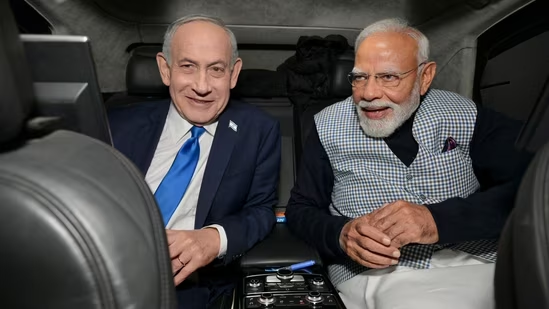
Prime Minister Narendra Modi’s second day in Israel is packed with high-level diplomacy, symbolic remembrance and community outreach, underscoring the deepening strategic partnership between New Delhi and Jerusalem.
Prime Minister Narendra Modi began his second state visit to Israel with a historic address at the Knesset, setting the tone for a visit focused on strengthening bilateral cooperation across security, technology, trade and political engagement. On the second and final day of his visit, the Prime Minister’s schedule reflects both solemn reflection and forward-looking diplomacy, as he engages with Israel’s top leadership and the Indian-Jewish community before departing for New Delhi.
The day’s engagements highlight the maturing India-Israel relationship, which has evolved significantly since Modi became the first Indian Prime Minister to visit Israel in 2017. That landmark trip redefined bilateral ties, elevating cooperation in defence, agriculture, water management and innovation. Nearly a decade later, the relationship stands on firmer ground, shaped by converging strategic interests and expanding economic collaboration.
Modi’s second day begins with a visit to Yad Vashem, Israel’s official memorial to the victims of the Holocaust. Established in 1953 by an act of the Israeli parliament, the institution stands as a solemn tribute to the six million Jews who perished during World War II. The visit carries deep symbolic weight, reaffirming India’s longstanding respect for Jewish history and its unequivocal stand against hatred and extremism.
At Yad Vashem, world leaders traditionally pay homage by laying wreaths and observing moments of silence. Modi’s presence at the memorial reinforces India’s moral and diplomatic positioning as a nation that values pluralism, historical memory and international solidarity. His earlier remarks in Israel have repeatedly emphasised shared democratic values and a mutual commitment to combating terrorism.
Following the memorial visit, the Prime Minister is scheduled to hold bilateral engagements with Israeli President Isaac Herzog. The meeting with the largely ceremonial head of state carries diplomatic importance, symbolising institutional continuity in the relationship. Discussions are expected to touch upon expanding cooperation in education, cultural exchange and technological innovation, areas that have seen growing momentum in recent years.
After a brief interlude, Modi will proceed to delegation-level talks with Israeli Prime Minister Benjamin Netanyahu. These talks form the core of the day’s strategic engagements. Officials from both sides are expected to deliberate on defence cooperation, counter-terrorism strategies, artificial intelligence, quantum technologies and infrastructure investment. The evolving geopolitical landscape, particularly in West Asia, is also likely to feature prominently in their discussions.
The delegation-level talks will be followed by the exchange of memoranda of understanding and joint press statements at the iconic Hotel King David. The venue itself carries historical resonance and has hosted numerous high-level diplomatic meetings over decades. The signing of agreements is expected to further institutionalise cooperation in economic, security and political domains.
According to Israeli officials, the agreements may span a wide spectrum of sectors, reflecting the multidimensional character of bilateral ties. Trade and investment flows have steadily expanded, and both governments are keen to diversify collaboration beyond traditional defence ties into cutting-edge areas such as semiconductor research, cyber security and green technologies.
Strategic partnership deepens across sectors
India and Israel have steadily transformed their relationship into a comprehensive strategic partnership. Defence remains a cornerstone, with Israel emerging as one of India’s key suppliers of advanced military technology. However, the relationship has broadened significantly to include agriculture technology, water conservation systems, renewable energy and digital innovation.
In his address at the Knesset, Modi underscored India’s commitment to further consolidating ties across sectors, including security cooperation and the sharing of advancements in artificial intelligence and quantum computing. These domains are increasingly central to both nations’ economic and strategic futures.
Bilateral trade between the two countries has also demonstrated resilience. In the last fiscal year, total trade between Israel and India, Israel’s second-largest trading partner in Asia, was valued at approximately $3.6 billion. Both sides have expressed intent to elevate this figure substantially in the coming years by encouraging private sector partnerships and joint ventures.
Investment flows have likewise gained traction, with Israeli companies showing interest in India’s startup ecosystem and infrastructure projects. Indian firms, in turn, have invested in Israeli innovation hubs, particularly in cybersecurity and agritech. This cross-pollination of expertise has fostered a dynamic innovation bridge between the two nations.
The geopolitical context further shapes the partnership. Netanyahu publicly acknowledged Modi’s early expression of solidarity with Israel following the October 7, 2023 attacks by Hamas. That gesture was seen in Israel as a clear signal of India’s firm stance against terrorism. Netanyahu praised Modi’s unwavering support, describing it as a reflection of shared democratic values and mutual trust.
For India, engagement with Israel also aligns with its broader West Asia strategy, which seeks to maintain balanced relations across the region while deepening strategic partnerships. New Delhi has consistently emphasised dialogue, stability and economic connectivity in its approach to the region.
Community outreach and symbolic milestones
Beyond high-level diplomacy, Modi’s itinerary includes interaction with prominent members of the Indian-Jewish community at Hotel King David. The Indian-Jewish diaspora, though relatively small in Israel, represents a historic bridge between the two civilizations. Communities such as the Bene Israel and Cochin Jews trace their roots in India back centuries, embodying a legacy of peaceful coexistence.
The meeting is expected to highlight cultural bonds and people-to-people connections that underpin the strategic relationship. India has often showcased its history of providing refuge and acceptance to Jewish communities without episodes of state-sponsored antisemitism, a point frequently referenced in diplomatic exchanges.
Modi’s return flight to New Delhi later in the evening will conclude a visit that blends symbolism with substance. His 2017 trip marked a watershed moment as the first-ever standalone visit by an Indian Prime Minister to Israel, breaking with earlier diplomatic hesitations rooted in regional sensitivities. Netanyahu’s reciprocal visit to India the following year further cemented the momentum.
Over the years, the two leaders have cultivated a visible rapport, often characterised by warm public gestures and strong political messaging. This personal chemistry has translated into institutional mechanisms for cooperation, including joint working groups and innovation funds.
As the visit unfolds, it signals continuity rather than departure in India-Israel relations. The second day’s engagements encapsulate remembrance at Yad Vashem, state-level diplomacy with President Herzog, strategic deliberations with Prime Minister Netanyahu and outreach to the Indian-Jewish community. Together, these engagements reflect a partnership that has matured into one of India’s most significant relationships in West Asia, driven by shared interests, democratic values and an expanding economic footprint.