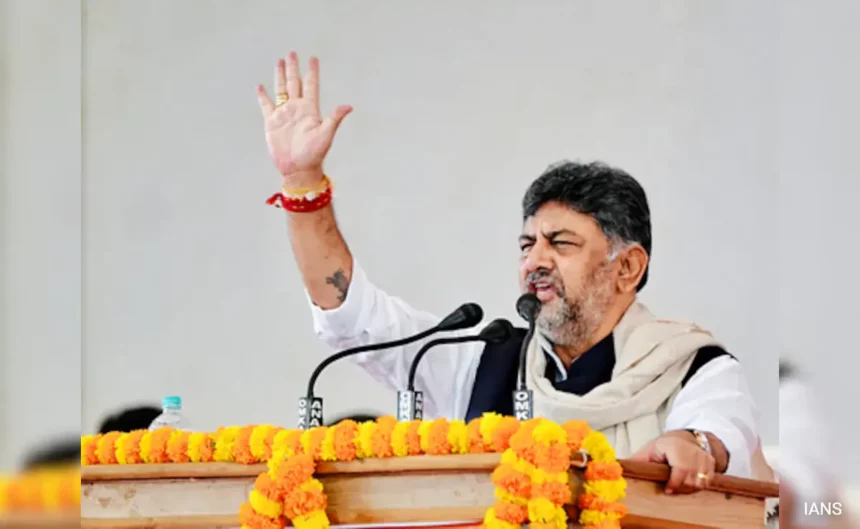
The political developments gained traction on Thursday, when Karnataka Minister N Chaluvarayaswamy and MLAs Iqbal Hussain, H C Balakrishna, and S R Srinivas reportedly left for New Delhi. Their visit, sources indicated, was aimed at meeting senior Congress leadership and reinforcing Shivakumar’s claim to the chief minister’s post. Although such visits are not entirely unusual in national parties where regional leaders consult the high command periodically, the timing has sharply amplified internal tensions.
The trigger for renewed political speculation was the symbolic milestone achieved by Chief Minister Siddaramaiah, who completed two and a half years in office on Wednesday. The tenure’s midpoint is significant because, shortly after the May 2023 election victory, strong rumours emerged that the Congress had agreed to implement a rotational formula: Siddaramaiah would serve the first half of the five-year term, followed by D K Shivakumar for the remaining period. The party never publicly confirmed this arrangement, but the narrative of a “secret compromise” became deeply embedded in state political discourse.
Siddaramaiah, for his part, dismissed such reports outright, asserting firmly that he would remain chief minister for a full five-year term. His public stand was repeated several times over the past year, each time accompanied by efforts to project stability, seniority, and administrative continuity. However, many in the state Congress have continued to believe that such a rotation could still be activated at the “appropriate moment” if the party high command so decides.
Political observers note that the movement of Shivakumar loyalists to Delhi is unlikely to be a spontaneous decision. Instead, it appears to be a coordinated signal to the high command that a section of the party expects the alleged rotational promise—if indeed it was made—to be honoured. Several legislators aligned with Shivakumar have openly spoken in the past about his eligibility and seniority, arguing that he commands immense organisational influence, financial expertise, and mass appeal, making him a natural claimant to the chief minister’s chair.
The current situation echoes the intense competition witnessed immediately after the 2023 Assembly election results were declared on May 20. At that time, both Siddaramaiah and Shivakumar had emerged as strong contenders for the top post, each enjoying significant internal support. The party eventually balanced the equation by appointing Siddaramaiah as chief minister and Shivakumar as deputy chief minister, a compromise that temporarily alleviated internal friction.
Sources indicated on Thursday that up to a dozen more MLAs are likely to reach Delhi on Friday, further intensifying the indications of a coordinated political effort. The political capital, therefore, appears poised to host several rounds of discussions and negotiations that could influence the balance of power in Karnataka’s government.
Adding to the movement, reports emerged earlier in the week that around a dozen Congress MLCs had already spent days in the national capital, speaking to the party’s general secretaries. Their presence suggests that the effort to mobilize organisational support for Shivakumar has been under way for some time.
The situation places the Congress leadership in a delicate position. While the party has historically relied on central intervention to manage competing ambitions, any change in the chief ministership carries major implications for governance, public messaging, and electoral strategy ahead of the 2028 Assembly elections and the Lok Sabha polls.
Siddaramaiah Projects Confidence While Shivakumar Maintains Ambiguous Posture as Supporters Press the High Command
While the movement of Shivakumar loyalists has created ripples in Bengaluru’s political circles, Chief Minister Siddaramaiah appeared calm and confident. Addressing a public gathering in Chamarajanagar on Thursday, he hinted clearly that he expects to continue as chief minister for the full term. He told the audience that his position had been strong from the beginning and would remain strong in the future. This message was widely interpreted as an affirmation that he intends to stay in office irrespective of internal lobbying.
Shivakumar, meanwhile, responded with characteristic restraint when questioned by reporters about the MLAs travelling to Delhi. He said he was unaware of the developments and noted that he was unwell. When asked specifically about Siddaramaiah’s assertion that he would complete a full five-year term, Shivakumar replied, “I am very glad about it. No one has said no. No one questioned that he will not be the chief minister.”
His response, while calm on the surface, did little to settle the speculation. Shivakumar reiterated that the party had given Siddaramaiah the responsibility to serve as chief minister and that all leaders were working together. Political analysts suggest that his statements are carefully balanced—avoiding open confrontation while still leaving room for negotiation.
Reporters also asked him about the meeting with Congress MLCs at his residence, to which he clarified that the discussions pertained to electing the chairman and deputy chairman of the legislative council from the Congress. While the explanation appeared routine, the accumulation of interactions involving MLAs, MLCs, and other leaders has contributed to a sense of political unease.
In another significant development, Shivakumar’s brother and former MP D K Suresh weighed in on the debate. Speaking to reporters, he said that Chief Minister Siddaramaiah “never backtracks from his promises.” When asked whether this included any promise made to Shivakumar regarding rotation of the chief ministership, Suresh said he had no knowledge of such an understanding. He added, somewhat cryptically, that questions of this scale should be addressed to “big leaders,” implying that the decisions now lie entirely with the Congress high command.
He also indicated that Shivakumar has already communicated everything necessary to the party’s senior leadership. Ultimately, he said, the decision rests with the party president and leaders such as Rahul Gandhi. This comment reinforced the idea that the leadership question has entered a decisive phase in New Delhi, rather than being a matter for the Karnataka legislature alone.
Political analysts argue that the situation is emblematic of the Congress party’s long-standing challenges with internal factionalism. Karnataka has historically been one of the party’s strongest states, and the 2023 victory was seen as a revival of its electoral fortunes. However, internal rivalries have often hindered the party’s ability to maintain stable governance.
The current tension arises at a time when the Siddaramaiah government is attempting to implement major welfare programs, manage fiscal pressures, and navigate the demands of different caste and regional blocs. Any disruption in leadership could have far-reaching implications, including potential instability within the government and a weakening of public confidence.
At the same time, Shivakumar remains a dominant force within the party’s organizational structure. His reputation as a political strategist and resource mobilizer gives him significant influence, especially among legislators. This makes the current situation particularly sensitive for the Congress high command, which must balance competing ambitions without risking internal collapse.
The days ahead are likely to involve intense political negotiations, internal reviews, and possibly difficult decisions for the party leadership. With multiple MLAs and MLCs mobilizing, the balance of power within Karnataka Congress is visibly shifting, and both factions are preparing for outcomes that could reshape the future of the government.