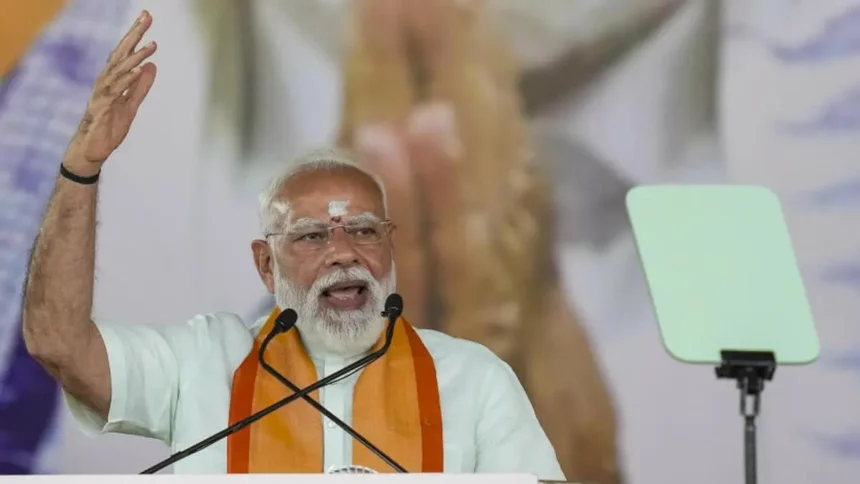
The political landscape of Tamil Nadu has once again come into sharp focus as Prime Minister Narendra Modi strongly criticized the ruling DMK government, alleging poor governance and administrative failures. Addressing party workers and supporters, he emphasized the role of BJP karyakartas in exposing governance gaps and bringing public concerns to the forefront. His remarks underline not just a critique of the current state administration but also signal a broader strategy by the BJP to expand its footprint in a state where it has traditionally struggled to gain dominance.
BJP’s Expanding Grassroots Network and Strategic Political Messaging
Narendra Modi’s speech highlighted the growing presence of BJP workers across Tamil Nadu, portraying them as a committed force working tirelessly to connect with citizens and raise awareness about governance shortcomings. According to him, party karyakartas have played a crucial role in identifying issues at the grassroots level, ranging from public service inefficiencies to broader concerns related to development and accountability. This narrative positions BJP workers not merely as political activists but as agents of change who are actively engaging with the everyday struggles of people.
The emphasis on grassroots mobilization is a key aspect of the BJP’s strategy in Tamil Nadu. Historically dominated by regional parties like the DMK and AIADMK, the state presents a challenging political terrain for national parties. By focusing on local-level engagement, the BJP aims to gradually build trust and credibility among voters. Modi’s remarks suggest that the party is attempting to redefine its image in the state by aligning itself with public concerns and presenting itself as a viable alternative to the existing political establishment.
The messaging also reflects a broader attempt to create a narrative around governance accountability. By repeatedly highlighting what he describes as the failures of the DMK government, Modi seeks to frame the political discourse in terms of performance and delivery rather than identity-based politics, which has historically played a significant role in Tamil Nadu. This shift in narrative is designed to appeal to a younger and more aspirational voter base that prioritizes development, transparency, and efficient administration.
At the same time, the Prime Minister’s statements reinforce the importance of party discipline and dedication. He praised BJP karyakartas for their commitment, portraying them as the backbone of the party’s efforts in the state. This emphasis serves a dual purpose: it motivates party workers while also sending a message to voters that the BJP is building a strong organizational structure capable of addressing local issues effectively.
The focus on grassroots activism also ties into the BJP’s broader national strategy of strengthening its presence in states where it has historically been weak. Tamil Nadu, with its unique political culture and strong regional identities, represents both a challenge and an opportunity. By investing in grassroots networks, the BJP aims to gradually erode the dominance of regional parties and establish itself as a credible contender in the state’s political arena.
Critique of DMK Governance and the Battle for Public Perception
A central theme of Narendra Modi’s address was his critique of the DMK government’s performance. He alleged that the state administration has failed to meet the expectations of the people, pointing to issues related to governance, development, and public welfare. While specific examples were not elaborated in detail, the broader message was clear: the BJP intends to position itself as a party that prioritizes good governance and accountability.
This criticism is part of a larger political battle for public perception. In a state where regional parties have long enjoyed strong support, shaping the narrative around governance is crucial for any challenger. By focusing on alleged shortcomings, the BJP aims to create a sense of dissatisfaction among voters and present itself as a viable alternative capable of delivering better outcomes.
The emphasis on governance also reflects a broader trend in Indian politics, where performance and delivery are increasingly becoming central to electoral success. Voters are more informed and connected than ever before, and their expectations from elected representatives have evolved accordingly. In this context, highlighting governance issues becomes a powerful tool for opposition parties seeking to challenge incumbents.
Narendra Modi’s remarks also underscore the importance of communication in modern politics. By publicly acknowledging the efforts of BJP workers in exposing governance issues, he amplifies their impact and ensures that their work reaches a wider audience. This approach not only boosts the morale of party workers but also helps in shaping public opinion by reinforcing the narrative of administrative failure.
At the same time, the critique of the DMK government is carefully balanced with a positive portrayal of the BJP’s vision. Modi emphasized the party’s commitment to development, transparency, and inclusive growth, positioning it as a forward-looking alternative. This dual strategy of criticism and constructive vision is a hallmark of effective political communication, as it allows the party to highlight existing problems while also offering solutions.
The political implications of this approach are significant. By framing the discourse around governance and accountability, the BJP seeks to move beyond traditional political divides and appeal to a broader cross-section of voters. This includes not only its core supporters but also undecided voters who may be dissatisfied with the current administration.
Furthermore, the focus on Tamil Nadu reflects the BJP’s broader ambition to expand its influence in southern India. While the party has made significant inroads in states like Karnataka and Telangana, Tamil Nadu remains a challenging frontier. Modi’s remarks indicate that the party is intensifying its efforts to gain a foothold in the state, leveraging both organizational strength and strategic messaging.
The emphasis on exposing governance failures also highlights the role of political competition in a लोकतांत्रिक system. By holding the ruling party accountable and bringing issues to light, opposition parties contribute to a more informed and engaged electorate. In this sense, the BJP’s strategy can be seen as part of a larger democratic process that encourages debate, scrutiny, and accountability.
At the same time, the success of this approach will depend on the party’s ability to translate its messaging into tangible electoral gains. While criticism of the ruling government can create momentum, it must be accompanied by a credible alternative that resonates with voters. This includes not only policy proposals but also a strong local leadership capable of connecting with the electorate.
Narendra Modi’s address thus serves as both a critique of the current administration and a statement of intent for the future. It reflects the BJP’s determination to expand its presence in Tamil Nadu and its belief that a focus on governance and grassroots engagement can help it achieve this goal. As the political landscape continues to evolve, the effectiveness of this strategy will become clearer in the coming years.