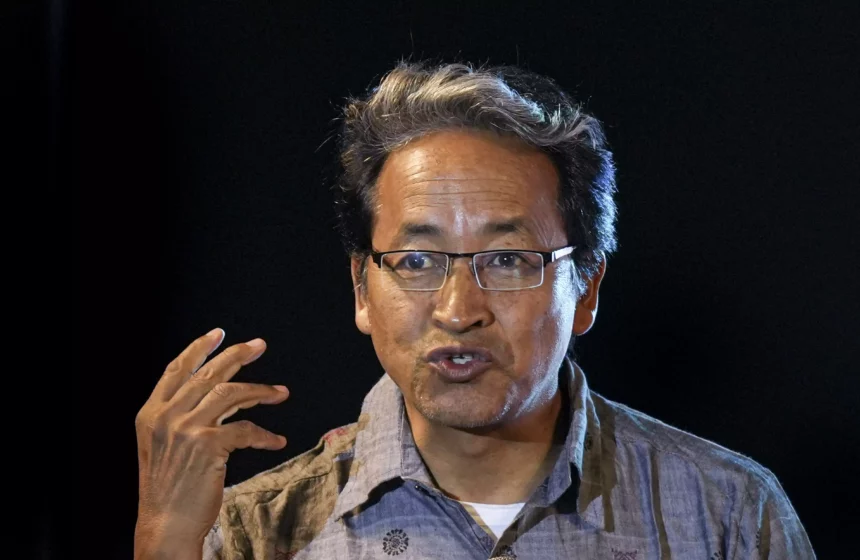
The detention of Ladakh-based activist Sonam Wangchuk under the National Security Act has sparked renewed debate after his wife, Gitanjali Angmo, alleged that he is being held in harsh conditions and that the government is deliberately delaying legal proceedings because it lacks a strong case. Speaking publicly for the first time in detail, Angmo said Wangchuk is sleeping on a blanket on the jail floor without basic furniture and is confined to a cramped barrack with barely enough space to move. Her remarks have brought fresh attention to the circumstances surrounding Wangchuk’s arrest, the legal process under the NSA, and the broader political and constitutional issues linked to protests in Ladakh.
Sonam Wangchuk was detained on September 26, 2025, under the NSA, two days after violent protests erupted in Leh over demands for statehood and inclusion under the Sixth Schedule of the Constitution. The protests resulted in four deaths and left around 90 people injured, prompting authorities to invoke stringent measures. Since then, Wangchuk’s detention has remained a contentious issue, with supporters questioning both the necessity and legality of the action. Angmo’s statements have added a personal and human dimension to the legal and political debate, highlighting not only alleged procedural lapses but also the psychological and physical conditions of confinement.
Allegations of harsh confinement and procedural violations raise questions over legality of detention
In an interview, Gitanjali Angmo described Wangchuk’s jail conditions as stark and dehumanising. She said her husband does not have a bed or any furniture and is forced to sleep on a blanket laid out on the floor. According to her, the barrack where he is housed is so small that he cannot walk properly inside it. She portrayed these conditions as especially troubling given that Wangchuk is a non-violent activist and educator with a long history of peaceful advocacy for Ladakh’s environmental and constitutional rights.
Angmo also raised serious concerns about the legal process followed in Wangchuk’s detention. She alleged that the government is repeatedly seeking adjournments in court because it is aware that the case lacks substance. According to her, the Solicitor General has been asking for one date after another, prolonging the matter and delaying judicial scrutiny. She expressed concern that this strategy is effectively punishing Wangchuk without a trial, which goes against the spirit of constitutional safeguards.
One of Angmo’s central allegations relates to procedural violations under the National Security Act. She stated that under the NSA, a detained person is supposed to be provided with all relevant documents, evidence, and materials relied upon for detention within five to ten days. In Wangchuk’s case, she claimed that crucial video materials were provided only on the 28th day after his detention. This delay, she argued, is a clear violation of Section 8 of the NSA and should be sufficient grounds for revoking the detention order.
Because of the delayed supply of documents, Angmo said Wangchuk was unable to effectively present his defence before the advisory board, which reviews NSA detentions. She maintained that timely access to evidence is essential for a detainee to exercise the limited rights available under preventive detention laws. Without this, she argued, the process becomes arbitrary and undermines the principles of natural justice.
Angmo also questioned the basis of the detention itself. She pointed out that out of the five FIRs cited to justify Wangchuk’s detention, his name does not appear in three. Of the remaining two FIRs where his name is mentioned, one dates back to August 2025, yet no notice was issued to him and no interrogation was conducted in that case. This, she argued, further weakens the government’s claim that his detention was necessary to prevent threats to public order or national security.
She alleged that the detention order issued by the district magistrate appears to be a verbatim reproduction of the police proposal, suggesting a lack of independent application of mind. According to her, the law requires the detaining authority to carefully evaluate the material placed before it, not merely copy official submissions. Such mechanical approval, she said, raises serious doubts about the fairness and legality of the detention.
While making these allegations, Angmo emphasised that she does not wish to politicise the matter. However, she said she is deeply troubled by what she described as unnecessary delays in court proceedings. She accused the central government of repeatedly seeking more time instead of allowing the judiciary to examine the case on its merits, thereby prolonging Wangchuk’s incarceration.
Silence, resilience, and life inside jail as Wangchuk documents his experience
Beyond legal arguments, Angmo expressed disappointment over what she perceives as a lack of strong and united public protest against Wangchuk’s detention. She said she had expected a louder and more collective voice in defence of her husband, given his standing as a respected activist and educator. According to her, the issue goes beyond one individual and touches upon broader questions of democratic dissent, civil liberties, and the use of preventive detention laws.
Despite the circumstances, Angmo described Wangchuk as remaining mentally resilient and creatively engaged during his time in jail. She revealed that he is writing a book based on his experiences behind bars, which may be titled “Forever Positive.” According to her, the writing process has become a way for him to reflect, observe, and maintain a sense of purpose despite restrictions.
Angmo shared small but telling details about Wangchuk’s daily life in custody. She said he has spent time observing ants and their behaviour within the jail premises and has asked her to bring him books on ant communities. He is reportedly fascinated by the unity, discipline, and teamwork displayed by ants, which he sees as a subject worth studying. This curiosity, she suggested, reflects his enduring interest in learning and understanding systems, even in confinement.
She also mentioned that for a long period, Wangchuk did not even have access to a clock. Because detainees are not allowed to keep any devices, including mechanical watches, he reportedly asked for books on sundials to understand timekeeping through natural means. These anecdotes, Angmo said, illustrate how Wangchuk is adapting intellectually to restrictive conditions while continuing to observe and analyse the world around him.
Wangchuk’s detention must also be viewed in the broader context of the protests in Ladakh that preceded his arrest. The demonstrations in Leh were driven by demands for statehood and inclusion under the Sixth Schedule, which would provide constitutional safeguards for land, jobs, and cultural identity. The protests turned violent, leading to deaths and injuries, after which authorities moved swiftly to restore order. Wangchuk’s detention under the NSA was justified by the administration as a preventive measure, though critics argue that it conflates peaceful advocacy with threats to security.
Angmo’s statements have reignited debate on the use of the National Security Act, a law that allows detention without trial for extended periods. Civil liberties groups and legal experts have long argued that such laws are prone to misuse and lack adequate safeguards. The allegations raised in Wangchuk’s case, particularly regarding delayed documentation and questionable reliance on FIRs, are likely to intensify scrutiny of how the NSA is applied in politically sensitive situations.
As the legal process continues, Angmo said her focus remains on securing justice for her husband rather than engaging in political confrontation. She reiterated that her concern is the rule of law and the proper functioning of constitutional protections. Her account of Wangchuk’s jail conditions and mental resilience has added a deeply personal layer to a case that sits at the intersection of national security, democratic dissent, and individual rights.