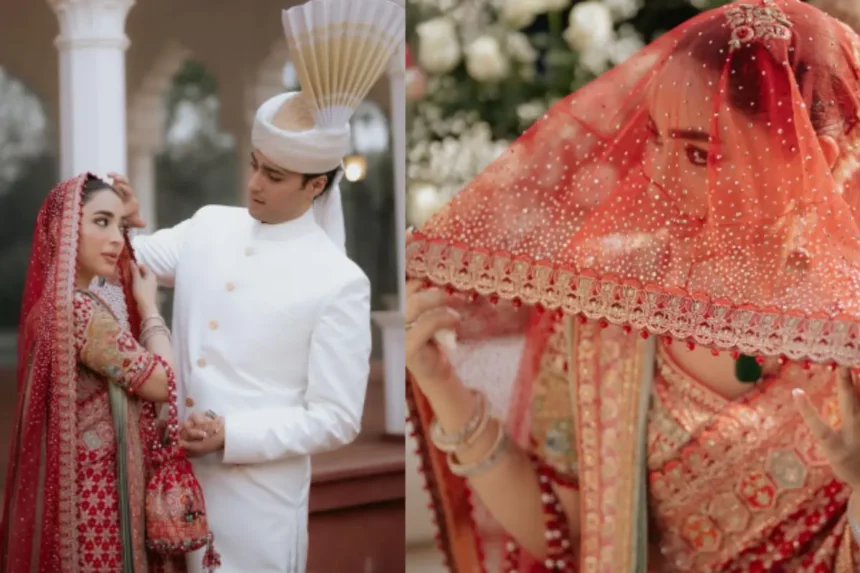
The wedding of Junaid Safdar, grandson of former Pakistan Prime Minister Nawaz Sharif, has unexpectedly ignited a heated debate across Pakistan after it emerged that the bride wore outfits designed by leading Indian fashion designers. What was meant to be a high-profile family celebration quickly turned into a social media flashpoint, with many Pakistanis questioning the Sharif family’s choice of Indian designers for such a prominent wedding. The controversy has blended discussions of fashion, nationalism, hypocrisy, and personal freedom, revealing deep sensitivities about India–Pakistan relations even in matters of culture and lifestyle.
Junaid Safdar, son of Punjab Chief Minister Maryam Nawaz, married Shanze Ali Rohel in Lahore in a ceremony attended by Pakistan’s political elite, including Prime Minister Shehbaz Sharif and Deputy Prime Minister Ishaq Dar. While the wedding itself drew attention because of the family’s stature, it was the bride’s attire at different ceremonies that dominated online conversations. Images from the mehndi and wedding functions went viral, leading to sharp reactions that quickly spread across social media platforms.
Indian designer outfits at Lahore wedding trigger accusations of hypocrisy and political double standards
The controversy began after photographs surfaced showing Shanze Ali Rohel wearing a green lehenga designed by renowned Indian designer Sabyasachi Mukherjee at the mehndi ceremony. The lehenga featured traditional motifs, multicoloured panels, heavy zari embroidery, and a thick golden border, paired with green and pink dupattas. Many observers praised the craftsmanship and aesthetic appeal of the outfit, but the designer’s Indian origin soon became the focal point of criticism.
Social media users in Pakistan questioned why a member of one of the country’s most powerful political families would choose an Indian designer, especially given the Sharif family’s long association with nationalist rhetoric and strained India–Pakistan relations. Several users accused the family of hypocrisy, arguing that political leaders who speak of patriotism and national pride should support local designers instead of turning to Indian brands for personal celebrations. Some comments suggested that the choice undermined Pakistan’s own fashion industry, which is widely regarded as rich, diverse, and globally competitive.
The debate intensified further when images from the wedding ceremony showed the bride wearing a red saree designed by another prominent Indian designer, Tarun Tahiliani. The saree featured heavy golden embroidery, a thick embellished border, and a subtle sheen that gave it a regal appearance. Paired with a green stone necklace that contrasted with the red fabric, the look drew admiration from fashion enthusiasts but also renewed criticism from those who felt the Sharif family was sending the “wrong message” by repeatedly opting for Indian designers.
Adding to the discussion, reports indicated that Maryam Nawaz herself wore a powder-blue lehenga designed by Indian designer Abhinav Mishra at the mehndi ceremony, reportedly priced at around four lakh Pakistani rupees. For critics, this reinforced the perception that the family was deliberately favouring Indian designers despite political tensions between the two countries. Many users listed well-known Pakistani designers and questioned why none of them were chosen for such a high-profile event rooted in Pakistani political life.
The backlash reflected broader frustrations among some sections of Pakistani society, where India is often portrayed as a political rival and cultural competitor. For these critics, fashion was not merely a personal choice but a symbolic act loaded with national meaning. The fact that the controversy involved the family of a former prime minister amplified these sentiments, turning a wedding wardrobe into a national talking point.
Supporters defend personal choice, highlight cross-border cultural exchange and fashion without borders
While criticism dominated parts of social media, a significant number of users came forward to defend Shanze Ali Rohel and the Sharif family, arguing that clothing choices are personal and should not be politicised. Supporters said that fashion transcends borders and that art, craftsmanship, and creativity should not be restricted by political disputes. They pointed out that cultural exchange between India and Pakistan has existed for decades, particularly in music, cinema, and fashion, despite diplomatic tensions.
Many users highlighted that Indian celebrities and brides have often worn outfits designed by Pakistani designers, especially for formal wear and bridal couture. According to them, cross-border admiration in fashion is not new and should be seen as a sign of shared cultural heritage rather than betrayal or hypocrisy. Some commenters argued that the criticism unfairly targeted the bride, who should not be held accountable for broader political narratives or ideological expectations.
Fashion enthusiasts also focused on the craftsmanship of the outfits themselves. Sabyasachi Mukherjee is internationally known for blending traditional Indian techniques with modern aesthetics, particularly in bridal wear. His designs have been worn by some of the most high-profile figures in Indian cinema, making his creations highly sought after across South Asia. Similarly, Tarun Tahiliani is celebrated for his luxurious interpretations of Indian textiles and silhouettes, with decades of influence in the global fashion industry.
Supporters of the bride argued that choosing such designers was a reflection of aesthetic preference and appreciation for craftsmanship rather than a political statement. They said that weddings, especially within elite families, often involve international designers and global influences, and singling out Indian designers was selective outrage. For many, the controversy revealed how deeply politics can intrude into private lives in South Asia.
Beyond the fashion debate, the wedding itself carried personal significance. This was Junaid Safdar’s second marriage. He was previously married to Ayesha Saif in 2021, and the couple divorced two years later, with Junaid announcing the separation publicly in 2023. His marriage to Shanze Ali Rohel, granddaughter of senior political leader Sheikh Rohel Asghar from Nawaz Sharif’s own party, was therefore seen as both a personal new beginning and a union within influential political circles.
The presence of top political leaders at the nikah ceremony underscored the importance of the event, but it also meant that every detail, including clothing, was subject to public scrutiny. In this context, the fashion choices became symbolic far beyond their original intent, reflecting how public figures in Pakistan are often expected to align personal decisions with national sentiment.
The episode has once again highlighted the complex relationship between culture and politics in the subcontinent. While borders and diplomacy remain contentious, shared traditions, aesthetics, and tastes continue to overlap. The strong reactions to the Sharif family wedding demonstrate how unresolved political tensions can spill into cultural spaces, even as many people on both sides of the border continue to admire and consume each other’s art and fashion.
As the debate continues online, the wedding of Junaid Safdar and Shanze Ali Rohel has become more than a family celebration. It has turned into a reflection of Pakistan’s internal conversations about identity, nationalism, and the extent to which personal choice should be influenced by politics. Whether criticised or defended, the bride’s Indian-designed lehenga has undeniably sparked a broader discussion that goes far beyond fashion.