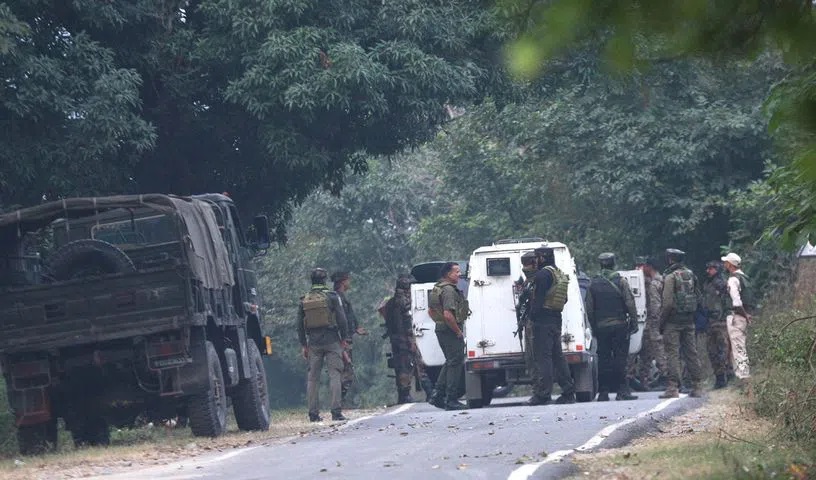
At least eight Indian Army personnel were injured during a fierce encounter with militants in the hilly Sonar area of Kishtwar district in Jammu and Kashmir, underscoring the persistent security challenges in the region’s high-altitude forest belts. The incident occurred on Sunday afternoon during an ongoing counterterrorism mission, Operation Trashi-1, being carried out by the army’s White Knight Corps. Three of the injured soldiers were airlifted to the Udhampur Army Base Hospital for advanced medical treatment, while others are being treated locally. The operation remains underway, with security forces intensifying search efforts to neutralise the militants believed to be hiding in the area.
The encounter highlights a continuing pattern of sporadic but dangerous militant activity in parts of Jammu and Kashmir, particularly in remote and forested zones that offer natural cover. Despite harsh weather conditions and difficult terrain, security forces have maintained sustained operations to prevent militant regrouping and infiltration. The latest incident in Kishtwar has once again drawn attention to the risks faced by soldiers operating in such environments and the evolving tactics employed by terrorist groups.
Grenade attack during close encounter injures soldiers as multi-agency search intensifies
According to officials, the encounter broke out when security forces surrounded a group of two to three militants during a search operation in the upper reaches of Sonar. As the cordon tightened, the militants retaliated with heavy firing and hurled grenades at the advancing troops, leading to injuries among the soldiers. The exchange of fire continued for some time before the militants managed to slip into the dense forest cover, prompting an expanded search operation.
The injured soldiers were immediately evacuated from the encounter site. Three of them were airlifted to the Udhampur Army Base Hospital due to the severity of their injuries, while the remaining personnel received prompt medical attention on the ground. Officials said all injured soldiers are stable, and their condition is being closely monitored by military doctors.
The operation is being conducted jointly by the Indian Army, Jammu and Kashmir Police, and the Central Reserve Police Force. Advanced surveillance tools, including drones, are being used to scan the rugged terrain, while sniffer dogs have been deployed to track the movement of the militants. The area has been placed under tight security, with additional troops rushed in to prevent the militants from escaping or regrouping.
Initial assessments suggest that the militants involved may be linked to the Jaish-e-Mohammed terror outfit, which has previously been active in parts of the Jammu region. However, officials cautioned that confirmation of the group’s identity will depend on the outcome of the ongoing operation and further intelligence inputs. The White Knight Corps has stated that Operation Trashi-1 will continue until the area is fully sanitised and the threat neutralised.
The Sonar area of Kishtwar, characterised by steep slopes, thick forests, and limited civilian presence, has emerged in recent years as a vulnerable zone for militant movement. Security forces have been maintaining a heightened presence in the region, especially after intelligence inputs pointed to the possibility of militants using these high-altitude routes to evade detection. The latest encounter reflects both the complexity of counterterrorism operations in such terrain and the determination of forces to maintain pressure on militant networks.
Recent encounters highlight sustained security challenges and sacrifices in Jammu and Kashmir
The Kishtwar encounter is part of a broader pattern of militant activity and counterterrorism operations witnessed across Jammu and Kashmir over the past several months. In December 2025, two Special Operations Group personnel were injured during an encounter near Sohan village in the Majalta area of Udhampur. That incident followed an earlier exchange in which a Jammu and Kashmir Police soldier was martyred, highlighting the continued risks in the region.
Kishtwar itself has seen multiple incidents in recent months. On November 4, 2025, another encounter in the district left one soldier injured after terrorists were reported hiding in the Kalaban forest area of Chhatru. Intelligence sources have indicated that militant groups have been active in these forested zones for several months, taking advantage of the terrain to evade security forces. Sporadic terrorist activity has been observed in high-altitude areas over the past year, prompting sustained deployment of troops even during extreme weather.
Other parts of Jammu and Kashmir have also witnessed significant encounters. On October 13, 2025, security forces killed two terrorists during a 12-hour-long operation in Kupwara’s Kumbakdi forest near the Line of Control. The operation successfully foiled an infiltration attempt from across the border, though it underscored the persistence of cross-border threats. Earlier, on September 8, 2025, two terrorists were killed in Kulgam during Operation Guddar, though the encounter also resulted in the deaths of two injured soldiers, reflecting the high human cost of such missions.
The period between March and August 2025 was particularly deadly, with at least seven security personnel martyred in encounters and cross-border firing. Incidents included the martyrdom of an Indian Army soldier in Baramulla following a shootout near the Line of Control in August, the death of Lance Naik Dinesh Kumar during Pakistani shelling in May, and the killing of Junior Commissioned Officer Kuldeep Chand in an encounter in Akhnoor in April. In March, a major encounter in Kathua resulted in the deaths of four Special Operations Group soldiers and injuries to several others, including a deputy superintendent of police.
These incidents collectively illustrate the evolving nature of the security situation in Jammu and Kashmir. While large-scale militant violence has declined compared to earlier years, smaller groups operating in remote areas continue to pose serious threats. Security forces have responded with a strategy of sustained operations, improved intelligence coordination, and the use of technology to monitor difficult terrain.
The ongoing Operation Trashi-1 in Kishtwar reflects this approach. Despite injuries to personnel, the operation has not been called off, signalling the resolve of security agencies to prevent militants from establishing safe havens. Officials have reiterated that the safety of civilians and the elimination of terrorist threats remain top priorities, even as troops operate under challenging conditions of terrain, weather, and persistent danger.
As the search continues in Sonar, the focus remains on tracking down the militants involved in the latest attack and preventing any further casualties. The incident serves as a reminder of the sacrifices made by security forces and the continuing vigilance required to maintain peace and stability in Jammu and Kashmir.