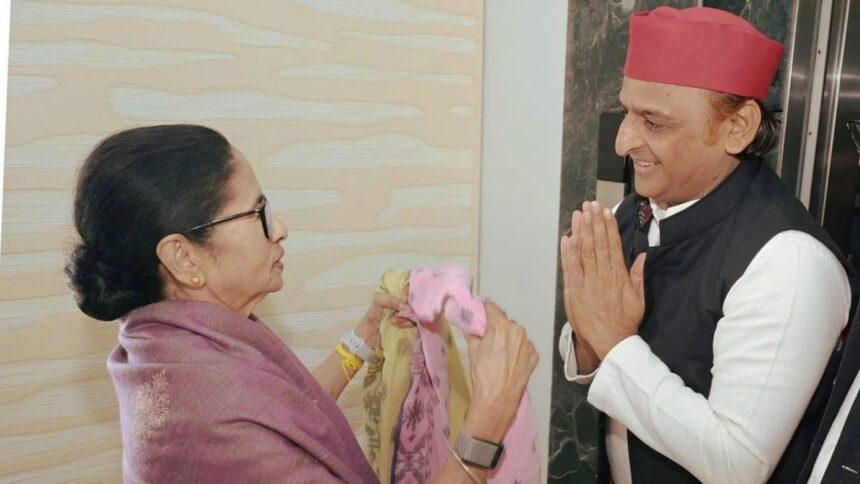
As political activity intensifies ahead of the West Bengal Assembly elections, Samajwadi Party chief Akhilesh Yadav has made a strong statement positioning Chief Minister Mamata Banerjee as the central figure in the national opposition’s fight against the Bharatiya Janata Party. Speaking in Kolkata after meeting the Bengal chief minister at Nabanna, Akhilesh asserted that Banerjee is the only leader who has consistently and successfully confronted the BJP through political struggle, expressing confidence that she will secure a fourth consecutive term in office.
The meeting, though described as brief, carried significant political weight. It came at a time when opposition parties across the country are reassessing leadership, strategy, and unity in the face of the BJP’s continued dominance at the national level. Akhilesh’s remarks have therefore been seen not merely as praise for a regional leader, but as a broader signal about where parts of the opposition see effective resistance emerging.
Akhilesh Yadav’s endorsement and attack on central agencies
After the meeting, Mamata Banerjee and Akhilesh Yadav jointly addressed the media. The chief minister explained that the interaction was short due to time constraints, but Akhilesh used the opportunity to deliver a sharp political message. He said that central agencies had already failed in their attempts to weaken Mamata Banerjee in Bengal and predicted that the BJP would meet the same fate in the state.
Referring specifically to the Enforcement Directorate, Akhilesh remarked that the agency had “already lost to Didi,” adding that the BJP would be defeated next. His statement reflected a long-standing opposition narrative that central investigating agencies are being misused for political purposes. Akhilesh argued that such tactics have not only failed to dent Mamata Banerjee’s popularity in West Bengal but have instead strengthened her political standing.
He cited recent Enforcement Directorate raids at the office of I-PAC and at the residence of its chief, Prateek Jain, as examples of what he described as politically motivated actions. According to Akhilesh, the BJP remains fixated on controversies such as the alleged pen drive issue, unable to accept that Mamata Banerjee has repeatedly withstood pressure from central agencies. In his view, the saffron party’s reliance on investigations and raids reflects political frustration rather than confidence.
The Samajwadi Party leader extended this criticism to a broader national context, suggesting that similar patterns of agency action have been witnessed in other opposition-ruled states. By highlighting Bengal as an example where such strategies have failed, Akhilesh sought to project Mamata Banerjee as proof that sustained political resistance, backed by popular support, can neutralise institutional pressure.
His remarks also reinforced the growing closeness between the Trinamool Congress and the Samajwadi Party, two regional forces that see themselves as key pillars of any effective anti-BJP front. While neither leader spoke explicitly about formal alliances beyond their respective states, the symbolism of the meeting and the language used by Akhilesh suggested an attempt to build momentum around opposition solidarity.
SIR row, Election Commission criticism, and fourth-term confidence
Standing alongside Mamata Banerjee, Akhilesh Yadav also strongly criticised the Special Intensive Revision process, commonly referred to as SIR, raising concerns about its impact on the electoral process. He accused both the BJP and the Election Commission of India of acting with political intent, alleging that voter list exercises were being used selectively to influence election outcomes.
According to Akhilesh, the BJP is heading towards defeat in West Bengal, and that is why such measures are being deployed to cut votes. He alleged that the Election Commission has been turned into a political weapon, a charge that echoes similar accusations made by opposition leaders in other states. These statements underline the level of distrust that currently characterises the relationship between the opposition and central institutions.
Akhilesh’s comments on SIR were significant because they tied administrative processes directly to electoral strategy. By questioning the neutrality of the Election Commission, he framed the upcoming Bengal elections not just as a contest between parties but as a test of democratic safeguards. This narrative aligns closely with Mamata Banerjee’s long-standing political messaging, which often centres on federalism, state rights, and resistance to central overreach.
Reiterating his confidence in Mamata Banerjee’s leadership, Akhilesh declared that there was no uncertainty about the election outcome in Bengal. He said the BJP would not succeed in the state and that “Didi will become Chief Minister for the fourth time.” Such an assertion was notable for its certainty, especially given the high-stakes nature of the upcoming polls and the BJP’s sustained efforts to expand its footprint in West Bengal.
Mamata Banerjee, for her part, maintained a measured tone during the interaction, but the optics of the meeting reinforced her role as a prominent opposition leader beyond Bengal. Over the years, she has positioned herself as a vocal critic of the BJP at the national level, often challenging central policies and decisions. Akhilesh’s endorsement adds to that image, suggesting that parts of the opposition see her not just as a regional heavyweight but as a symbol of effective resistance.
The political context of these remarks is crucial. With Assembly elections approaching, every statement carries strategic intent. By publicly backing Mamata Banerjee, Akhilesh Yadav has signalled his party’s support for her fight against the BJP, while also aligning himself with a leader who has successfully defended her state against sustained saffron advances.
At a broader level, the episode highlights ongoing debates within the opposition about leadership, coordination, and narrative. While there is no formal declaration of a national front emerging from this meeting, the language used points to an effort to shape public perception around who can effectively challenge the BJP. In that framing, Mamata Banerjee is being projected not merely as a state leader seeking another term, but as a central figure in a larger political struggle unfolding across the country.