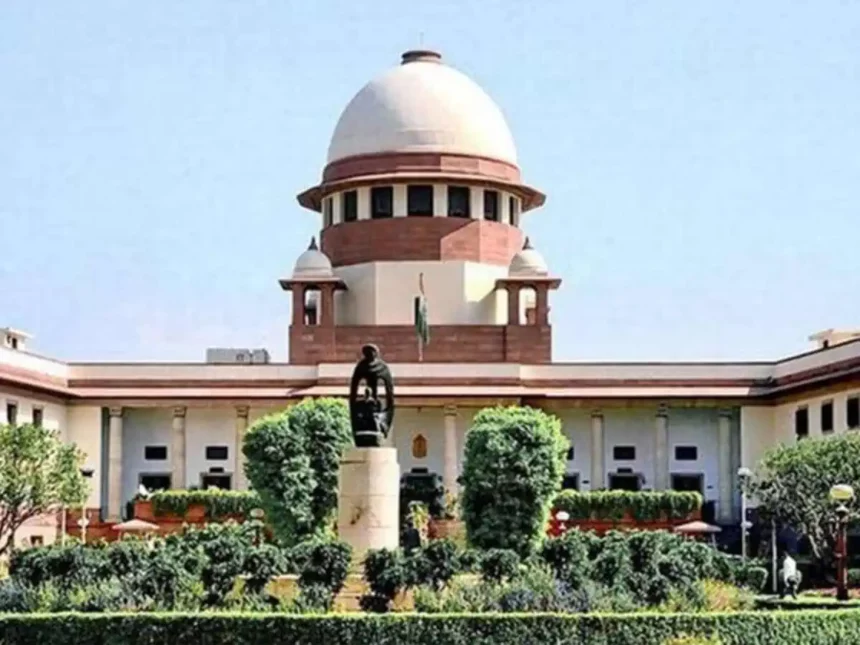
In a strong intervention, the Supreme Court has taken suo motu cognisance of a controversial chapter in an NCERT Class 8 Social Science textbook on judicial corruption, ordering a blanket ban on the chapter and halting the printing, sale, and circulation of the book while directing that accountability be fixed for those responsible.
Supreme Court orders immediate withdrawal and warns of strict action
The matter came before the Supreme Court of India after concerns were raised regarding a chapter in the NCERT Class 8 Social Science textbook titled *Exploring Society: India and Beyond*, which allegedly contained references to judicial corruption and pending cases in a manner the court found objectionable. Taking suo motu cognisance, the court directed an immediate and complete ban on the chapter and imposed a blanket prohibition on the printing, sale, and circulation of the textbook.
The bench further ordered the immediate removal of all print and digital copies of the book, signaling the seriousness with which it viewed the issue. The directive extends to halting dissemination across electronic and digital platforms, ensuring that the withdrawn content is not accessible through online channels.
According to reports, the National Council of Educational Research and Training has indicated that it will identify those responsible for drafting the controversial content. In parallel, the Ministry of Education has written to the Ministry of Information and Broadcasting and the Ministry of Electronics and Information Technology, requesting immediate steps to halt the digital circulation of the withdrawn material.
The three-judge bench hearing the matter comprises Chief Justice Surya Kant, Justice Joymalya Bagchi, and Justice Vipul M. Pancholi. During the proceedings, Chief Justice Surya Kant observed that the chapter appeared to be a deep and deliberate attempt to defame the judiciary. He cautioned that such actions could potentially amount to criminal contempt, reflecting the gravity of the court’s concerns.
Notices have been issued to the Secretary of the Ministry of Education and other officials. The court has sought detailed records of meetings related to syllabus design, as well as the names of individuals involved in authoring and approving the textbook content. The directive indicates that the court intends to scrutinize the decision-making process behind the inclusion of the disputed chapter.
The Chief Justice stated that strict action must be taken against those responsible and emphasized that the matter would be thoroughly investigated. The court’s remarks suggest that it is not satisfied with mere assurances and expects concrete steps toward fixing accountability.
During the hearing, the Ministry of Education tendered an unconditional apology. However, the court signaled that an apology alone would not suffice if systemic lapses or deliberate wrongdoing were established. The bench’s stance underscored the judiciary’s insistence on safeguarding its institutional integrity against what it perceives as defamatory or misleading representations in educational material.
Government response and wider implications for textbook oversight
In response to the controversy, Union Education Minister Dharmendra Pradhan expressed regret over the incident, stating that there was no intention to insult the judiciary. He assured that accountability would be fixed and that action would be taken against those involved in drafting the chapter on judicial corruption.
The minister’s statement sought to distance the government from any suggestion of deliberate disrespect toward the judiciary, while simultaneously acknowledging the seriousness of the issue. His assurance that action would follow indicates that internal reviews within NCERT and the education ministry are likely to examine how the content was conceptualized, reviewed, and cleared for publication.
The controversy has sparked a broader debate about textbook oversight, academic freedom, and institutional responsibility. Educational textbooks, particularly those prescribed for school students, undergo multiple layers of review to ensure factual accuracy, pedagogical clarity, and sensitivity to constitutional institutions. The Supreme Court’s intervention raises questions about whether established review mechanisms were adequately followed in this instance.
The court’s decision to halt not only the chapter but also the printing and circulation of the entire book reflects its view that the matter transcends isolated phrasing. By seeking records of syllabus design meetings and identifying authors and contributors, the bench appears focused on determining whether the inclusion of the disputed content was inadvertent, negligent, or intentional.
The warning that such actions could amount to criminal contempt adds a legal dimension to the issue. Contempt of court provisions are invoked when actions are perceived to undermine the authority or dignity of the judiciary. The court’s remarks signal that educational publications are not exempt from scrutiny if they are believed to cross legal boundaries.
The directive to coordinate with the ministries responsible for broadcasting and digital technology underscores the evolving nature of content dissemination. In an era where textbooks are accessible in electronic formats and shared widely across digital platforms, withdrawal orders must address both physical and online circulation to be effective.
The episode also places renewed focus on the role of NCERT as a central authority in school curriculum development. As the body responsible for designing and recommending textbooks for schools across the country, NCERT operates under a mandate to uphold academic standards and constitutional values. The court’s order suggests that any deviation from these expectations may invite judicial oversight.
The matter will likely continue to unfold as the Supreme Court examines the records and responses from the concerned authorities. The issuance of notices and the demand for detailed documentation indicate that the bench intends to pursue a comprehensive inquiry into the circumstances surrounding the publication of the chapter.
As the proceedings progress, the case may set precedents regarding the limits of commentary on constitutional institutions within school curricula and the accountability mechanisms applicable to educational authorities. The Supreme Court’s intervention has already sent a clear signal that the content of textbooks, particularly those addressing sensitive institutional themes, will be subject to rigorous scrutiny when challenged.
**Hashtags:**
#SupremeCourt
#NCERT
**Highlights:**
Supreme Court bans controversial NCERT textbook chapter
Accountability sought for alleged defamation of judiciary