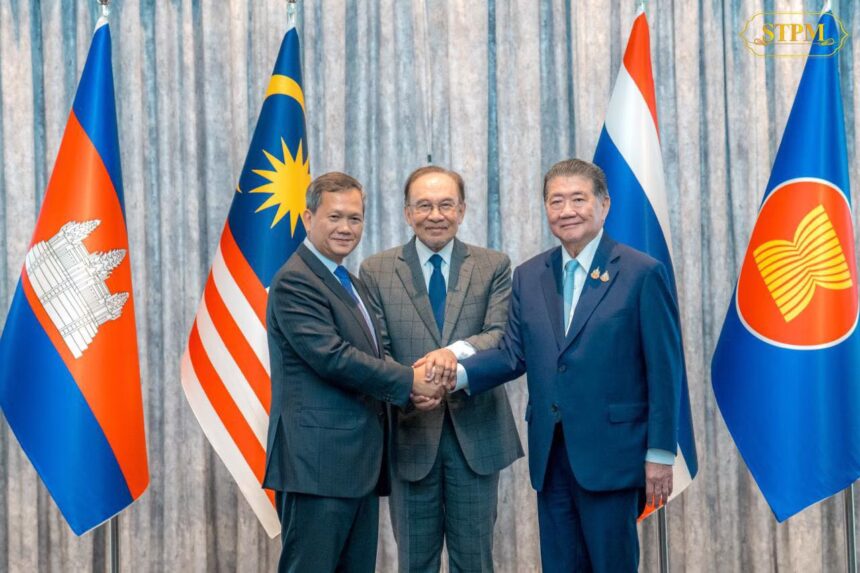
After more than two weeks of intense fighting and mounting humanitarian distress, Thailand and Cambodia have agreed to hold ceasefire talks on December 24, signalling a cautious diplomatic step toward calming one of Southeast Asia’s most serious recent border confrontations. The agreement follows an emergency meeting of ASEAN foreign ministers in Kuala Lumpur, where regional leaders expressed grave concern over the continued violence, civilian displacement, and the erosion of trust between the two neighbouring countries.
The talks, to be convened under an existing bilateral mechanism, come against a backdrop of deep bitterness, mutual accusations, and unresolved grievances that have accumulated since hostilities reignited earlier this month. While expectations of an immediate breakthrough remain limited, the decision to return to dialogue reflects growing regional pressure to prevent further escalation and to address the worsening humanitarian situation along the disputed border areas.
ASEAN steps in as Thailand and Cambodia agree to resume ceasefire dialogue
The agreement to hold ceasefire talks emerged from a Special ASEAN Foreign Ministers’ Meeting focused on the deteriorating situation between Thailand and Cambodia. The meeting was convened as fighting continued to claim lives and displace hundreds of thousands of civilians on both sides of the border. According to official figures, at least 22 people have been killed in Thailand and 19 in Cambodia since clashes resumed, with more than 750,000 residents forced to flee their homes amid shelling, airstrikes, and ground fighting.
In a chair’s statement released after the meeting, ASEAN foreign ministers said they welcomed discussions aimed at resuming a ceasefire and halting hostilities. While the meeting itself did not deliver an immediate ceasefire, it paved the way for renewed engagement through the General Border Committee, a long-standing bilateral forum between Thailand and Cambodia. The committee is scheduled to meet on December 24 to discuss the implementation and verification of a ceasefire, offering a structured platform for military and defence officials from both countries to engage directly.
ASEAN leaders urged both sides to exercise maximum restraint and to take immediate steps toward ending all forms of hostilities. They called on Bangkok and Phnom Penh to rebuild mutual trust and confidence and to return to sustained dialogue, emphasising the need to fully implement earlier agreements that were designed to stabilise the border. These include a ceasefire reached in late July that ended five days of fighting and a peace declaration signed in Malaysia in October, both of which have since unravelled amid renewed accusations and violence.
The foreign ministers expressed serious concern over the human cost of the conflict, pointing to significant casualties, damage to civilian infrastructure, and mass displacement. They stressed the importance of ensuring that civilians in affected border areas can return safely to their homes and resume normal livelihoods, underscoring the regional fear that prolonged instability could have lasting social and economic consequences.
Regional voices reinforced this message. Singapore’s foreign minister publicly appealed to both Thailand and Cambodia to de-escalate, resume talks, and resolve their dispute peacefully, stressing that ASEAN’s collective future depends on unity and cooperation. His remarks reflected a broader concern within the regional bloc that continued fighting could undermine ASEAN’s credibility as a forum for conflict resolution and regional stability.
Thai Foreign Minister Sihasak Phuangketkeow confirmed that the General Border Committee meeting would be held in Chanthaburi province, close to the Cambodian border. He said both sides were prepared to take as much time as necessary to negotiate a workable ceasefire arrangement, indicating a willingness to engage but also hinting at the complexity of the issues involved. The choice of a border location for the talks was seen as symbolically significant, placing discussions close to the communities most affected by the conflict.
Despite these diplomatic efforts, ASEAN officials privately acknowledged that the road ahead would be difficult. The conflict has reignited long-standing suspicions and grievances, making trust-building a slow and fragile process. The ceasefire talks are therefore widely viewed not as a solution in themselves, but as an initial step toward halting violence and creating space for more substantive negotiations.
Deep mistrust, landmine accusations and humanitarian fallout cloud peace efforts
While the agreement to hold talks marks a diplomatic opening, deep mistrust continues to cloud relations between Thailand and Cambodia. Of the two, Cambodia has appeared more willing to revert to earlier ceasefire arrangements and peace declarations, portraying itself as committed to dialogue and regional mediation. Thailand, however, has taken a more cautious and sceptical stance, accusing Cambodia of repeatedly violating previous agreements.
Central to Thailand’s concerns are allegations that Cambodian forces have planted new landmines along the border. Thai officials claim that since July, at least eight landmine explosions have killed Thai troops, with additional incidents injuring soldiers and threatening civilians. An explosion in early November reportedly prompted Thailand to suspend the implementation of the October peace declaration, pushing the two countries back toward open conflict. Thai authorities have also said that a recent blast cost a soldier his foot, reinforcing their argument that security guarantees must be credible and verifiable before any ceasefire can hold.
Cambodia has strongly denied planting new landmines, countering that the explosions are likely caused by unexploded ordnance left over from decades of civil war. Cambodian officials argue that they have no interest in reigniting conflict and that accusations of new mine-laying are being used to justify continued military action. This dispute over facts on the ground has become one of the biggest obstacles to rebuilding trust, as each side questions the other’s sincerity.
Reflecting this tension, the Thai Foreign Ministry issued a statement after the ASEAN meeting expressing support for dialogue but placing responsibility for progress squarely on Phnom Penh. The statement reaffirmed Thailand’s commitment to what it described as genuine and sustainable peace grounded in concrete actions, while warning that repeated breaches of past agreements, including landmine incidents, could not be ignored. Thai officials stressed that restraint has limits when soldiers and civilians continue to face lethal threats.
Cambodia, meanwhile, has focused attention on the humanitarian toll of the fighting. Its foreign ministry highlighted the displacement of nearly half a million Cambodians and raised concerns about access to shelter, food, and medical care. Cambodian officials have sought to frame their position in terms of regional responsibility and humanitarian urgency, emphasising their commitment to shared peace, security, and prosperity within Southeast Asia.
Adding to the volatility are continued reports of military activity even as diplomatic efforts proceed. Cambodian sources have accused Thailand of carrying out airstrikes, including the use of F-16 fighter jets against positions in Preah Vihear province. Pro-government Cambodian media outlets have expressed scepticism that ASEAN diplomacy can halt the fighting, pointing to ongoing bombardment as evidence that political appeals are being drowned out by military action. Thailand has not publicly detailed its operational decisions, but has insisted that any use of force is defensive and proportionate.
The humanitarian consequences of the conflict have become increasingly severe as the fighting drags on. Displaced families on both sides of the border are facing uncertain living conditions, with many forced into temporary shelters or host communities. Schools, clinics, and local infrastructure have been damaged, disrupting daily life and raising fears of long-term social impact if stability is not restored soon. Aid groups and local authorities are struggling to respond to the scale of displacement, particularly in remote border regions.
Analysts note that even if the General Border Committee succeeds in brokering a ceasefire, sustaining it will require robust monitoring mechanisms and sustained political will. The bitterness that has built up over fifteen days of heavy fighting, combined with unresolved disputes over territory and security, means that confidence-building measures will be essential. Without them, any agreement risks collapsing under the weight of mutual suspicion.
The planned talks on December 24 are therefore widely seen as the beginning of a long and uncertain process rather than a decisive turning point. They offer a chance to halt immediate violence and to test whether both governments are prepared to move beyond rhetoric toward verifiable steps that reduce the risk of renewed clashes. In a region that prides itself on dialogue and consensus, the outcome of these talks will carry implications not only for Thailand and Cambodia, but also for ASEAN’s role as a mediator in times of crisis.