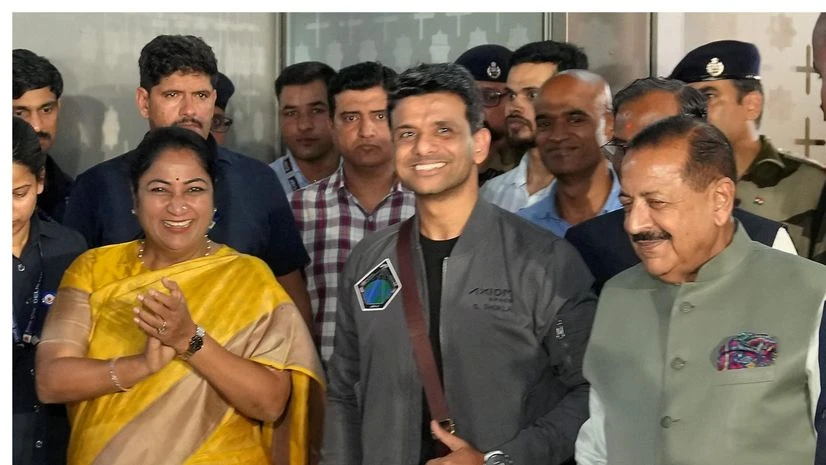
The triumphant homecoming of Group Captain Shubhanshu Shukla, India’s first astronaut to visit the International Space Station (ISS), has ignited national pride and global recognition for the country’s growing space aspirations. Set to meet Prime Minister Narendra Modi today at his official residence in New Delhi, Shubhanshu Shukla’s return is being celebrated as a landmark moment in India’s journey towards becoming a spacefaring nation with ambitions that extend beyond Earth’s orbit. His story, marked by rigorous training, extraordinary resilience, and a year-long mission abroad, is not just about personal achievement but also about the dawn of a new era in Indian space exploration.
Shubhanshu Shukla’s Journey to the Stars and Back
Group Captain Shubhanshu Shukla’s ascent to becoming the first Indian astronaut to board the International Space Station is a tale of perseverance, discipline, and national service. Born in a modest family with deep-rooted values of hard work, Shubhanshu Shukla joined the Indian Air Force as a young cadet and steadily rose through the ranks with his exceptional skills as a pilot. Known for his calm under pressure and sharp decision-making abilities, his career within the Air Force laid the foundation for what would later become his most significant mission—representing India in space.
In June 2024, Shubhanshu Shukla served as the pilot for the Axiom-4 mission, a privately organized but internationally recognized spaceflight launched from NASA’s Kennedy Space Center in Florida. This mission marked India’s official participation in commercial and collaborative human spaceflight ventures. Unlike India’s earlier astronaut, Rakesh Sharma, who flew aboard the Soviet Soyuz mission in 1984, Shubhanshu Shukla’s journey represented a new model of global cooperation where private aerospace companies like Axiom Space work in tandem with national space agencies.
On June 25, the Axiom-4 mission took off from Florida, and within 24 hours, the spacecraft docked with the International Space Station. For Shubhanshu Shukla, stepping into the ISS was not only a personal milestone but also a historic one for India. He became the first Indian ever to live and work aboard the orbiting laboratory, carrying the aspirations of over a billion citizens and marking India’s entry into an elite club of nations with astronauts onboard the ISS.
During his mission, Shubhanshu Shukla played a critical role in piloting the spacecraft, conducting research experiments, and engaging in international collaborations with astronauts from the United States, Europe, and Japan. His work aboard the ISS ranged from life sciences and microgravity experiments to testing technologies that may one day be used on longer missions to the Moon and Mars. His experiences have been documented as part of a knowledge-sharing initiative with ISRO (Indian Space Research Organisation) and other Indian scientific bodies to help India prepare for its indigenous human spaceflight program, Gaganyaan.
While in orbit, Shubhanshu Shukla had multiple interactions with Prime Minister Narendra Modi, who encouraged him to record his experiences meticulously. The Prime Minister emphasized that Shubhanshu Shukla’s first-hand knowledge—ranging from pre-launch training and adaptation to microgravity, to handling research and psychological endurance—would be invaluable in shaping India’s long-term space strategy. These conversations not only reflected the personal rapport between Shubhanshu Shukla and the Prime Minister but also highlighted the seriousness with which India is now approaching its role as a rising space power.
His stay aboard the ISS was followed closely by millions of Indians who watched live sessions, interviews, and even social media updates. Schools and universities across India organized events where students could watch his interactions, igniting curiosity and inspiring the next generation of scientists, engineers, and explorers. For young Indians, Shubhanshu Shukla quickly became a symbol of possibility—a living example that India’s dream of space exploration is no longer confined to science fiction but is unfolding in real time.
After completing his mission duties, Shubhanshu Shukla spent several months in the United States undergoing post-flight medical examinations, debriefings, and rehabilitation. Long-duration space travel takes a toll on the human body, and the rehabilitation process is crucial for astronauts to regain physical strength and adapt back to Earth’s gravity. His resilience during this phase further demonstrated the physical and mental endurance required for such groundbreaking missions.
On Sunday, he finally returned home to India. At the airport, the atmosphere was electric. His family, Union Minister Jitendra Singh, and Delhi Chief Minister Rekha Gupta were present to receive him, along with hundreds of enthusiastic supporters waving the Indian tricolor. The moment symbolized not only the return of an astronaut but also the homecoming of a national hero who had taken India’s flag into space and brought it back with dignity.
India’s Vision for Space and Shubhanshu Shukla’s Role in Shaping Viksit Bharat 2047
Shubhanshu Shukla’s return has not just been a personal milestone—it is an inflection point for India’s larger space ambitions. In the coming days, he is set to join the National Space Day celebrations on August 23, where his experiences will form the centerpiece of discussions on India’s roadmap for the future.
National Space Day was established to honor India’s advancements in space research, and this year, Shubhanshu Shukla’s presence is expected to energize the nation’s dialogue on how to scale greater heights. His contributions will directly influence ISRO’s plans for the Gaganyaan mission, which aims to send Indian astronauts into low-Earth orbit aboard an indigenous spacecraft. Unlike his Axiom-4 mission, which was collaborative, Gaganyaan will be India’s wholly indigenous effort, and Shubhanshu Shukla’s insights on astronaut training, operational challenges, and psychological preparedness will be of immense value.
Prime Minister Modi, during his Independence Day address at the Red Fort, already highlighted Shubhanshu Shukla’s achievements, underscoring the symbolic importance of his mission. Referring to him as “our Group Captain Shubhanshu Shukla,” the Prime Minister lauded his safe return and positioned him as a role model for young Indians. By weaving Shubhanshu Shukla’s story into his national address, Modi linked India’s space achievements with the broader vision of Viksit Bharat 2047—a fully developed India by the centenary of independence.
The government sees space exploration not merely as a scientific pursuit but also as a strategic and economic imperative. India’s participation in space missions opens new avenues in international cooperation, space commerce, and defense capabilities. With increasing competition in space between countries like the United States, China, and Russia, India’s assertive entry into the human spaceflight domain signals its determination to play a leading role in the new global order.
Shubhanshu Shukla’s mission also has significant socio-cultural impact. His interactions with students, his emotional posts on social media, and his humility in acknowledging his crewmates and mentors reflect the kind of inspiration India needs for its youth. His Instagram post during his return journey, where he shared a smiling photo from his flight and spoke about the bittersweet emotions of leaving his fellow astronauts while reuniting with his family, resonated deeply with millions of Indians. It humanized the otherwise technical and scientific aspects of space travel, making the story relatable to the common citizen.
Moreover, Shubhanshu Shukla’s presence at National Space Day is expected to spark discussions on how India can leverage its space achievements for societal benefits. From satellite technology improving agriculture and disaster management to advanced research contributing to healthcare and communication, India’s space program has always had a strong developmental focus. Shubhanshu Shukla’s experience will further broaden the narrative to include human spaceflight as part of this continuum of national progress.
The Air Force officer turned astronaut has also become a bridge between defense and civilian science. His background in aviation and military discipline brings a unique perspective to the space program, where precision, resilience, and tactical thinking are indispensable. In many ways, his journey represents the integration of India’s defense forces into the nation’s broader technological and scientific future.
As India prepares for more ambitious missions—to the Moon, Mars, and beyond—Shubhanshu Shukla’s pioneering role ensures that the country will not be starting from scratch. His detailed documentation of training protocols, psychological adjustments, and operational routines aboard the ISS will form the backbone of India’s astronaut training modules for decades to come. He stands today as both a participant and a teacher in India’s unfolding space odyssey.
The anticipation around his meeting with Prime Minister Modi today is high. Scheduled for 5 pm at the Prime Minister’s official residence, 7 Lok Kalyan Marg, the interaction is expected to go beyond symbolic gestures. Officials suggest that discussions will cover Shubhanshu Shukla’s learnings from the mission, potential applications for India’s space programs, and his role as a mentor for upcoming astronaut candidates. For a country at the cusp of a transformative era in space exploration, this meeting could well be a defining moment, aligning political vision with scientific achievement.