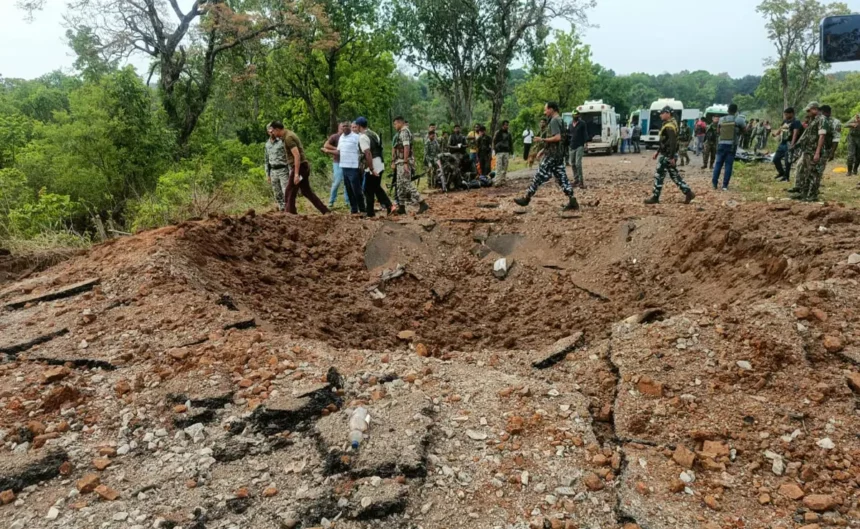
The rising frequency of Maoist attacks in Chhattisgarh has once again underlined the persistent challenge faced by security forces in the insurgency-hit Bastar region. On Monday, tragedy struck in Bijapur district when an improvised explosive device (IED) planted by Maoists exploded during an anti-Naxal operation, killing a jawan of the District Reserve Guard (DRG) and injuring three others. The attack occurred in the dense and hostile terrain of Indravati National Park, a zone notorious for Maoist ambushes, highlighting the continued vulnerability of security forces despite intensified counter-insurgency strategies in the state.
The blast not only claimed the life of a brave policeman but also brought into focus the escalating use of sophisticated IEDs by Maoist groups in their bid to stall security operations. While security personnel continue to push deep into Maoist-dominated areas to neutralize threats, the insurgents’ tactics have turned increasingly lethal, posing grave risks to lives and testing the endurance of both state machinery and law enforcement agencies.
IED Explosion Claims Life in Indravati National Park
According to officials, the explosion took place on Monday morning when a DRG team was conducting an anti-Naxal patrol in the thick forests of Bijapur’s Indravati National Park. The DRG, a specialized unit of Chhattisgarh Police comprising mostly local recruits, is often at the forefront of operations against Maoists due to its familiarity with the terrain and ability to carry out swift, guerrilla-style engagements.
During the patrol, Maoists triggered an IED that had been strategically planted along the route frequently used by security forces. The blast killed DRG jawan Dinesh Nag, whose sacrifice has now become symbolic of the relentless struggle in the region. Three other personnel accompanying him sustained serious injuries in the incident. Senior police officials confirmed that the injured men received preliminary medical attention before being evacuated from the forest for further treatment.
This is not the first such incident in the area. Just last week, another DRG official was seriously injured when a pressure IED exploded in the same district. On that occasion, the blast occurred under Bhairamgarh police station limits when a joint team of the DRG and Special Task Force (STF) was conducting an anti-Maoist sweep in the forested Indravati area. Sub-Inspector Prakash Chatti, part of the patrol unit, accidentally stepped on a pressure-triggered IED, resulting in a devastating explosion that severely injured his ankle. While Chatti survived after emergency treatment and referral to a higher medical facility, the incident underscored the lurking danger security teams face daily.
Police officials emphasized that the Maoists’ reliance on IEDs is a deliberate tactic designed to exploit the challenging geography and maximize damage with minimum direct confrontation. These devices, often hidden underground and triggered by pressure, wires, or remote controls, are notoriously difficult to detect in forested terrain. For security forces, even with advanced equipment, identifying and neutralizing such threats remains a daunting task.
Escalating Maoist Threats and Security Force Countermeasures in Chhattisgarh
The Bijapur incident is part of a worrying trend of Maoist attacks that continue to disrupt peace and stability in Chhattisgarh’s Bastar region. In a separate operation last week, security forces discovered a 10 kg IED planted by Maoists in Tarrem police station area, neutralizing yet another attempt to target patrolling units. Such recoveries are frequent but often pale in comparison to the losses incurred when devices successfully detonate, taking lives and leaving families shattered.
The challenges were further highlighted during a recent gunfight in Gariaband district, where security forces engaged Maoists in a fierce encounter. Following the clash, four Maoists carrying a combined bounty of ₹19 lakh surrendered to the police. Their surrender led to the discovery of a Maoist arms dump in a forested hill along Gobra road. The recovery was significant, including four BGL rounds, a hand grenade, 15 INSAS rounds and a magazine, 15 gelatin rods, 50 detonators, an SLR rifle magazine, and ₹16.50 lakh in cash. This cache exposed the level of preparation and stockpiling undertaken by insurgent groups to sustain their violent campaign.
Despite such setbacks, Maoists continue to regroup and adapt their methods. Their primary reliance on IEDs reflects both their resourcefulness and intent to wage asymmetric warfare against security forces. Unlike direct encounters, where Maoists often face heavy casualties due to superior firepower and coordination by police and paramilitary units, IED attacks allow them to inflict damage from a distance and retreat undetected.
Chhattisgarh Police, along with central forces like the Central Reserve Police Force (CRPF), have intensified anti-Naxal operations across Bijapur, Sukma, Dantewada, and other hotbed districts. Yet, officials acknowledge that eliminating the Maoist network remains an uphill battle, particularly in areas where dense forests provide natural cover and sympathetic local networks facilitate insurgent movement.
The recurring casualties also raise questions about the psychological and operational toll on jawans deployed in the conflict zone. Constant exposure to danger, harsh terrain, and the unpredictability of Maoist ambushes have added layers of complexity to counter-insurgency missions. Families of slain personnel, like that of DRG jawan Dinesh Nag, are left grieving and yet remain symbols of resilience in the state’s fight against the decades-old insurgency.
As the latest Bijapur blast reverberates across Chhattisgarh, it has renewed calls for stronger detection technologies, better protective gear, and more comprehensive rehabilitation programs for surrendered Maoists. Officials insist that while armed operations are essential, tackling the Maoist problem also requires socio-economic interventions—development in tribal regions, improved governance, and cutting off the Maoists’ recruitment base. However, until such long-term strategies bear fruit, security personnel continue to be on the frontlines, risking their lives in one of India’s most enduring internal security challenges.