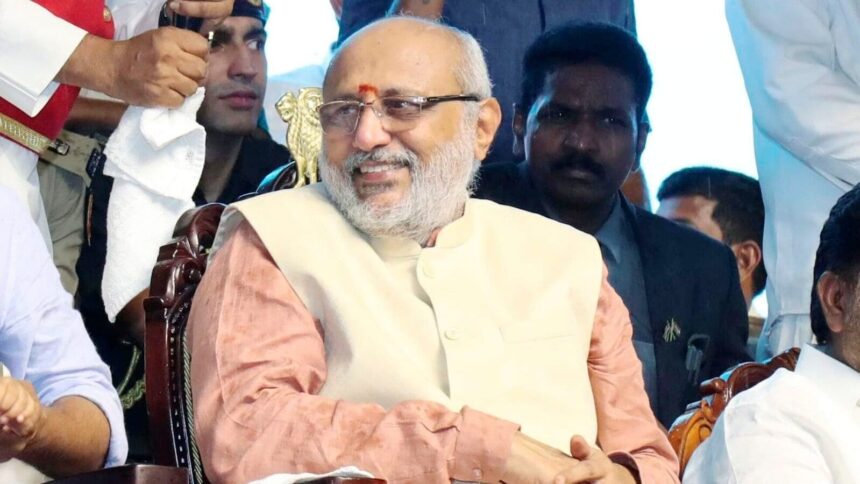
Maharashtra has once again entered the national spotlight as the state’s sitting Governor, CP Radhakrishnan, emerges as the Bharatiya Janata Party’s (BJP) candidate for the Vice-President of India. His candidature signals not only a continuation of his long political journey from Tamil Nadu to New Delhi but also a strategic move by the ruling party to balance stability, representation, and regional aspirations. The announcement has evoked comparisons with the late Shankar Dayal Sharma, the last Maharashtra Governor to rise to the country’s second-highest constitutional office before later assuming the presidency. For CP Radhakrishnan, who has spent over a year as Maharashtra’s Governor with an image of calmness and neutrality, the nomination is both a personal milestone and a political endorsement.
CP Radhakrishnan’s Rise from Tamil Nadu Politics to National Prominence
CP Radhakrishnan’s political journey has spanned decades, rooted in Tamil Nadu’s complex political landscape. Born and raised in Coimbatore, he became one of the few BJP leaders from the state who managed to carve out a distinctive identity in a region traditionally dominated by Dravidian parties. His election to the Lok Sabha twice from Coimbatore was a rare feat at a time when the BJP’s presence in Tamil Nadu remained marginal. As a parliamentarian, he established himself as a strong voice for southern India, combining his organizational skills with an ability to navigate ideological divides. His articulation of issues, particularly those concerning industry and commerce in Coimbatore, earned him respect beyond partisan circles.
Even before his gubernatorial assignments, CP Radhakrishnan had developed a reputation for being non-confrontational, a quality that would later define his tenure as Governor. In a political climate where Governors often find themselves at odds with elected chief ministers, he maintained a reputation for restraint and constitutional propriety. His leadership style was quiet yet firm, with an emphasis on consensus rather than confrontation.
When he was appointed Governor of Jharkhand, a politically sensitive state, many expected friction between Raj Bhavan and the Hemant Soren-led government. Instead, CP Radhakrishnan chose the path of neutrality, maintaining cordial ties with the government while ensuring that constitutional protocols were never compromised. This ability to maintain balance in politically charged environments marked him out as a dependable administrator.
It was this reputation that followed him when he assumed charge as Maharashtra’s Governor on June 29, 2023. Maharashtra’s politics has often been turbulent, with shifting alliances, bitter rivalries, and frequent challenges to political stability. Yet, in his brief tenure of a little over a year, CP Radhakrishnan avoided controversies and projected an image of stability, focusing on the ceremonial and constitutional role of his office rather than political maneuvering. This in itself was notable in a state where Governors have often been drawn into political disputes.
His nomination to the Vice-Presidential post reflects the BJP’s appreciation of his qualities—loyalty, administrative steadiness, and the ability to stay above partisan confrontations. At a time when parliamentary politics requires a steady hand in the Rajya Sabha, the BJP seems to have chosen a candidate who can combine constitutional responsibility with quiet political acumen.
Political Significance of BJP’s Choice: Balancing Stability and Regional Representation
The decision to nominate CP Radhakrishnan also carries political weight beyond his personal journey. The Vice-President of India holds a critical role as the Chairperson of the Rajya Sabha, where legislative debates, government bills, and opposition challenges are constantly in play. Having someone with a calm, impartial, and non-combative style is seen as a pragmatic move, particularly when the opposition is keen on testing the ruling alliance’s strength in the Upper House.
The BJP’s choice also underscores the party’s strategy of expanding its presence and symbolism in southern India. While the party has consolidated power in the Hindi heartland and made deep inroads into the Northeast, its presence in the South remains uneven, with significant gaps in Tamil Nadu, Kerala, and parts of Telangana. By elevating a senior Tamil Nadu leader to such a high constitutional office, the BJP sends a message of inclusion and representation to the southern states.
Political observers see the move as both recognition of CP Radhakrishnan’s loyalty and as a symbolic gesture aimed at addressing the BJP’s limited electoral success in Tamil Nadu. While the Vice-President’s role is constitutionally detached from electoral politics, the optics of having a southern face in such a position cannot be ignored. It reflects the BJP’s desire to project itself as a pan-Indian party that goes beyond its traditional bases of support.
The comparison with Shankar Dayal Sharma adds another layer of historical resonance. Sharma, who served as the Governor of Maharashtra before being elected Vice-President in 1987, went on to become President of India in 1992. For Maharashtra, this marks the second time in history that a sitting Governor is on the path to such high constitutional office. The symbolism is not lost on political analysts, who see in it a cycle of continuity and institutional recognition.
Within Maharashtra itself, CP Radhakrishnan’s nomination has generated considerable interest. Chief Minister Devendra Fadnavis was among the first to extend his wishes to the Governor, highlighting both personal regard and political camaraderie. The BJP’s central leadership, in turn, is keen to project the nomination as a recognition of the state’s contribution to national politics, even though CP Radhakrishnan’s political roots lie in Tamil Nadu.
At the national level, the Vice-Presidential election is expected to be a straightforward process. The Vice-President is elected by members of both Houses of Parliament through a secret ballot, but given the BJP’s majority and the support of its allies, CP Radhakrishnan’s victory is seen as a foregone conclusion. Unlike presidential elections, where the balance of votes across states can sometimes make contests interesting, the Vice-Presidential election is largely a parliamentary affair, and the ruling alliance’s strength makes the outcome predictable.
The current election comes in the wake of the resignation of former Vice-President Jagdeep Dhankhar, leaving the office vacant. The role of the Vice-President as Rajya Sabha Chairperson is particularly significant, given the need for impartial and firm handling of debates, disruptions, and the legislative agenda. With Parliament expected to take up several contentious issues in the coming years, the Chairperson’s role will require both composure and constitutional adherence—qualities that CP Radhakrishnan has already demonstrated in his gubernatorial roles.
For CP Radhakrishnan personally, the elevation represents both a culmination of his political journey and a new chapter in national service. From being one of the BJP’s few prominent faces in Tamil Nadu to representing Coimbatore in Parliament, and from balancing state politics in Jharkhand to stabilizing Raj Bhavan in Maharashtra, his career has traversed multiple geographies and responsibilities. Now, as he prepares to assume the role of Vice-President, he carries with him both the expectations of constitutional duty and the symbolism of regional representation.