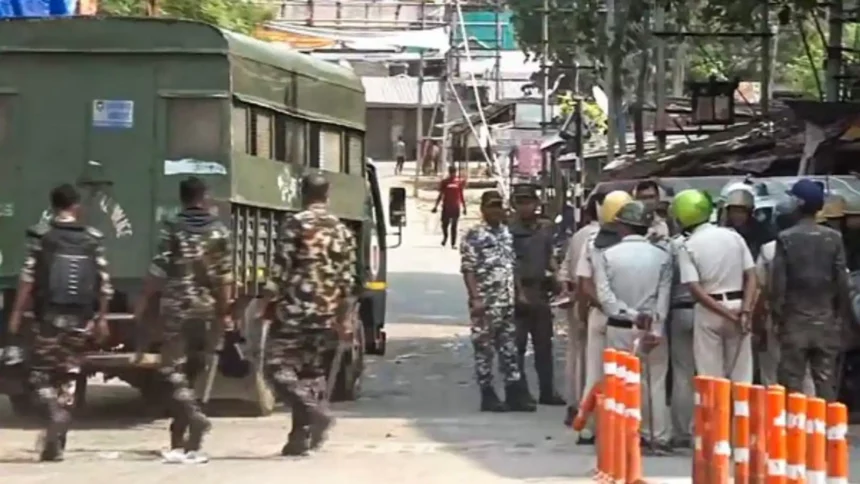
What started as whispers of religious fear among young migrant workers in Murshidabad exploded into a violent, organized assault across multiple towns. Misled by rumours about the Waqf (Amendment) Act, and believing that their homes, mosques, and burial grounds would be seized by the government, hundreds of teenagers and young men took to the streets in a frenzy. The chaos on April 11 was not a spontaneous outburst—it was a planned wave of unrest that overwhelmed authorities, left public property torched, and resulted in tragic loss of lives.
Fuelled by Fear, Triggered by Misinformation
Many of the agitators, aged just 14 to 19, had returned home to Murshidabad from other states for the festive season. On April 11, after Friday prayers, a coordinated attack unfolded in Jangipur, Dhuliyan, and Samserganj. Roads were blocked, government offices set ablaze, trains torched, and ambulances and police vehicles were attacked. In some areas, Hindu homes were targeted and a father-son duo was brutally killed. According to officials, the attacks were alarmingly organized and executed with precision.
Despite senior police officers, including those of ADG and IG rank, stationed in the region since April 9, the violence escalated rapidly. Meetings with local imams and clerics had initially assured peace, but by Friday morning, those efforts had unraveled. The police, overwhelmed and receiving misleading distress calls, were forced to open fire late at night as a last resort. During the chaos, certain groups entered Hindu localities, destroyed homes and temples, igniting fresh communal clashes.
Suspected Organised Involvement and Political Links
Investigators now believe this was not an isolated or spontaneous event. With over 150 people arrested, evidence is emerging that suggests possible involvement of the banned Popular Front of India (PFI), which once had a strong presence in Murshidabad. The Indian Secular Front (ISF) is also under scrutiny. Most of those arrested were young migrant workers, some joined by individuals from Jharkhand, raising concerns of wider coordination.
As tension continues, around 40 Hindu families have taken shelter across the river, waiting for the situation to normalize. Authorities are maintaining peace talks with community leaders and vow strict action against those responsible. While damages are still being tallied, the deeper concern lies in how fear and rumours manipulated vulnerable youth and turned them into instruments of chaos.